News · Traceability & Technology
Can Science Verify a Gemstone's Mine of Origin?
New research presented at the 1st International Sustainable Gem Research Symposium explores whether highly sensitive X-ray fluorescence imaging can tell gemstones from different mines apart.
By Gem Trail Lab · · 5 min read
Every gemstone has a geological history. But can science reveal where it was mined?
Determining the origin of coloured gemstones remains one of the most complex challenges in the gemstone industry. While laboratory techniques can provide valuable information about a gemstone's geological characteristics and likely geographic origin, identifying the exact mine from which a stone was extracted is considerably more difficult.
Emerging research at the University of Hamburg is exploring whether advanced X-ray fluorescence imaging could help address this challenge.
The Challenge of Gemstone Provenance
Unlike diamonds, which have benefited from substantial investment in traceability systems, coloured gemstones frequently pass through complex networks of miners, traders, cutters and exporters.
During this journey, stones from different mining locations may be combined, separated or transferred without consistent documentation.
Traditional origin determination relies on gemological observations and analytical techniques that examine characteristics such as inclusions, chemical composition and spectroscopy. These methods can provide important evidence about a gemstone's geological formation and, in some cases, its likely country or region of origin.
However, gemstones from different deposits can share similar characteristics, making precise origin determination challenging.
This raises an important research question: could highly sensitive analytical techniques distinguish gemstones from individual mines, even when those mines are located within the same geological region?
Exploring X-ray Fluorescence Imaging
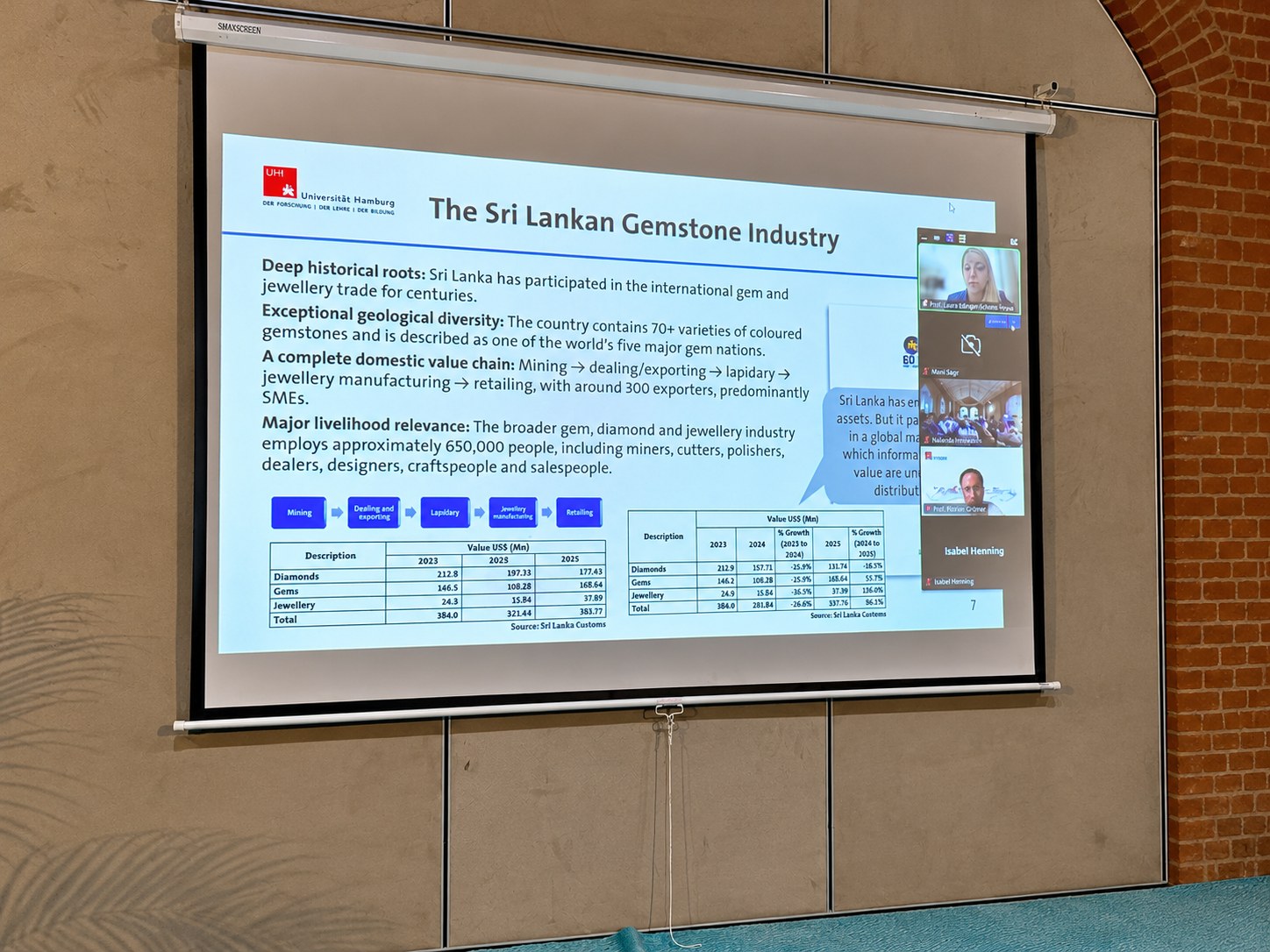
At the 1st International Sustainable Gem Research Symposium in Colombo, Prof. Florian Grüner of the University of Hamburg introduced research exploring the potential of advanced X-ray fluorescence imaging (XFI) for gemstone traceability.
XFI is based on the same underlying physical principles as X-ray fluorescence analysis (XRF). When X-rays interact with a material, certain elements emit characteristic fluorescence signals that can be measured to identify their presence.
The challenge is sensitivity.
Some trace elements occur in extremely small concentrations, and their signals can be difficult to distinguish from background radiation.
Prof. Grüner's research builds on highly sensitive imaging technologies originally developed for life-science applications, including the detection and tracking of very small quantities of labelled substances.
The University of Hamburg's laboratory system, known as SCOTTI — Super Compact Optics-based Tunable Testbed for Imaging — uses specialised X-ray optics to enable highly sensitive measurements outside large synchrotron research facilities.
An Encouraging First Proof of Concept
The initial results presented at the symposium offer an interesting starting point.
Researchers measured two rough gemstones originating from two different mines within the same region of Sri Lanka.
Despite their geographical proximity, the gemstones produced clearly distinguishable X-ray fluorescence spectra.
This suggests that highly sensitive measurements may reveal differences in trace-element composition that could potentially support more precise gemstone provenance research.
Importantly, these findings represent an early proof of concept rather than a validated method for determining the mine of origin.
Further measurements involving larger sample collections, different deposits and controlled reference data will be necessary to assess the method's reliability and practical limitations.
Combining Scientific Evidence with Digital Traceability
Scientific origin verification and digital traceability address different but complementary questions.
Scientific analysis examines the physical and chemical characteristics of a gemstone to assess whether they are consistent with a claimed origin.
Digital traceability, by contrast, records information about the gemstone's journey through the supply chain, including extraction, ownership transfers, processing and certification.
Combining these approaches could strengthen the credibility of gemstone provenance information.
For example, a Digital Product Passport could preserve records collected at the mine while linking them to laboratory findings and other supporting evidence.
Scientific measurements would not replace supply-chain documentation, but they could provide an additional layer of verification.
Towards More Reliable Gemstone Provenance
The potential implications extend beyond laboratory research.
More reliable provenance verification could support responsible sourcing, strengthen confidence in origin claims and improve recognition of mining communities that invest in transparent and responsible practices.
However, the practical application of such technologies will depend on several factors, including analytical reliability, measurement costs, access to equipment and the availability of representative reference samples.
The research presented by Prof. Grüner illustrates how scientific innovation could contribute to one of the gemstone industry's most persistent challenges.
The question is no longer simply whether a gemstone's journey can be documented, but whether scientific evidence can help verify the story that accompanies it.
Further research will determine how far this promising approach can go.
Research spotlight: Based on the presentation “Advanced X-ray Fluorescence Imaging (XFI): A Possible New Approach for Gemstone Traceability” by Prof. Florian Grüner, University of Hamburg, at the 1st International Sustainable Gem Research Symposium, Colombo, September 2026.