Insight · Traceability & Responsible Sourcing
From Mine to Market: Why Gemstone Traceability Matters
Every gemstone has a story. Yet by the time a stone reaches a jewellery showroom, much of the information about its origin, journey and the people involved in its production may have been lost. Improving traceability could help change that.
By Gem Trail Lab · · 5 min read

Every gemstone has a story. Yet by the time a stone reaches a jewellery showroom, much of the information about its origin, journey and the people involved in its production may have been lost. Improving traceability could help change that.
The Journey Behind a Gemstone
Coloured gemstones travel through complex international supply chains.
A sapphire extracted from a small mine in Sri Lanka may pass through local traders, gemstone cutters, exporters, wholesalers and jewellery manufacturers before reaching its final customer.
Each stage contributes to the gemstone's journey and economic value.
However, information about the original mining location, working conditions and subsequent transactions is not always systematically recorded or transferred between participants.
As a result, a gemstone may arrive at its destination with detailed information about its physical characteristics but limited documentation about where it was mined and how it reached the market.
This information gap creates challenges for businesses seeking to demonstrate responsible sourcing and for consumers interested in understanding the origins of their jewellery.
Why Is Traceability So Difficult?
Unlike highly centralised industrial supply chains, coloured gemstone production often involves numerous independent participants.
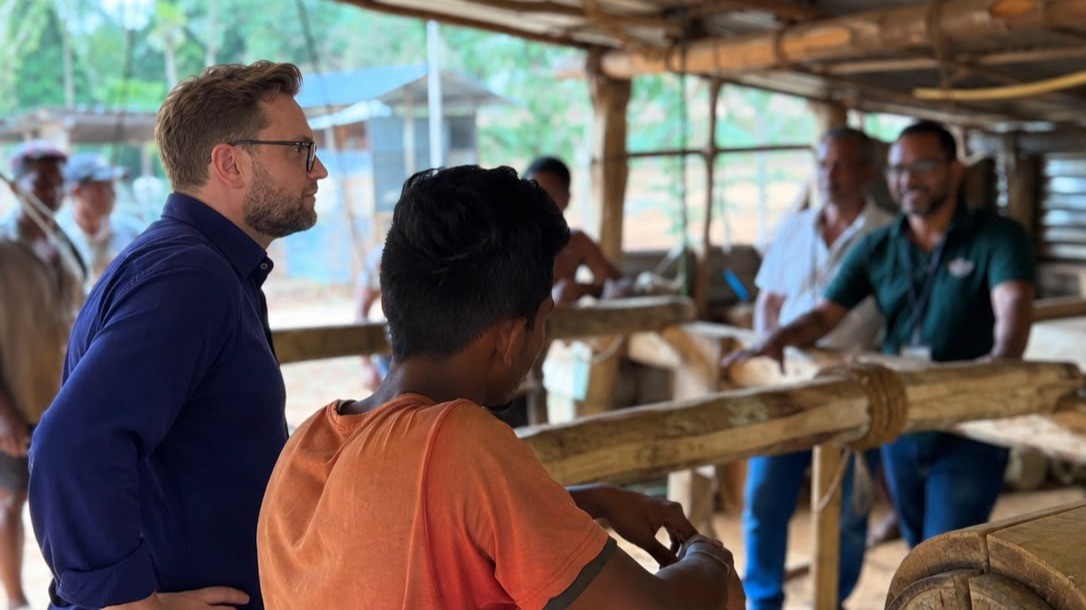
Artisanal and small-scale miners play an important role in gemstone-producing countries, including Sri Lanka.
Many operate with limited financial resources, informal business relationships and relatively simple documentation systems.
Gemstones may also change hands multiple times, be combined into parcels or undergo cutting and treatment before entering international markets.
Each transfer creates an opportunity for provenance information to become incomplete, inconsistent or disconnected from the physical stone.
Establishing reliable traceability therefore requires more than recording the name of a country or mining region.
It requires systems that can connect information across multiple stages of the supply chain while remaining practical and affordable for smaller participants.
Traceability Is Not the Same as Origin Verification
Two concepts are particularly important.
Traceability refers to the ability to follow a gemstone through documented stages of its journey, from extraction through processing, trading and distribution.
Origin verification refers to the process of evaluating evidence supporting a gemstone's claimed geographic or geological origin.
These approaches are related but not identical.
A digital record can document that a gemstone was reported to originate from a particular mine. However, the existence of that record does not automatically prove the claim.
Similarly, scientific analysis may support an assessment of geographic origin without revealing every transaction or working condition associated with the gemstone.
Stronger provenance systems can combine documented supply-chain information with appropriate verification procedures and, where feasible, scientific evidence.
The Potential of Digital Product Passports
Digital technologies offer opportunities to improve how gemstone information is collected, organised and shared.
A Digital Product Passport (DPP) can provide a structured digital record linked to an individual gemstone through a unique identifier, such as a QR code or serial number.
Depending on the system, this record may include the reported mining location, relevant dates, photographs, transaction history, gemological certificates and information about environmental or social practices.
Digital records can help make provenance information more accessible to traders, jewellery businesses and customers.
They may also reduce the need to repeatedly collect the same information at different stages of the supply chain.
However, technology alone cannot guarantee transparency.
The reliability of a Digital Product Passport depends on the quality of the underlying information, the credibility of verification procedures and the willingness of supply-chain participants to maintain accurate records.
A QR code is therefore a way to access information—not, by itself, proof that the information is correct.
Making Traceability Accessible to Artisanal Miners
For traceability systems to succeed, they must work for the people at the beginning of the supply chain.
Complex documentation requirements, expensive technologies and additional administrative work can create barriers for artisanal and small-scale miners.
Effective solutions should therefore prioritise simplicity, affordability and practical value.
Gem Trail Lab is exploring how digital documentation and gemstone-specific product passports can support greater transparency in Sri Lankan gemstone supply chains.
Its approach focuses on connecting information about gemstone origins and mining practices with digital records that can accompany stones as they move through the market.
An important consideration is ensuring that miners and local communities are not merely sources of information, but also participants who can benefit from improved recognition and market visibility.
From Transparency to Responsibility
Traceability is an important foundation for responsible sourcing, but it is not the final objective.
Knowing where a gemstone originated does not automatically mean that it was mined responsibly.
Environmental impacts, occupational safety, labour conditions and community livelihoods must be assessed separately using appropriate evidence.
Nevertheless, better provenance documentation can create opportunities to identify risks, support improvement and recognise responsible practices.
For businesses, it can provide a clearer basis for sourcing decisions and communication with customers.
For miners, it may create opportunities to demonstrate the value of their work and participate more visibly in international supply chains.
For researchers and policymakers, improved data can contribute to a better understanding of the gemstone sector.
Building Trust Through Better Information
The future of gemstone traceability will depend on cooperation between miners, traders, researchers, technology providers and jewellery businesses.
Digital tools can make information easier to collect and share, but trust ultimately depends on reliable evidence, transparent procedures and accountability.
A gemstone's journey should not become invisible once it leaves the mine. By preserving and verifying information along the supply chain, the industry can take meaningful steps towards greater transparency and more responsible sourcing.
This article draws on the practical challenges of coloured gemstone supply chains and Gem Trail Lab's ongoing work on digital gemstone documentation and traceability in Sri Lanka.