Research Report · Symposium · Published
1st International Sustainable Gem Research Symposium Sri Lanka 2026 — Symposium Publication
Gem Trail Lab
Abstract
From extraction to the final market, each stone passes through a complex journey involving people, communities, environments and often fragmented supply chains. Understanding this journey is essential to building a more transparent, responsible and sustainable gemstone sector. Unlike diamonds or commodities such as coffee and tea, where traceability and certification frameworks have developed over decades, the coloured gemstone industry remains highly fragmented. Diverse mining practices, informal trading networks and international supply chains make verifying provenance particularly challenging. Addressing these challenges requires bringing together perspectives from science, nature, livelihoods, technology and trade. Against this backdrop, Gem Trail Lab convened the 1st International Sustainable Gem Research Symposium on 22 September 2026 at TRACE Expert City in Colombo. Bringing together researchers, industry professionals and technology practitioners, the symposium explored how science and innovation can contribute to a more sustainable gemstone sector. Rather than offering a single answer, the symposium aimed to share emerging research, connect perspectives and inspire future collaboration -keeping the people, communities and environments behind gemstones at the heart of the conversation.
- Sustainable gemstones
- Gem traceability
- Symposium
- Sri Lanka
- Gem Trail Lab
Publication reader · AI
Ask this publication
1st international

SUSTAINABLE
GEM research
SYMPOSIUM
SRI LANKA
2026

Symposium Publication

22 September 2026
TRACE Expert City,
Colombo, Sri Lanka
When we think of gemstones, we picture polished gems
valued by their cut, colour, clarity and carat - and perhaps
even ask a seemingly simple question: Where did this
gemstone come from?

THE BIGGER
PICTURE

Yet a gemstone’s story goes far beyond its origin. From
extraction to the final market, each stone passes through a
complex journey involving people, communities, environments
and often fragmented supply chains. Understanding this
journey is essential to building a more transparent, responsible
and sustainable gemstone sector.
Unlike diamonds or commodities such as coffee and tea,
where traceability and certification frameworks have
developed over decades, the coloured gemstone industry
remains highly fragmented. Diverse mining practices, informal
trading networks and international supply chains make
verifying provenance particularly challenging. Addressing
these challenges requires bringing together perspectives from
science, nature, livelihoods, technology and trade.
Against this backdrop, Gem Trail Lab convened the 1st
International Sustainable Gem Research Symposium on 22
September 2026 at TRACE Expert City in Colombo. Bringing
together researchers, industry professionals and technology
practitioners, the symposium explored how science and
innovation can contribute to a more sustainable gemstone
sector.
Rather than offering a single answer, the symposium aimed to
share emerging research, connect perspectives and inspire
future collaboration -keeping the people, communities and
environments behind gemstones at the heart of the
conversation.

Manuel Kreitmeir

Vandana Hettiaratchi

CEO
Gem Trail Lab

Managing Director
Gem Trail Lab

www.gemtraillab.org
www.gemstonesustainablity.org

2
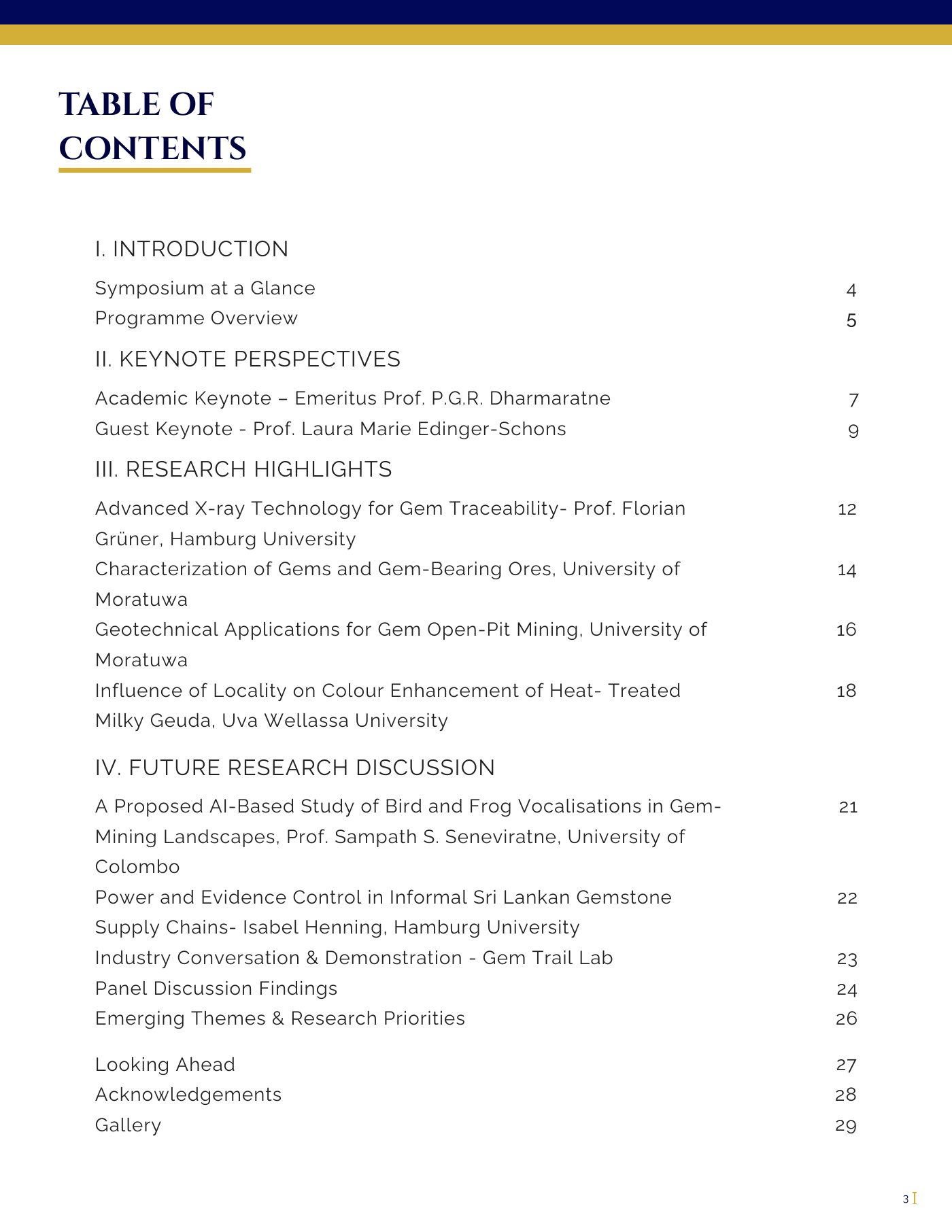
TABLE OF
CONTENTS
I. INTRODUCTION
Symposium at a Glance

4

Programme Overview

5

II. KEYNOTE PERSPECTIVES
Academic Keynote – Emeritus Prof. P.G.R. Dharmaratne

7

Guest Keynote - Prof. Laura Marie Edinger-Schons

9

III. RESEARCH HIGHLIGHTS
Advanced X-ray Technology for Gem Traceability- Prof. Florian

12

Grüner, Hamburg University
Characterization of Gems and Gem-Bearing Ores, University of

14

Moratuwa
Geotechnical Applications for Gem Open-Pit Mining, University of

16

Moratuwa
Influence of Locality on Colour Enhancement of Heat- Treated

18

Milky Geuda, Uva Wellassa University

IV. FUTURE RESEARCH DISCUSSION
A Proposed AI-Based Study of Bird and Frog Vocalisations in Gem-

21

Mining Landscapes, Prof. Sampath S. Seneviratne, University of
Colombo
Power and Evidence Control in Informal Sri Lankan Gemstone

22

Supply Chains- Isabel Henning, Hamburg University
Industry Conversation & Demonstration - Gem Trail Lab

23

Panel Discussion Findings

24

Emerging Themes & Research Priorities

26

Looking Ahead

27

Acknowledgements

28

Gallery

29

3
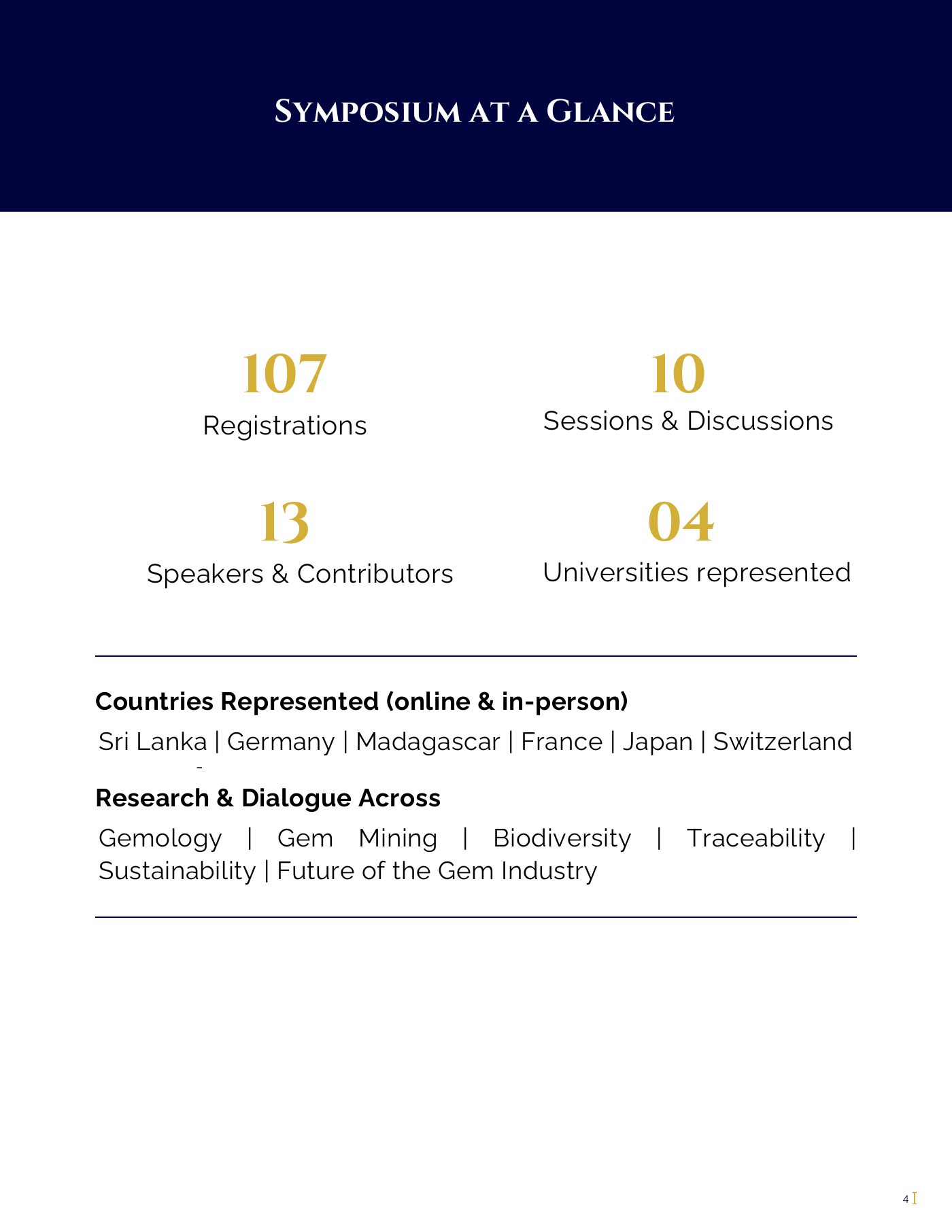
Symposium at a Glance

107

10

Registrations

Sessions & Discussions

13

04

Speakers & Contributors

Universities represented

Countries Represented (online & in-person)
Sri Lanka | Germany | Madagascar | France | Japan | Switzerland
-

Research & Dialogue Across
Gemology | Gem Mining | Biodiversity | Traceability |
Sustainability | Future of the Gem Industry

4
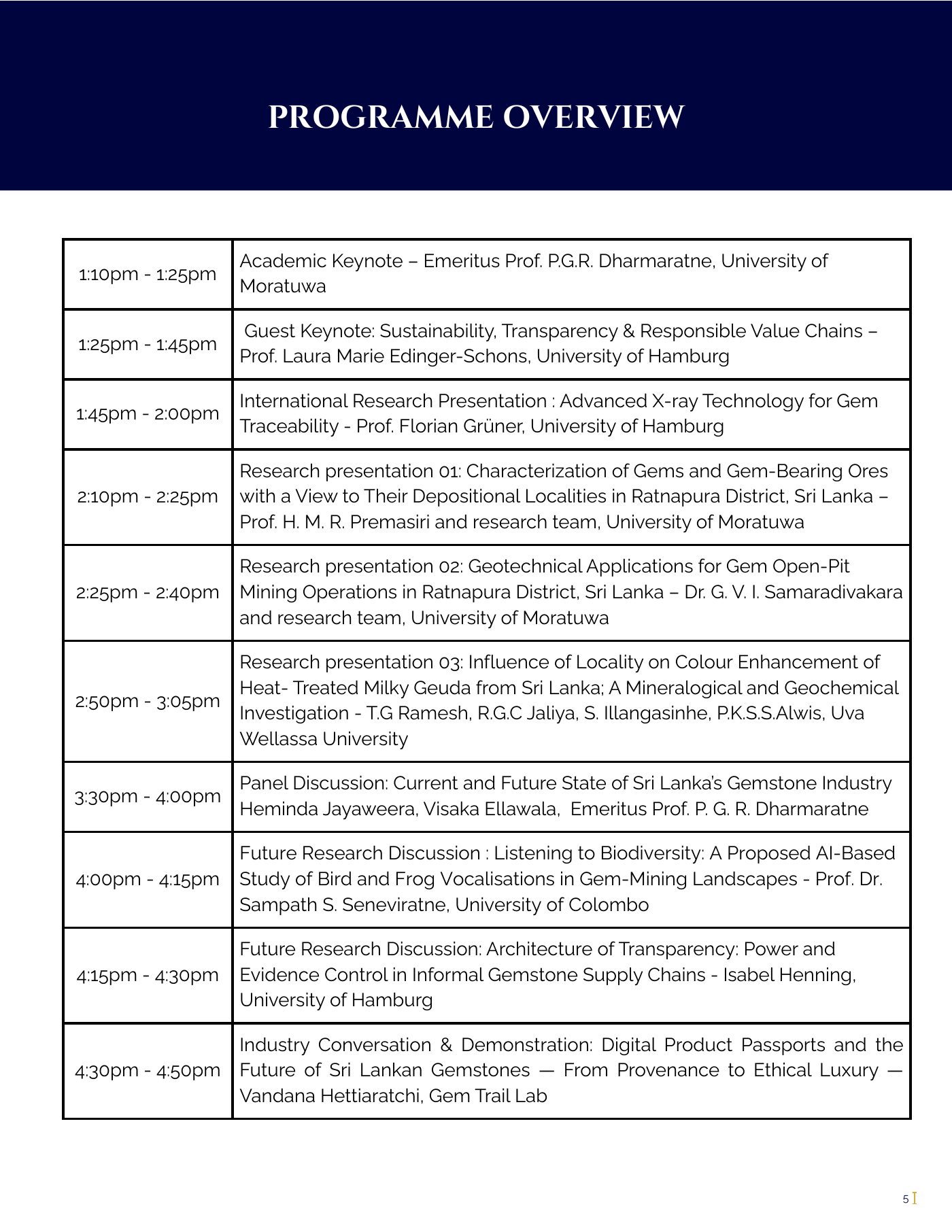
PROGRAMME OVERVIEW

1:10pm - 1:25pm

Academic Keynote – Emeritus Prof. P.G.R. Dharmaratne, University of
Moratuwa

1:25pm - 1:45pm

Guest Keynote: Sustainability, Transparency & Responsible Value Chains –
Prof. Laura Marie Edinger-Schons, University of Hamburg

1:45pm - 2:00pm

International Research Presentation : Advanced X-ray Technology for Gem
Traceability - Prof. Florian Grüner, University of Hamburg

2:10pm - 2:25pm

Research presentation 01: Characterization of Gems and Gem-Bearing Ores
with a View to Their Depositional Localities in Ratnapura District, Sri Lanka –
Prof. H. M. R. Premasiri and research team, University of Moratuwa

2:25pm - 2:40pm

Research presentation 02: Geotechnical Applications for Gem Open-Pit
Mining Operations in Ratnapura District, Sri Lanka – Dr. G. V. I. Samaradivakara
and research team, University of Moratuwa

2:50pm - 3:05pm

Research presentation 03: Influence of Locality on Colour Enhancement of
Heat- Treated Milky Geuda from Sri Lanka; A Mineralogical and Geochemical
Investigation - T.G Ramesh, R.G.C Jaliya, S. Illangasinhe, P.K.S.S.Alwis, Uva
Wellassa University

3:30pm - 4:00pm

Panel Discussion: Current and Future State of Sri Lanka’s Gemstone Industry
Heminda Jayaweera, Visaka Ellawala, Emeritus Prof. P. G. R. Dharmaratne

4:00pm - 4:15pm

Future Research Discussion : Listening to Biodiversity: A Proposed AI-Based
Study of Bird and Frog Vocalisations in Gem-Mining Landscapes - Prof. Dr.
Sampath S. Seneviratne, University of Colombo

4:15pm - 4:30pm

Future Research Discussion: Architecture of Transparency: Power and
Evidence Control in Informal Gemstone Supply Chains - Isabel Henning,
University of Hamburg

4:30pm - 4:50pm

Industry Conversation & Demonstration: Digital Product Passports and the
Future of Sri Lankan Gemstones — From Provenance to Ethical Luxury —
Vandana Hettiaratchi, Gem Trail Lab

5

KEYNOTES
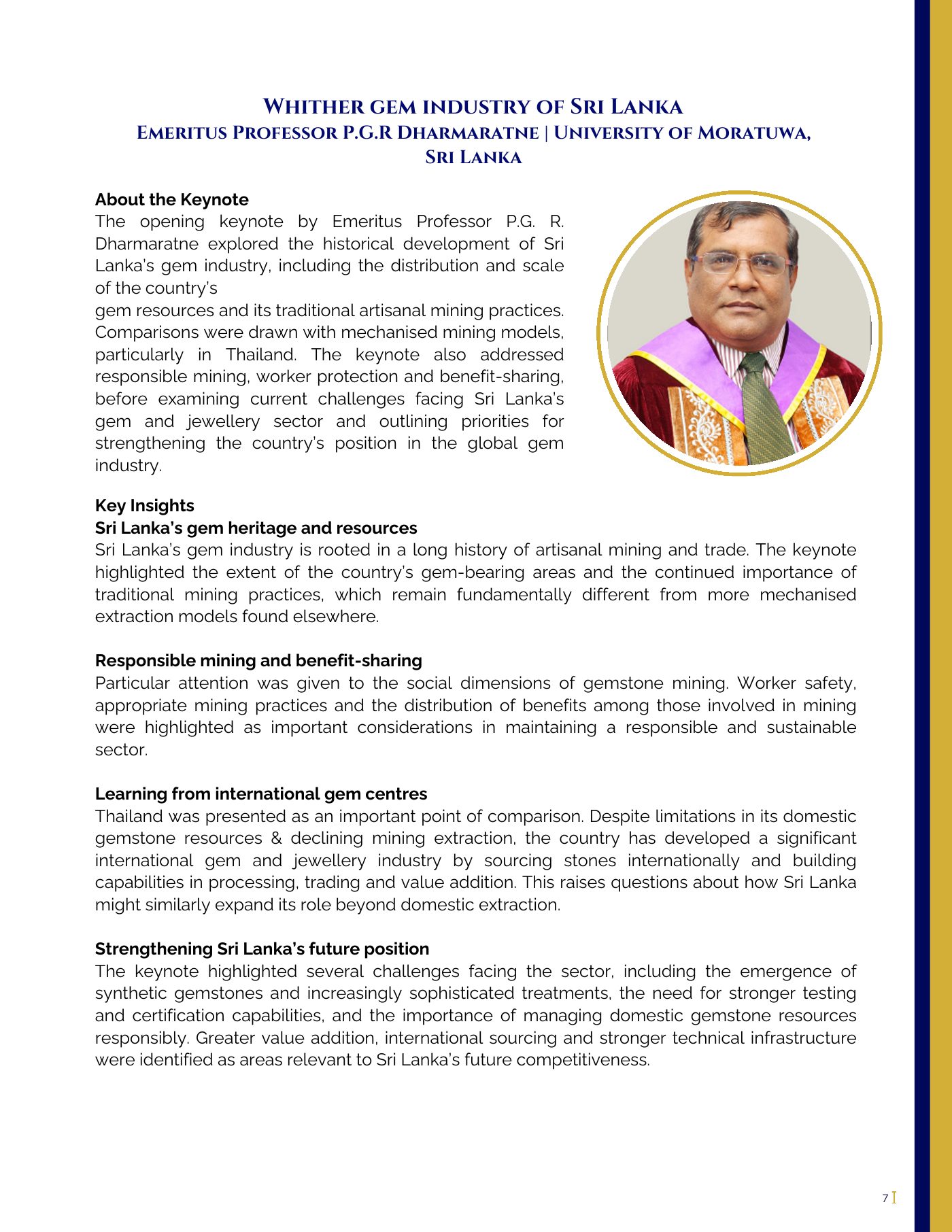
Whither gem industry of Sri Lanka

Emeritus Professor P.G.R Dharmaratne | University of Moratuwa,
Sri Lanka
About the Keynote
The opening keynote by Emeritus Professor P.G. R.
Dharmaratne explored the historical development of Sri
Lanka’s gem industry, including the distribution and scale
of the country’s
gem resources and its traditional artisanal mining practices.
Comparisons were drawn with mechanised mining models,
particularly in Thailand. The keynote also addressed
responsible mining, worker protection and benefit-sharing,
before examining current challenges facing Sri Lanka’s
gem and jewellery sector and outlining priorities for
strengthening the country’s position in the global gem
industry.
Key Insights
Sri Lanka’s gem heritage and resources
Sri Lanka’s gem industry is rooted in a long history of artisanal mining and trade. The keynote
highlighted the extent of the country’s gem-bearing areas and the continued importance of
traditional mining practices, which remain fundamentally different from more mechanised
extraction models found elsewhere.
Responsible mining and benefit-sharing
Particular attention was given to the social dimensions of gemstone mining. Worker safety,
appropriate mining practices and the distribution of benefits among those involved in mining
were highlighted as important considerations in maintaining a responsible and sustainable
sector.
Learning from international gem centres
Thailand was presented as an important point of comparison. Despite limitations in its domestic
gemstone resources & declining mining extraction, the country has developed a significant
international gem and jewellery industry by sourcing stones internationally and building
capabilities in processing, trading and value addition. This raises questions about how Sri Lanka
might similarly expand its role beyond domestic extraction.
Strengthening Sri Lanka’s future position
The keynote highlighted several challenges facing the sector, including the emergence of
synthetic gemstones and increasingly sophisticated treatments, the need for stronger testing
and certification capabilities, and the importance of managing domestic gemstone resources
responsibly. Greater value addition, international sourcing and stronger technical infrastructure
were identified as areas relevant to Sri Lanka’s future competitiveness.

7
Implications for the Gemstone Sector
The keynote highlighted the need for Sri Lanka to consider its future in the gemstone sector
beyond the extraction of domestic resources alone. The comparison with Thailand illustrated
how a country can strengthen its position as an international gem and jewellery hub through
trading, processing and value addition, including the sourcing of gemstones from other
producing countries.
At the same time, maintaining Sri Lanka’s distinctive artisanal mining tradition requires continued
attention to responsible resource management, worker safety and equitable benefit-sharing.
Strengthening these practices can help preserve the social and economic value generated by
small-scale mining while addressing sustainability concerns associated with extraction.
Advances in synthetic gemstones and gemstone treatments also increase the importance of
strong technical capabilities. Investment in modern testing infrastructure, specialist expertise
and credible certification could therefore play an increasingly important role in protecting
market confidence and supporting Sri Lanka’s international competitiveness.
Taken together, the keynote pointed towards several areas of strategic importance for the
sector:
responsible management of domestic gemstone resources;
stronger worker protection and mining practices;
greater domestic processing and value addition;
development of internationally credible testing and certification capabilities
a broader role for Sri Lanka in international gemstone sourcing and trade.

Key Takeaway
Sri Lanka’s future as a global gemstone hub depends not only on its natural gem
resources, but also on how effectively it combines responsible mining with stronger value
addition, international sourcing, and credible testing and certification capabilities.

8
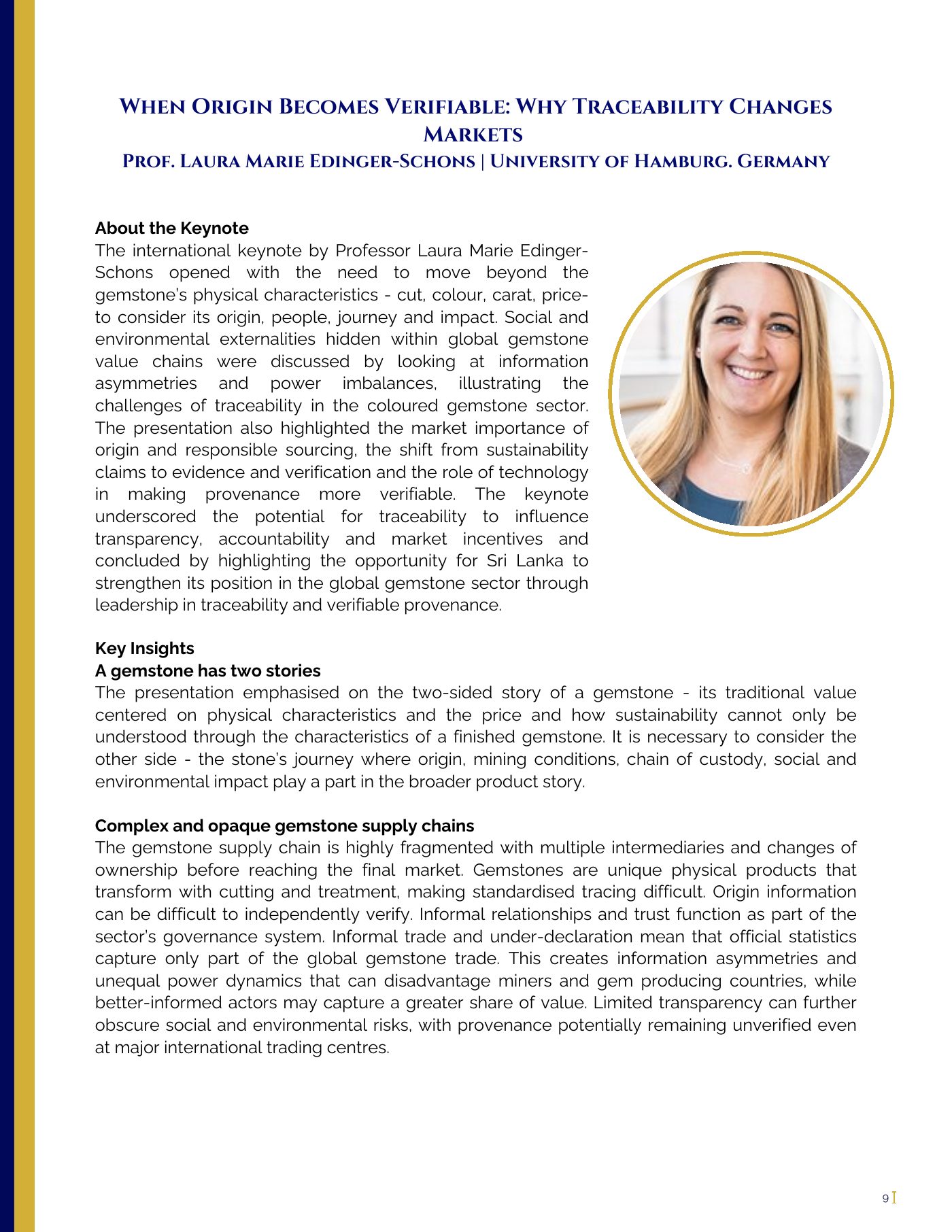
When Origin Becomes Verifiable: Why Traceability Changes
Markets
Prof. Laura Marie Edinger-Schons | University of Hamburg. Germany

About the Keynote
The international keynote by Professor Laura Marie EdingerSchons opened with the need to move beyond the
gemstone’s physical characteristics - cut, colour, carat, priceto consider its origin, people, journey and impact. Social and
environmental externalities hidden within global gemstone
value chains were discussed by looking at information
asymmetries and power imbalances, illustrating the
challenges of traceability in the coloured gemstone sector.
The presentation also highlighted the market importance of
origin and responsible sourcing, the shift from sustainability
claims to evidence and verification and the role of technology
in making provenance more verifiable. The keynote
underscored the potential for traceability to influence
transparency, accountability and market incentives and
concluded by highlighting the opportunity for Sri Lanka to
strengthen its position in the global gemstone sector through
leadership in traceability and verifiable provenance.
Key Insights
A gemstone has two stories
The presentation emphasised on the two-sided story of a gemstone - its traditional value
centered on physical characteristics and the price and how sustainability cannot only be
understood through the characteristics of a finished gemstone. It is necessary to consider the
other side - the stone’s journey where origin, mining conditions, chain of custody, social and
environmental impact play a part in the broader product story.
Complex and opaque gemstone supply chains
The gemstone supply chain is highly fragmented with multiple intermediaries and changes of
ownership before reaching the final market. Gemstones are unique physical products that
transform with cutting and treatment, making standardised tracing difficult. Origin information
can be difficult to independently verify. Informal relationships and trust function as part of the
sector’s governance system. Informal trade and under-declaration mean that official statistics
capture only part of the global gemstone trade. This creates information asymmetries and
unequal power dynamics that can disadvantage miners and gem producing countries, while
better-informed actors may capture a greater share of value. Limited transparency can further
obscure social and environmental risks, with provenance potentially remaining unverified even
at major international trading centres.

9
Origin is increasingly becoming part of the product proposition
The presentation stressed the growing attention frominternational jewellery brands and
customers towards provenance, origin information and responsible sourcing, which is
connected to brand reputation and consumer trust. This is further emphasized by increasing
expectations for sustainability and origin claims to be verified and substantiated. The transition
from the voluntary “trust me” to “show me” shows that traceability is more than just
documentation. It is accountable and verifiable evidence, through independent verification.
From digital traceability to verifiable markets
Digital systems can preserve information across the gemstone journey, but they cannot
guarantee that the original data is correct. Digital traceability and physical verification are
therefore complementary, combining recorded information with evidence from the gemstone
itself. More verifiable provenance can strengthen transparency and accountability, potentially
influencing reputation, risk, market access, price and bargaining power across gemstone
supply chains.
Implications for the Gemstone Sector
The keynote highlighted how verifiable provenance could move traceability beyond
documentation and become a driver of broader market change.
Key implications include:
Evidence-based traceability - moving from origin claims towards verifiable evidence.
Physical and digital integration - combining digital records with scientific verification of the
gemstone itself.
Transparency and accountability - increasing visibility of origin, conditions and impacts
across fragmented supply chains.
Market differentiation - credible provenance potentially influencing reputation, market
access and value.
Value distribution - better information potentially changing bargaining power and how
value is captured across the supply chain.
Opportunity for Sri Lanka - using verifiable provenance to strengthen its position as a
responsible and innovative gemstone-producing country.
The keynote concluded with three questions for the future:
1. Can we know? Can technology reliably establish provenance?
2. Will we know? Will actors share and connect information?
3. What happens when we know? How might verifiable provenance change prices, power,
responsibility and value creation?

Key Takeaway
Traceability becomes transformative when origin moves from a claim to verifiable
evidence. Combining credible information, physical verification and digital traceability can
strengthen transparency and accountability while potentially changing how trust, risk and
value are distributed across gemstone markets.

10
RESEARCH
HIGHLIGHTS

9
Advanced X-ray Fluorescence Imaging: A Possible New
Approach for Gemstone Traceability

Prof. Florian Grüner | CENTER FOR FREE ELECTRON LASER SCIENCE,
Institute for Experimental Physics, Universityof Hamburg, GERMANY
Research Context
X-ray Fluorescence Imaging (XFI) is a highly sensitive imaging approach for tracking and
detecting labelled entities, including cells, medical drug compounds, nanoparticles and
antibodies. The key strength of the XFI approach is the unprecedented level of sensitivity
combined with spatially resolved information. The same underlying physics can be applied to
gemstone analysis, where sensitive detection of trace elements could provide information for
distinguishing gemstones.
Research Objective
The research explores whether highly sensitive XFI measurements could provide a physical
signature capable of distinguishing gemstones from different mining locations, and therefore
potentially contribute to gemstone traceability.
Approach and Technology
XFI uses an incident X-ray beam to excite atoms within a material, causing them to emit
characteristic X-ray fluorescence. A major challenge is separating these signals from the
spectral background, particularly where trace elements occur only in very small quantities.
The University of Hamburg developed SCOTTI (Super Compact Optics-based Tunable Testbed
for Imaging), a laboratory-scale XFI system designed to achieve the sensitivity previously
associated with large synchrotron facilities.
Proof of Concept
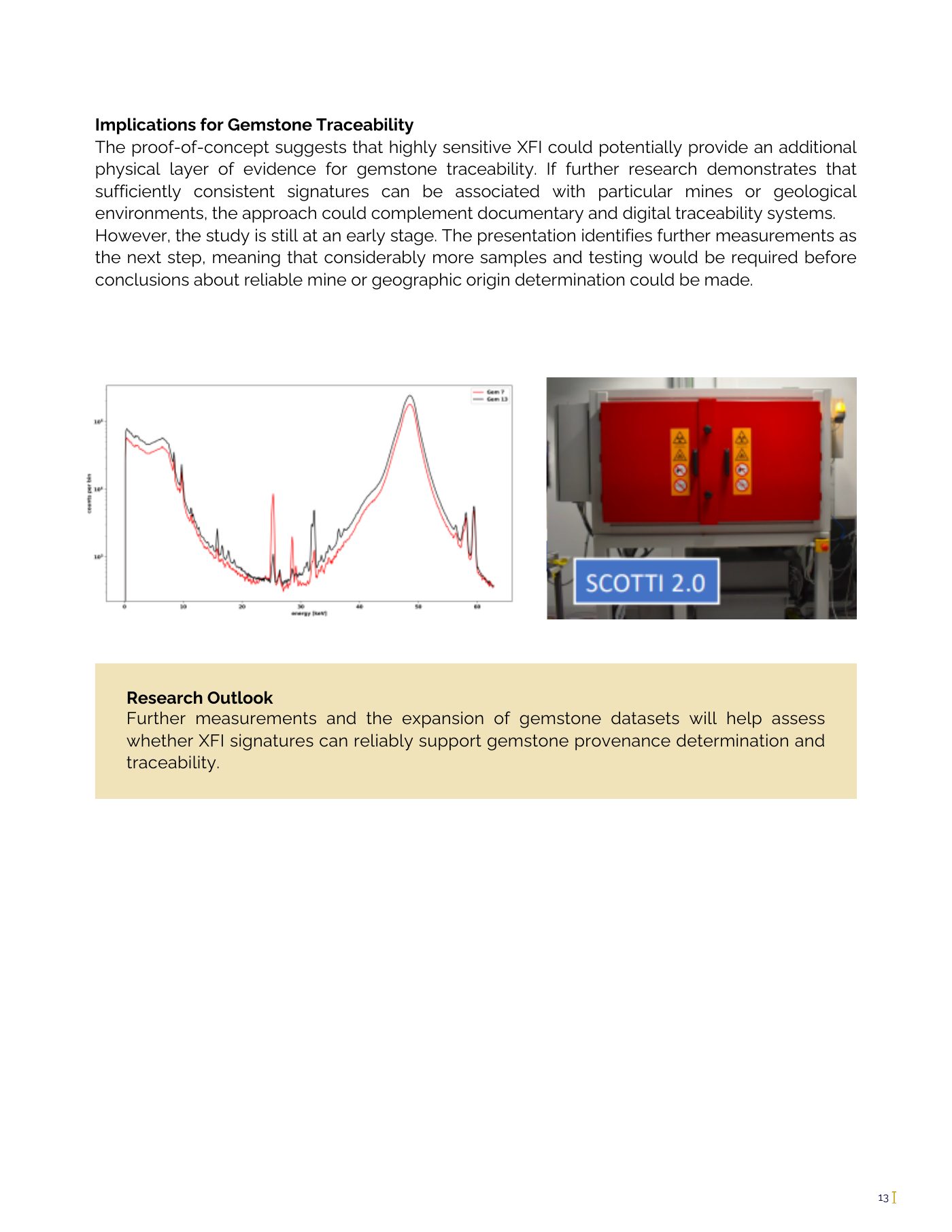
The first gemstone proof-of-concept examined two raw gemstones from two different mines
within the same region of Sri Lanka using SCOTTI.
The two gemstones produced clearly distinguishable XFI spectra.
Differences were detectable despite the very small quantities of relevant trace elements.
The experiment demonstrated the potential of high-sensitivity XFI to distinguish between
gemstone samples.
The results represent an initial proof-of-concept, rather than a validated method for
determining gemstone origin.

12
Implications for Gemstone Traceability
The proof-of-concept suggests that highly sensitive XFI could potentially provide an additional
physical layer of evidence for gemstone traceability. If further research demonstrates that
sufficiently consistent signatures can be associated with particular mines or geological
environments, the approach could complement documentary and digital traceability systems.
However, the study is still at an early stage. The presentation identifies further measurements as
the next step, meaning that considerably more samples and testing would be required before
conclusions about reliable mine or geographic origin determination could be made.

Research Outlook
Further measurements and the expansion of gemstone datasets will help assess
whether XFI signatures can reliably support gemstone provenance determination and
traceability.

13
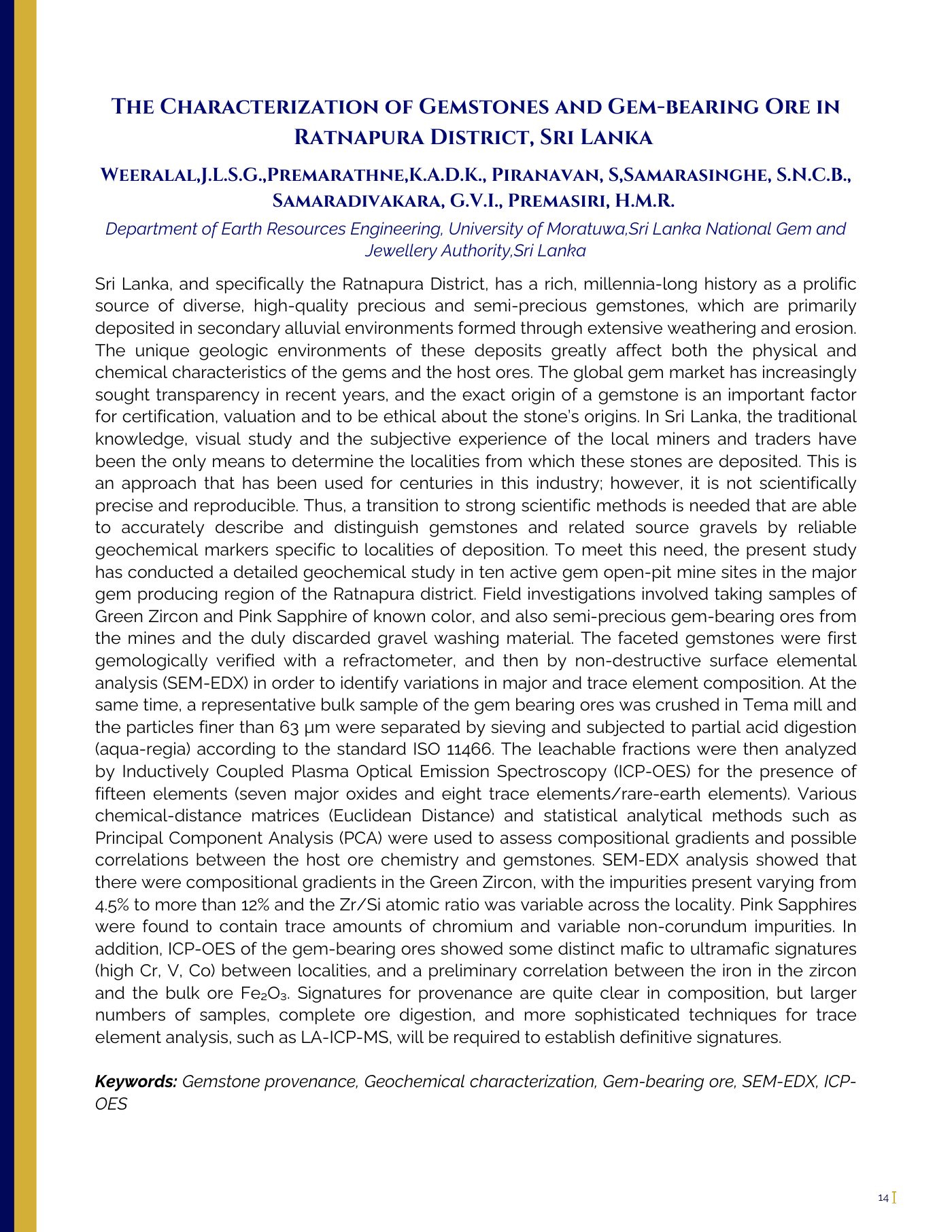
The Characterization of Gemstones and Gem-bearing Ore in
Ratnapura District, Sri Lanka
Weeralal,J.L.S.G.,Premarathne,K.A.D.K., Piranavan, S,Samarasinghe, S.N.C.B.,
Samaradivakara, G.V.I., Premasiri, H.M.R.
Department of Earth Resources Engineering, University of Moratuwa,Sri Lanka National Gem and
Jewellery Authority,Sri Lanka
Sri Lanka, and specifically the Ratnapura District, has a rich, millennia-long history as a prolific
source of diverse, high-quality precious and semi-precious gemstones, which are primarily
deposited in secondary alluvial environments formed through extensive weathering and erosion.
The unique geologic environments of these deposits greatly affect both the physical and
chemical characteristics of the gems and the host ores. The global gem market has increasingly
sought transparency in recent years, and the exact origin of a gemstone is an important factor
for certification, valuation and to be ethical about the stone’s origins. In Sri Lanka, the traditional
knowledge, visual study and the subjective experience of the local miners and traders have
been the only means to determine the localities from which these stones are deposited. This is
an approach that has been used for centuries in this industry; however, it is not scientifically
precise and reproducible. Thus, a transition to strong scientific methods is needed that are able
to accurately describe and distinguish gemstones and related source gravels by reliable
geochemical markers specific to localities of deposition. To meet this need, the present study
has conducted a detailed geochemical study in ten active gem open-pit mine sites in the major
gem producing region of the Ratnapura district. Field investigations involved taking samples of
Green Zircon and Pink Sapphire of known color, and also semi-precious gem-bearing ores from
the mines and the duly discarded gravel washing material. The faceted gemstones were first
gemologically verified with a refractometer, and then by non-destructive surface elemental
analysis (SEM-EDX) in order to identify variations in major and trace element composition. At the
same time, a representative bulk sample of the gem bearing ores was crushed in Tema mill and
the particles finer than 63 µm were separated by sieving and subjected to partial acid digestion
(aqua-regia) according to the standard ISO 11466. The leachable fractions were then analyzed
by Inductively Coupled Plasma Optical Emission Spectroscopy (ICP-OES) for the presence of
fifteen elements (seven major oxides and eight trace elements/rare-earth elements). Various
chemical-distance matrices (Euclidean Distance) and statistical analytical methods such as
Principal Component Analysis (PCA) were used to assess compositional gradients and possible
correlations between the host ore chemistry and gemstones. SEM-EDX analysis showed that
there were compositional gradients in the Green Zircon, with the impurities present varying from
4.5% to more than 12% and the Zr/Si atomic ratio was variable across the locality. Pink Sapphires
were found to contain trace amounts of chromium and variable non-corundum impurities. In
addition, ICP-OES of the gem-bearing ores showed some distinct mafic to ultramafic signatures
(high Cr, V, Co) between localities, and a preliminary correlation between the iron in the zircon
and the bulk ore Fe₂O₃. Signatures for provenance are quite clear in composition, but larger
numbers of samples, complete ore digestion, and more sophisticated techniques for trace
element analysis, such as LA-ICP-MS, will be required to establish definitive signatures.
Keywords: Gemstone provenance, Geochemical characterization, Gem-bearing ore, SEM-EDX, ICPOES

14
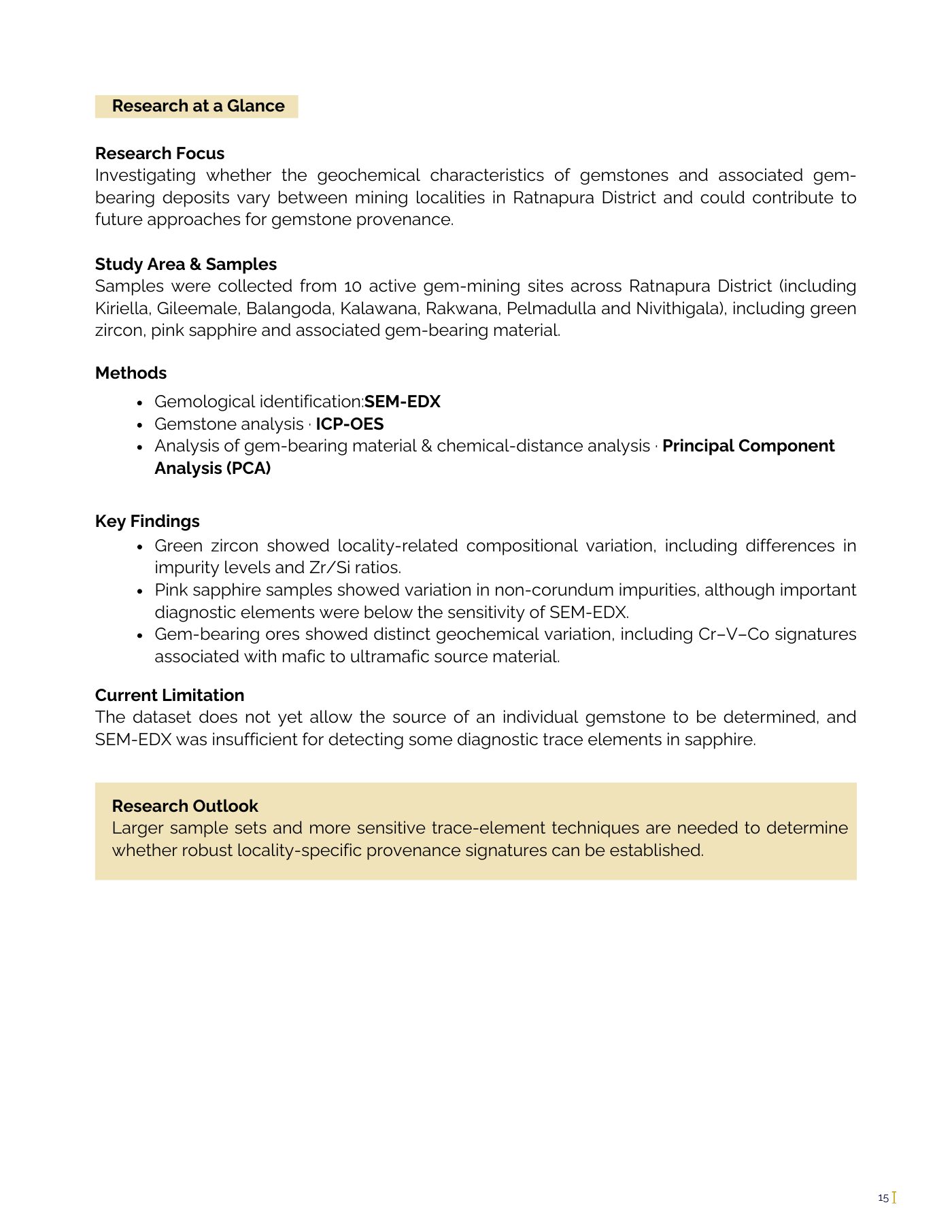
Research at a Glance
Research Focus
Investigating whether the geochemical characteristics of gemstones and associated gembearing deposits vary between mining localities in Ratnapura District and could contribute to
future approaches for gemstone provenance.
Study Area & Samples
Samples were collected from 10 active gem-mining sites across Ratnapura District (including
Kiriella, Gileemale, Balangoda, Kalawana, Rakwana, Pelmadulla and Nivithigala), including green
zircon, pink sapphire and associated gem-bearing material.
Methods
Gemological identification:SEM-EDX
Gemstone analysis · ICP-OES
Analysis of gem-bearing material & chemical-distance analysis · Principal Component
Analysis (PCA)
Key Findings
Green zircon showed locality-related compositional variation, including differences in
impurity levels and Zr/Si ratios.
Pink sapphire samples showed variation in non-corundum impurities, although important
diagnostic elements were below the sensitivity of SEM-EDX.
Gem-bearing ores showed distinct geochemical variation, including Cr–V–Co signatures
associated with mafic to ultramafic source material.
Current Limitation
The dataset does not yet allow the source of an individual gemstone to be determined, and
SEM-EDX was insufficient for detecting some diagnostic trace elements in sapphire.

Research Outlook
Larger sample sets and more sensitive trace-element techniques are needed to determine
whether robust locality-specific provenance signatures can be established.

15
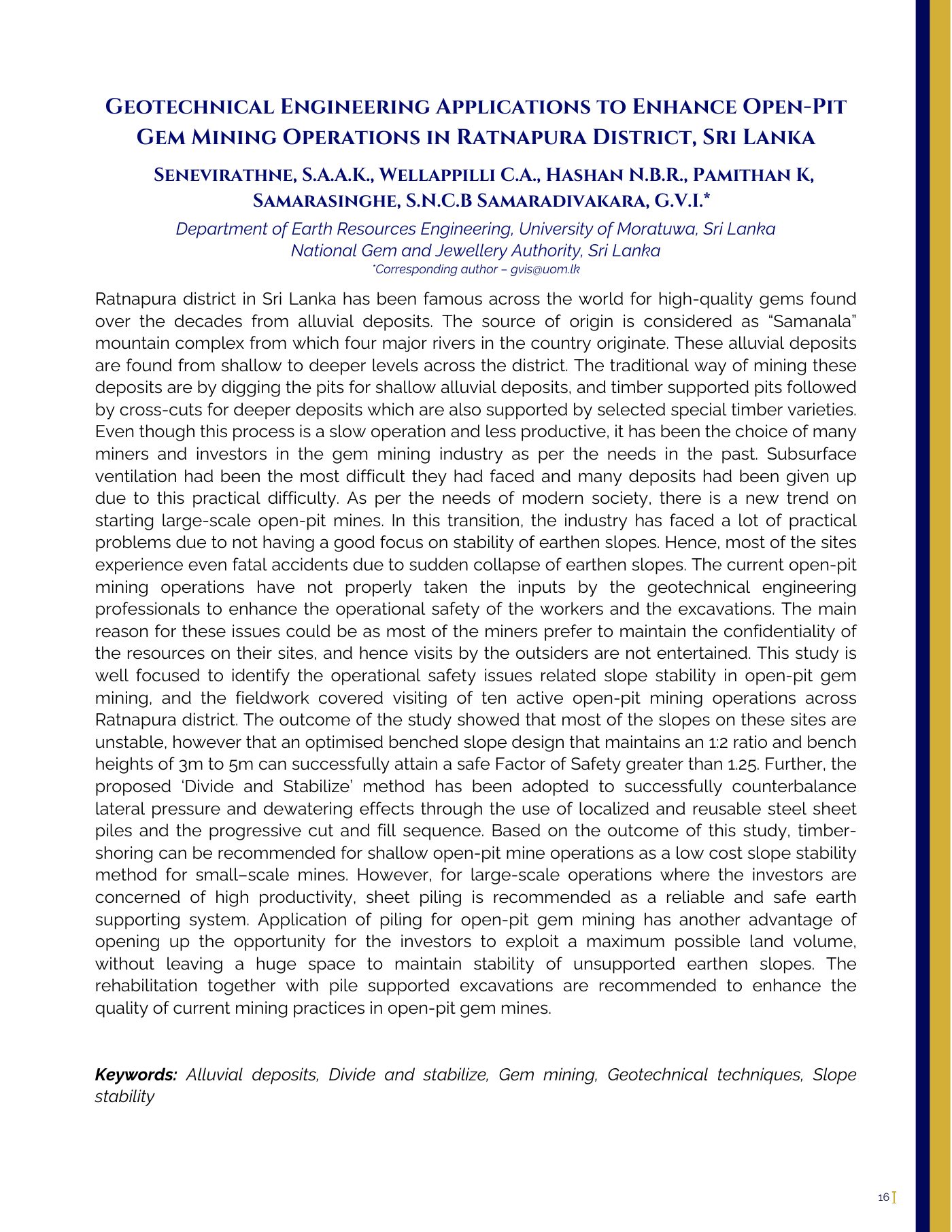
Geotechnical Engineering Applications to Enhance Open-Pit
Gem Mining Operations in Ratnapura District, Sri Lanka
Senevirathne, S.A.A.K., Wellappilli C.A., Hashan N.B.R., Pamithan K,
Samarasinghe, S.N.C.B Samaradivakara, G.V.I.*
Department of Earth Resources Engineering, University of Moratuwa, Sri Lanka
National Gem and Jewellery Authority, Sri Lanka
*Corresponding author – gvis@uom.lk

Ratnapura district in Sri Lanka has been famous across the world for high-quality gems found
over the decades from alluvial deposits. The source of origin is considered as “Samanala”
mountain complex from which four major rivers in the country originate. These alluvial deposits
are found from shallow to deeper levels across the district. The traditional way of mining these
deposits are by digging the pits for shallow alluvial deposits, and timber supported pits followed
by cross-cuts for deeper deposits which are also supported by selected special timber varieties.
Even though this process is a slow operation and less productive, it has been the choice of many
miners and investors in the gem mining industry as per the needs in the past. Subsurface
ventilation had been the most difficult they had faced and many deposits had been given up
due to this practical difficulty. As per the needs of modern society, there is a new trend on
starting large-scale open-pit mines. In this transition, the industry has faced a lot of practical
problems due to not having a good focus on stability of earthen slopes. Hence, most of the sites
experience even fatal accidents due to sudden collapse of earthen slopes. The current open-pit
mining operations have not properly taken the inputs by the geotechnical engineering
professionals to enhance the operational safety of the workers and the excavations. The main
reason for these issues could be as most of the miners prefer to maintain the confidentiality of
the resources on their sites, and hence visits by the outsiders are not entertained. This study is
well focused to identify the operational safety issues related slope stability in open-pit gem
mining, and the fieldwork covered visiting of ten active open-pit mining operations across
Ratnapura district. The outcome of the study showed that most of the slopes on these sites are
unstable, however that an optimised benched slope design that maintains an 1:2 ratio and bench
heights of 3m to 5m can successfully attain a safe Factor of Safety greater than 1.25. Further, the
proposed ‘Divide and Stabilize’ method has been adopted to successfully counterbalance
lateral pressure and dewatering effects through the use of localized and reusable steel sheet
piles and the progressive cut and fill sequence. Based on the outcome of this study, timbershoring can be recommended for shallow open-pit mine operations as a low cost slope stability
method for small–scale mines. However, for large-scale operations where the investors are
concerned of high productivity, sheet piling is recommended as a reliable and safe earth
supporting system. Application of piling for open-pit gem mining has another advantage of
opening up the opportunity for the investors to exploit a maximum possible land volume,
without leaving a huge space to maintain stability of unsupported earthen slopes. The
rehabilitation together with pile supported excavations are recommended to enhance the
quality of current mining practices in open-pit gem mines.

Keywords: Alluvial deposits, Divide and stabilize, Gem mining, Geotechnical techniques, Slope
stability

16
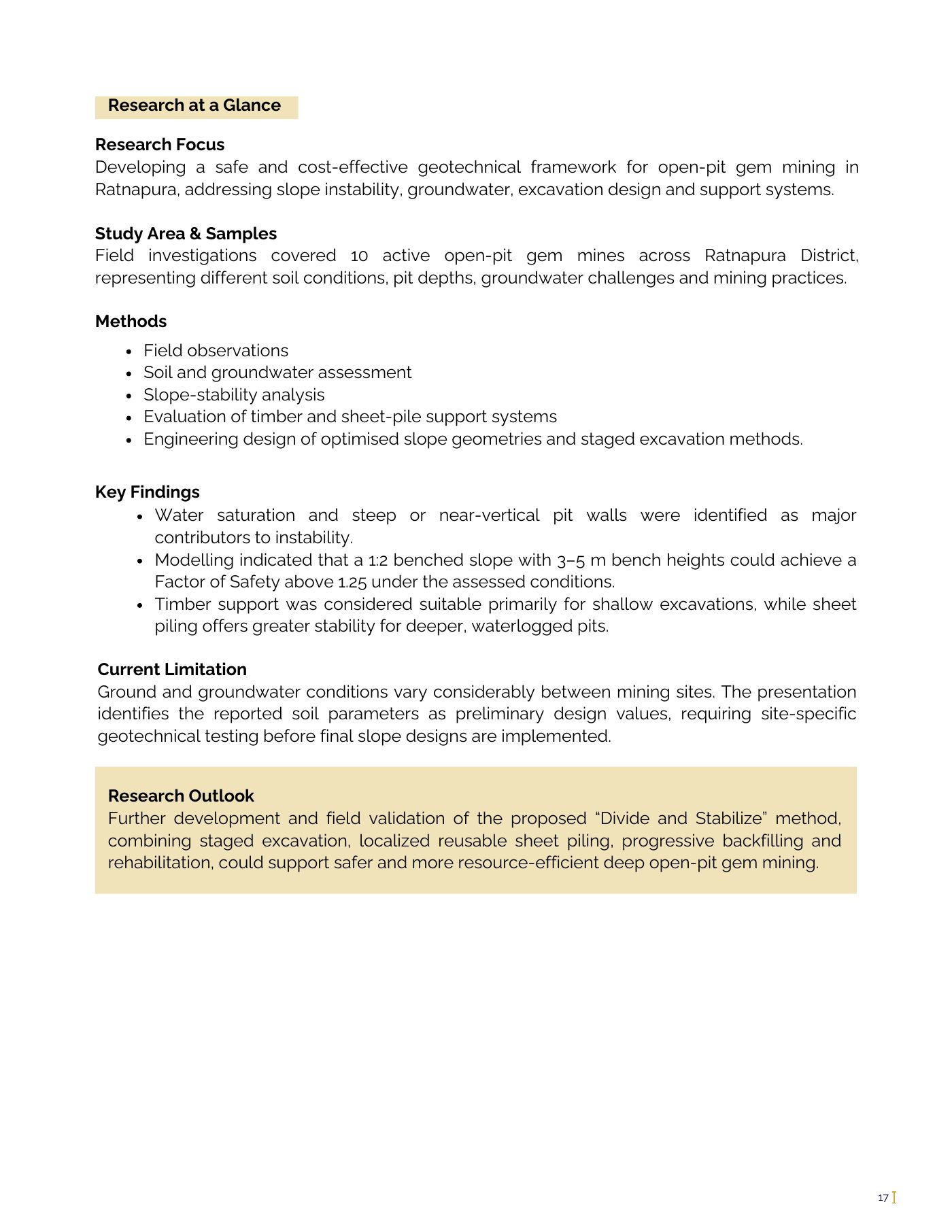
Research at a Glance
Research Focus
Developing a safe and cost-effective geotechnical framework for open-pit gem mining in
Ratnapura, addressing slope instability, groundwater, excavation design and support systems.
Study Area & Samples
Field investigations covered 10 active open-pit gem mines across Ratnapura District,
representing different soil conditions, pit depths, groundwater challenges and mining practices.
Methods
Field observations
Soil and groundwater assessment
Slope-stability analysis
Evaluation of timber and sheet-pile support systems
Engineering design of optimised slope geometries and staged excavation methods.
Key Findings
Water saturation and steep or near-vertical pit walls were identified as major
contributors to instability.
Modelling indicated that a 1:2 benched slope with 3–5 m bench heights could achieve a
Factor of Safety above 1.25 under the assessed conditions.
Timber support was considered suitable primarily for shallow excavations, while sheet
piling offers greater stability for deeper, waterlogged pits.
Current Limitation
Ground and groundwater conditions vary considerably between mining sites. The presentation
identifies the reported soil parameters as preliminary design values, requiring site-specific
geotechnical testing before final slope designs are implemented.
Research Outlook
Further development and field validation of the proposed “Divide and Stabilize” method,
combining staged excavation, localized reusable sheet piling, progressive backfilling and
rehabilitation, could support safer and more resource-efficient deep open-pit gem mining.

17
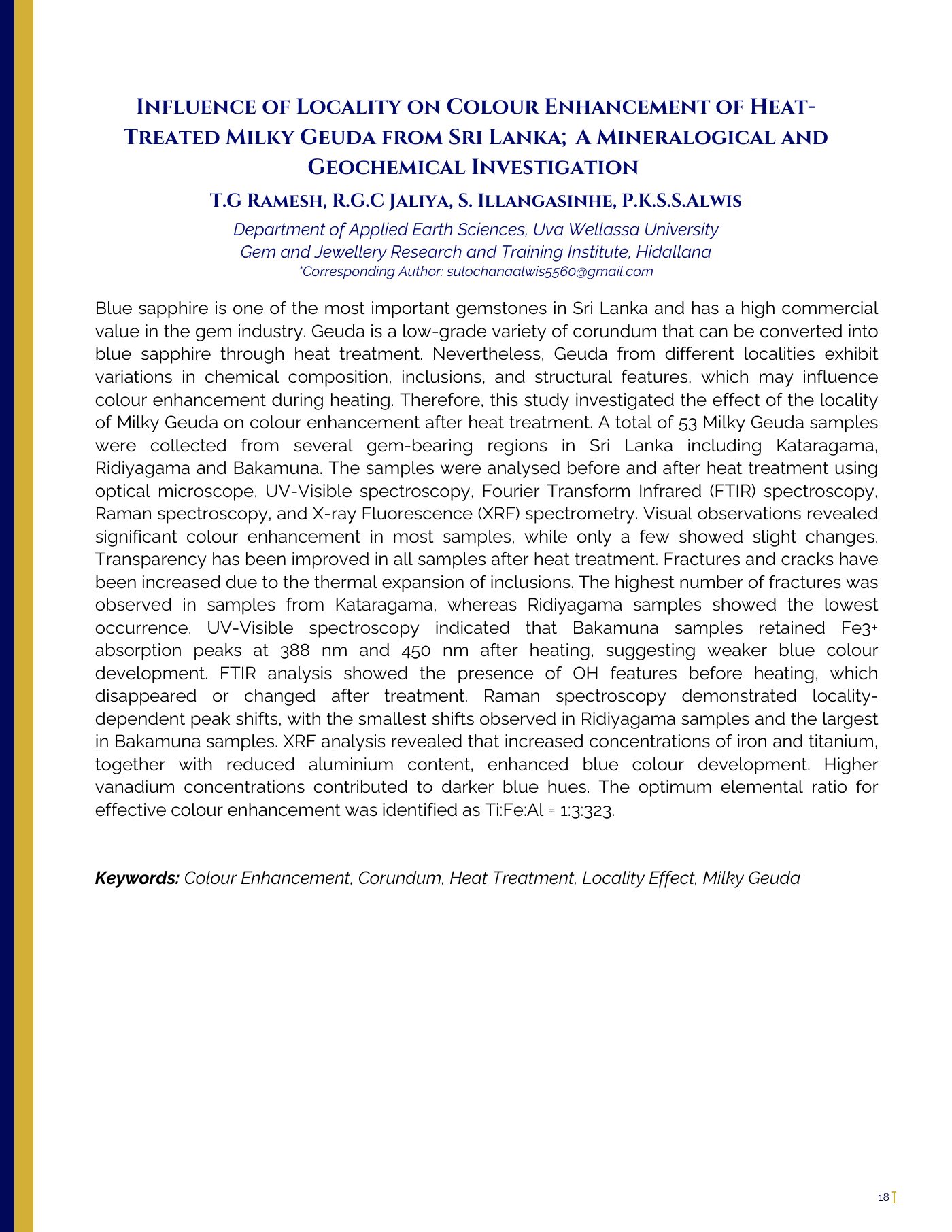
Influence of Locality on Colour Enhancement of HeatTreated Milky Geuda from Sri Lanka; A Mineralogical and
Geochemical Investigation
T.G Ramesh, R.G.C Jaliya, S. Illangasinhe, P.K.S.S.Alwis
Department of Applied Earth Sciences, Uva Wellassa University
Gem and Jewellery Research and Training Institute, Hidallana
*Corresponding Author: sulochanaalwis5560@gmail.com

Blue sapphire is one of the most important gemstones in Sri Lanka and has a high commercial
value in the gem industry. Geuda is a low-grade variety of corundum that can be converted into
blue sapphire through heat treatment. Nevertheless, Geuda from different localities exhibit
variations in chemical composition, inclusions, and structural features, which may influence
colour enhancement during heating. Therefore, this study investigated the effect of the locality
of Milky Geuda on colour enhancement after heat treatment. A total of 53 Milky Geuda samples
were collected from several gem-bearing regions in Sri Lanka including Kataragama,
Ridiyagama and Bakamuna. The samples were analysed before and after heat treatment using
optical microscope, UV-Visible spectroscopy, Fourier Transform Infrared (FTIR) spectroscopy,
Raman spectroscopy, and X-ray Fluorescence (XRF) spectrometry. Visual observations revealed
significant colour enhancement in most samples, while only a few showed slight changes.
Transparency has been improved in all samples after heat treatment. Fractures and cracks have
been increased due to the thermal expansion of inclusions. The highest number of fractures was
observed in samples from Kataragama, whereas Ridiyagama samples showed the lowest
occurrence. UV-Visible spectroscopy indicated that Bakamuna samples retained Fe3+
absorption peaks at 388 nm and 450 nm after heating, suggesting weaker blue colour
development. FTIR analysis showed the presence of OH features before heating, which
disappeared or changed after treatment. Raman spectroscopy demonstrated localitydependent peak shifts, with the smallest shifts observed in Ridiyagama samples and the largest
in Bakamuna samples. XRF analysis revealed that increased concentrations of iron and titanium,
together with reduced aluminium content, enhanced blue colour development. Higher
vanadium concentrations contributed to darker blue hues. The optimum elemental ratio for
effective colour enhancement was identified as Ti:Fe:Al = 1:3:323.

Keywords: Colour Enhancement, Corundum, Heat Treatment, Locality Effect, Milky Geuda

18
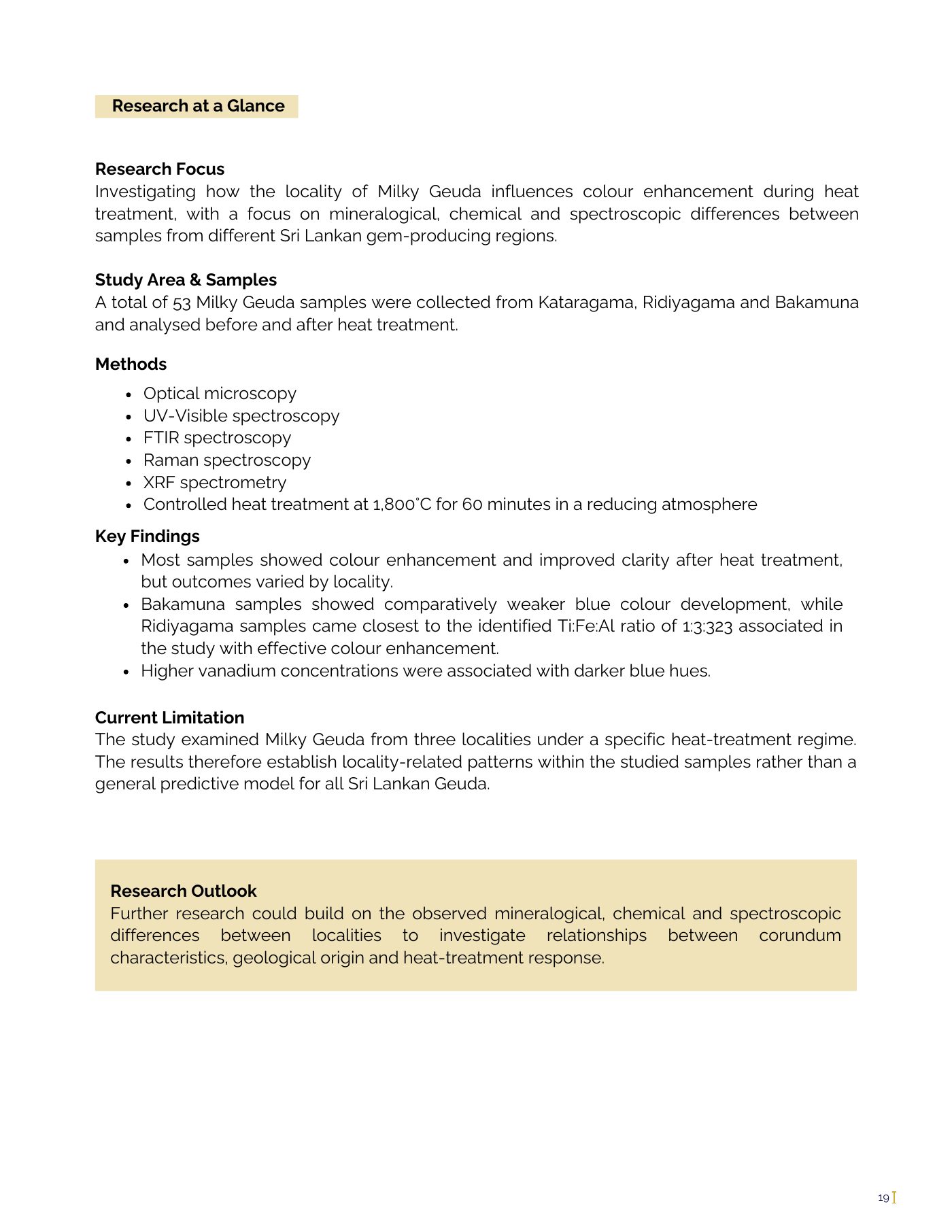
Research at a Glance

Research Focus
Investigating how the locality of Milky Geuda influences colour enhancement during heat
treatment, with a focus on mineralogical, chemical and spectroscopic differences between
samples from different Sri Lankan gem-producing regions.
Study Area & Samples
A total of 53 Milky Geuda samples were collected from Kataragama, Ridiyagama and Bakamuna
and analysed before and after heat treatment.
Methods
Optical microscopy
UV-Visible spectroscopy
FTIR spectroscopy
Raman spectroscopy
XRF spectrometry
Controlled heat treatment at 1,800°C for 60 minutes in a reducing atmosphere
Key Findings
Most samples showed colour enhancement and improved clarity after heat treatment,
but outcomes varied by locality.
Bakamuna samples showed comparatively weaker blue colour development, while
Ridiyagama samples came closest to the identified Ti:Fe:Al ratio of 1:3:323 associated in
the study with effective colour enhancement.
Higher vanadium concentrations were associated with darker blue hues.
Current Limitation
The study examined Milky Geuda from three localities under a specific heat-treatment regime.
The results therefore establish locality-related patterns within the studied samples rather than a
general predictive model for all Sri Lankan Geuda.

Research Outlook
Further research could build on the observed mineralogical, chemical and spectroscopic
differences between localities to investigate relationships between corundum
characteristics, geological origin and heat-treatment response.

19
FUTURE
RESEARCH
DISCUSSIONS

18
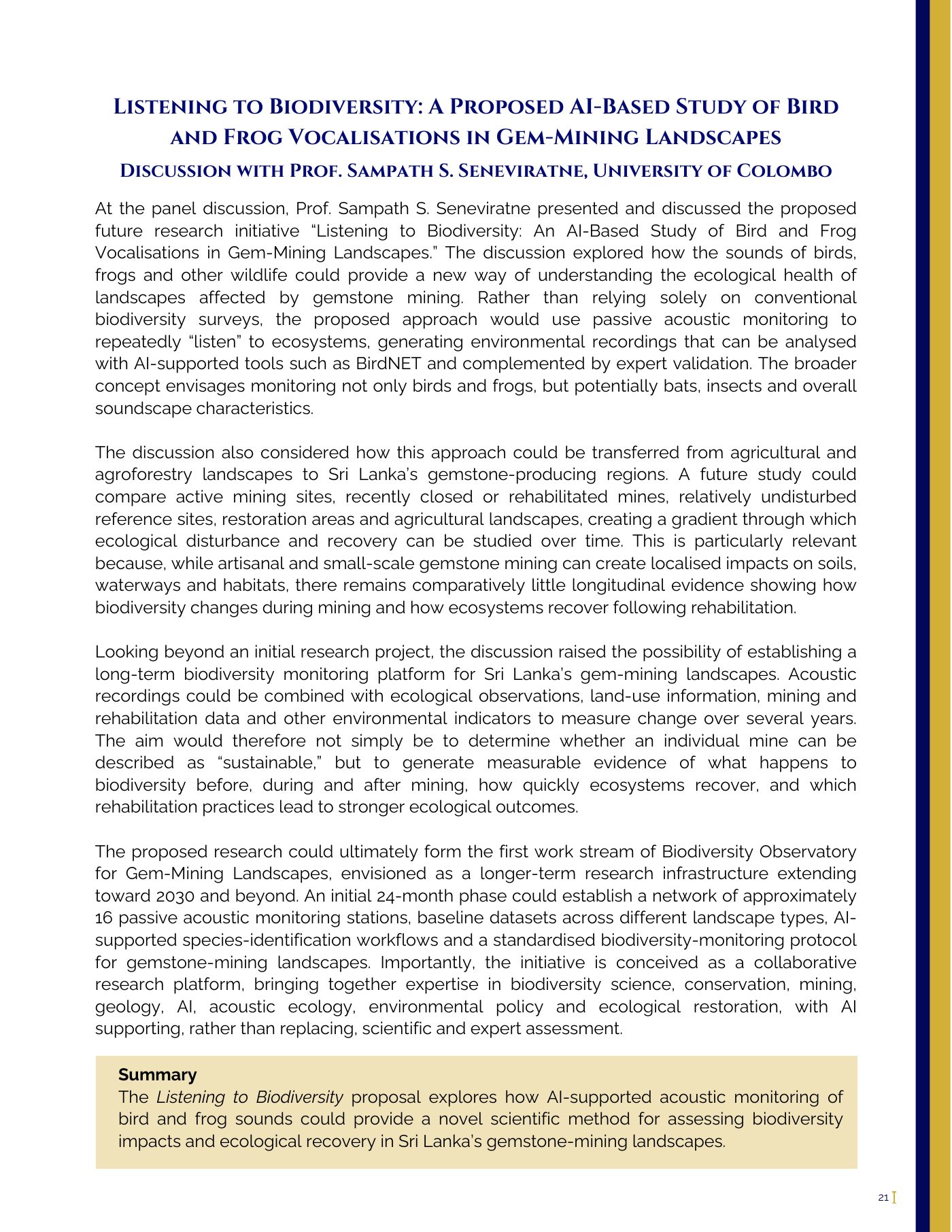
Listening to Biodiversity: A Proposed AI-Based Study of Bird
and Frog Vocalisations in Gem-Mining Landscapes
Discussion with Prof. Sampath S. Seneviratne, University of Colombo
At the panel discussion, Prof. Sampath S. Seneviratne presented and discussed the proposed
future research initiative “Listening to Biodiversity: An AI-Based Study of Bird and Frog
Vocalisations in Gem-Mining Landscapes.” The discussion explored how the sounds of birds,
frogs and other wildlife could provide a new way of understanding the ecological health of
landscapes affected by gemstone mining. Rather than relying solely on conventional
biodiversity surveys, the proposed approach would use passive acoustic monitoring to
repeatedly “listen” to ecosystems, generating environmental recordings that can be analysed
with AI-supported tools such as BirdNET and complemented by expert validation. The broader
concept envisages monitoring not only birds and frogs, but potentially bats, insects and overall
soundscape characteristics.
The discussion also considered how this approach could be transferred from agricultural and
agroforestry landscapes to Sri Lanka’s gemstone-producing regions. A future study could
compare active mining sites, recently closed or rehabilitated mines, relatively undisturbed
reference sites, restoration areas and agricultural landscapes, creating a gradient through which
ecological disturbance and recovery can be studied over time. This is particularly relevant
because, while artisanal and small-scale gemstone mining can create localised impacts on soils,
waterways and habitats, there remains comparatively little longitudinal evidence showing how
biodiversity changes during mining and how ecosystems recover following rehabilitation.
Looking beyond an initial research project, the discussion raised the possibility of establishing a
long-term biodiversity monitoring platform for Sri Lanka’s gem-mining landscapes. Acoustic
recordings could be combined with ecological observations, land-use information, mining and
rehabilitation data and other environmental indicators to measure change over several years.
The aim would therefore not simply be to determine whether an individual mine can be
described as “sustainable,” but to generate measurable evidence of what happens to
biodiversity before, during and after mining, how quickly ecosystems recover, and which
rehabilitation practices lead to stronger ecological outcomes.
The proposed research could ultimately form the first work stream of Biodiversity Observatory
for Gem-Mining Landscapes, envisioned as a longer-term research infrastructure extending
toward 2030 and beyond. An initial 24-month phase could establish a network of approximately
16 passive acoustic monitoring stations, baseline datasets across different landscape types, AIsupported species-identification workflows and a standardised biodiversity-monitoring protocol
for gemstone-mining landscapes. Importantly, the initiative is conceived as a collaborative
research platform, bringing together expertise in biodiversity science, conservation, mining,
geology, AI, acoustic ecology, environmental policy and ecological restoration, with AI
supporting, rather than replacing, scientific and expert assessment.
Summary
The Listening to Biodiversity proposal explores how AI-supported acoustic monitoring of
bird and frog sounds could provide a novel scientific method for assessing biodiversity
impacts and ecological recovery in Sri Lanka’s gemstone-mining landscapes.
21
Architecture of Transparency: Power and Evidence Control
in Informal Sri Lankan Gemstone Supply Chains
Discussion with Researcher Isabel Henning,University of Hamburg,
Field Work - Sri Lanka (September 2026)

During her research stay in Sri Lanka, Isabel Henning from the University of Hamburg explored
an often-overlooked dimension of gemstone traceability: who controls information, evidence and
origin claims along the gemstone supply chain, and how this relates to economic power and
value creation. Sri Lanka offers a particularly revealing setting, combining centuries-old
gemstone trading traditions and relationship-based networks with growing international
demands for transparency, responsible sourcing and verifiable origin. Stones may pass through
miners, mine owners, brokers, traders, cutters, dealers and exporters, while much of the
exchange continues to rely on reputation, verbal agreements and tacit knowledge rather than
formal documentation. This tension between established, trust-based practices and emerging
expectations for documented evidence lies at the heart of her research.
From the mine to the international markets
During four weeks of fieldwork, Isabel Henning followed different stages of the value chain
through visits and conversations in Meetiyagoda, Beruwala, Ratnapura and Colombo. Her
qualitative approach combines stakeholder and value-chain mapping, semi-structured
interviews and participant observation with miners, traders, cutters, brokers, exporters and other
industry actors. Rather than simply tracing the physical journey of a gemstone, the research asks
who has access to the stone, who possesses information about its history, who can document
that information and whose evidence is ultimately considered credible. Local knowledge about
origin may exist without formal records, while actors able to translate that knowledge into
certificates, documentation or internationally accepted claims can gain significant influence.
Transparency is also about power
A central concept is 'evidence control'. Isabel Henning's work examines the social and economic
structures behind transparency systems. Who decides what counts as credible evidence? Who
has the resources and knowledge to produce it? Who controls origin narratives? And what
happens when formal transparency requirements encounter supply chains built around
interpersonal trust and informal institutions?
Why this matters for responsible gemstone supply chains
The research suggests that traceability, certification and digital technologies cannot be
introduced effectively without understanding existing relationships, incentives and power
structures. Effective traceability is therefore not only about collecting more data. It is also about
understanding who produces that data, who controls it, who benefits from making it visible and
whose knowledge may otherwise remain excluded. By connecting global value-chain research
with the realities of artisanal and small-scale mining and informal gemstone trading, the Master's
thesis aims to inform traceability approaches that are technologically credible while remaining
locally grounded, inclusive and responsive to the people who make the gemstone supply chain
function.
Summary
Isabel Henning’s research explores how information, evidence control and power
dynamics shape gemstone traceability in Sri Lanka.
22
Digital Product Passports and the Future of Sri Lankan
Gemstones: From Provenance to Ethical Luxury
Industry Conversation & Demonstration with Vandana Hettiaratchi,
Gem Trail Lab
During the industry discussion, Vandana Hettiaratchi presented Gem Trail Lab's vision for
transforming Sri Lanka's gemstone industry through technology, research and responsible
sourcing. The conversation explored how Digital Product Passports (DPPs) can improve
transparency and traceability by documenting a gemstone's journey from mine to market,
bringing together information on origin, mining practices, verification, certification and
environmental and social responsibility.
The discussion also addressed the importance of developing credible verification and
certification frameworks that recognise responsible practices in artisanal and small-scale
mining. Rather than focusing solely on gemstone origin, the proposed approach aims to make
environmental and social performance more visible, helping miners and businesses
demonstrate their efforts while building greater trust among international buyers and
consumers.
Particular attention was given to the European Union's Empowering Consumers for the Green
Transition Directive (EmpCo) and its implications for sustainability communication. As the EU
strengthens requirements around environmental claims, businesses will increasingly need
credible, verifiable evidence to support statements about sustainability and responsible
sourcing. For the gemstone industry, this highlights the importance of moving beyond general
claims towards documented practices, transparent methodologies and independent verification.
Digital Product Passports could play an important role in organising and communicating such
evidence, helping businesses substantiate their claims while reducing the risks of greenwashing
and greenhushing.
The conversation further introduced MADE by Gem Trails™, an AI-powered B2B jewellery
commissioning platform designed to connect international buyers with vetted local artisans and
small-scale jewellery producers in Sri Lanka. By combining AI-supported jewellery design and
commissioning with responsibly sourced gemstones and local craftsmanship, MADE™ aims to
create new market opportunities for smaller producers who often lack direct access to
international clients. The initiative seeks to strengthen local value creation, support responsible
sourcing and demonstrate how technology can connect Sri Lanka’s artisanal jewellery sector
with global markets.
Looking ahead, the discussion highlighted the potential for Sri Lanka to position itself as a leader
in responsibly sourced coloured gemstones.
Summary
Vandana Hettiaratchi presented Gem Trail Lab’s vision for transforming the gemstone
industry through Digital Product Passports, credible sustainability verification and
certification, and AI-powered solutions that strengthen traceability, responsible sourcing and
market access.

23
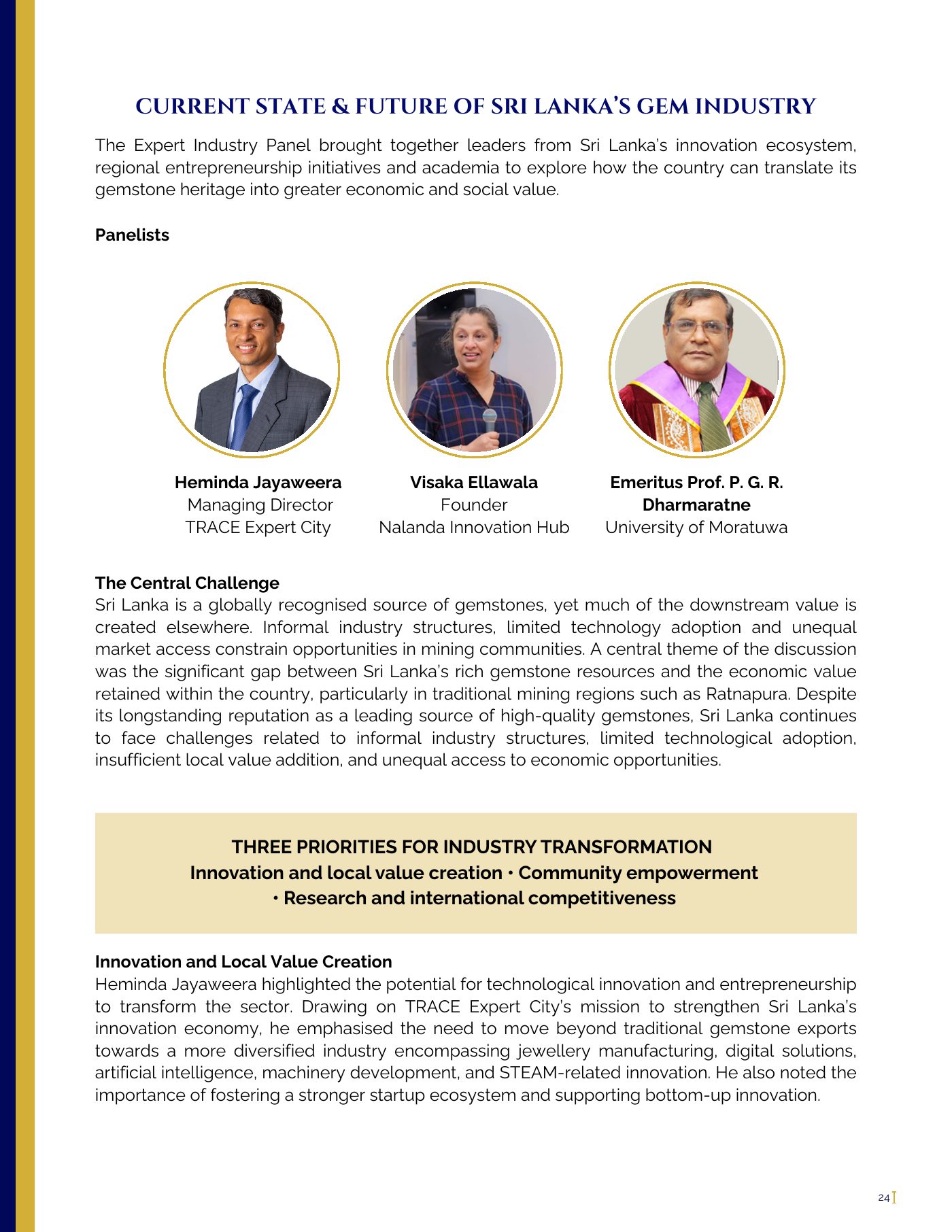
CURRENT STATE & FUTURE OF SRI LANKA’S GEM INDUSTRY
The Expert Industry Panel brought together leaders from Sri Lanka’s innovation ecosystem,
regional entrepreneurship initiatives and academia to explore how the country can translate its
gemstone heritage into greater economic and social value.
Panelists

Heminda Jayaweera
Managing Director
TRACE Expert City

Visaka Ellawala
Founder
Nalanda Innovation Hub

Emeritus Prof. P. G. R.
Dharmaratne
University of Moratuwa

The Central Challenge
Sri Lanka is a globally recognised source of gemstones, yet much of the downstream value is
created elsewhere. Informal industry structures, limited technology adoption and unequal
market access constrain opportunities in mining communities. A central theme of the discussion
was the significant gap between Sri Lanka’s rich gemstone resources and the economic value
retained within the country, particularly in traditional mining regions such as Ratnapura. Despite
its longstanding reputation as a leading source of high-quality gemstones, Sri Lanka continues
to face challenges related to informal industry structures, limited technological adoption,
insufficient local value addition, and unequal access to economic opportunities.

THREE PRIORITIES FOR INDUSTRY TRANSFORMATION
Innovation and local value creation • Community empowerment
• Research and international competitiveness
Innovation and Local Value Creation
Heminda Jayaweera highlighted the potential for technological innovation and entrepreneurship
to transform the sector. Drawing on TRACE Expert City’s mission to strengthen Sri Lanka’s
innovation economy, he emphasised the need to move beyond traditional gemstone exports
towards a more diversified industry encompassing jewellery manufacturing, digital solutions,
artificial intelligence, machinery development, and STEAM-related innovation. He also noted the
importance of fostering a stronger startup ecosystem and supporting bottom-up innovation.

24
Community Empowerment and Inclusive Development
Visaka Ellawala drew attention to the economic inequalities experienced by gemstoneproducing communities. Although gemstones worth up to an estimated LKR 1 billion are
extracted daily, according to figures cited during the discussion, much of the resulting economic
value does not remain in Ratnapura. Through Nalanda Innovation Hub, she advocates for greater
participation by local entrepreneurs, artisans, young people, and particularly women in shaping
the industry’s future. Her vision includes exploring digital platforms that could facilitate more
transparent and direct international trade in rough gemstones, potentially improving market
access and economic opportunities for artisanal and small-scale miners.
Research, Policy and International Competitiveness
Emeritus Professor P. G. R. Dharmaratne reflected on Sri Lanka’s longstanding gemstone
heritage and the need for stronger integration of scientific research, transparent governance,
and evidence-based policymaking. Drawing on his experience as former Chairman of the
National Gem and Jewellery Authority, he highlighted the importance of learning from
international competitors such as Thailand, which has successfully developed into a major
gemstone trading centre despite limited domestic mining activity.

A Shared Vision for the Future
Across the discussion, a common vision emerged: Sri Lanka’s gemstone industry must
evolve from a predominantly resource-driven sector towards a more innovative,
transparent, inclusive, and value-generating industry. Achieving this transformation will
require closer collaboration between academia, industry, technology innovators,
policymakers, and local mining communities. Particular emphasis was placed on ensuring
that the benefits of innovation reach the people and regions where gemstones originate.
The panel reinforced that Sri Lanka’s greatest opportunity lies not only in the gemstones it
extracts, but in the knowledge, technologies, entrepreneurship, and local capabilities it
develops around them.

25
EMERGING THEMES & RESEARCH PRIORITIES
Across the keynotes, research presentations, industry discussions and post-event surveys,
several interconnected themes emerged. While the symposium addressed different aspects
of the gemstone sector, from geological analysis and mining engineering to biodiversity,
traceability and market development, a common priority was evident: bridging scientific
research, technological innovation and industry practice to support a more responsible and
competitive gemstone sector. The following priorities represent a synthesis of the
symposium discussions and potential directions for future research and collaboration.
1. Advancing Scientific Gemstone Provenance
Research into geochemical signatures and advanced analytical technologies, including X-ray
Fluorescence Imaging (XFI), demonstrated promising approaches to investigating gemstone
origin. However, establishing reliable mine- or locality-specific provenance will require larger
datasets, improved analytical methods and further validation.
2. Improving Mining Safety and Environmental Responsibility
Research on open-pit mining highlighted the importance of geotechnical engineering for
improving worker safety and excavation stability. Future work could explore practical, affordable
solutions for artisanal and small-scale miners, alongside improved rehabilitation practices and
environmental management.
3. Measuring Biodiversity and Ecological Recovery
Proposed AI-supported acoustic monitoring offers opportunities to investigate biodiversity
across active, abandoned and rehabilitated mining landscapes. Developing long-term
environmental datasets could strengthen understanding of mining impacts and provide
evidence for more effective restoration.
4. Building Credible and Inclusive Traceability Systems
Digital traceability alone cannot guarantee the accuracy of origin or sustainability claims.
Combining scientific verification, documented supply-chain information and an understanding of
informal trading relationships could support more credible systems while ensuring that miners
and smaller businesses are not excluded.
5. Strengthening Local Value Creation and Competitiveness
The symposium highlighted opportunities for Sri Lanka to move beyond gemstone extraction
towards greater domestic processing, technological innovation, entrepreneurship and
international market participation. Research and innovation should contribute not only to
stronger industry competitiveness but also to greater recognition and economic opportunities
for gemstone-producing communities.

Progress across these areas will depend on stronger collaboration between universities,
industry stakeholders, technology developers, policymakers and mining communities.
Connecting research with practical field applications, accessible technologies and local
knowledge will be essential to translating emerging ideas into measurable improvements.

26
looking ahead
The 1st International Sustainable Gem Research Symposium
marked an important step towards connecting scientific
research, technological innovation and responsible industry
development in Sri Lanka's gemstone sector.
The discussions demonstrated both the opportunities and
the challenges ahead. From emerging technologies for
gemstone provenance to safer mining practices, biodiversity
monitoring and more inclusive value chains, meaningful
progress will require continued research, practical
experimentation and collaboration across disciplines.
For Gem Trail Lab, the symposium represents the beginning
of a longer-term effort to build bridges between academia,
industry and gemstone-producing communities. Building on
the connections established in Colombo, the aim is to
encourage further research partnerships, support fieldbased studies and explore how scientific knowledge and
digital technologies can translate into practical benefits for
artisanal and small-scale miners.
The future of Sri Lanka's gemstone industry will depend not
only on the resources beneath its soil, but also on the
knowledge, innovation and opportunities developed around
them.

Manuel Kreitmeir, CEO Gem Trail Lab
The conversation started in Colombo. The next step is
turning research and dialogue into action.
27
ACKNOWLEDGEMENTS
Gem Trail Lab would like to sincerely thank everyone who contributed to and attended the 1st
international Sustainable Gem Research Symposium on 22 September 2026. We are especially
grateful to all participants who took the time to join us, both in person and online, and made the
symposium such a meaningful exchange of ideas.
A special thank you goes to Heminda Jayaweera and the entire TRACE Expert City team for
hosting and supporting the event, and to the wonderful volunteers from The Generation
Alpha organisation, whose help with logistics and coordination made the day possible.
We would like to express our deepest gratitude to Emeritus Professor P. G. R. Dharmaratne,
whose academic guidance, encouragement and belief in this initiative from the very beginning
have been instrumental in bringing the symposium to life. We are equally grateful to Professor
H. M. R. Premasiri and Dr. G. V. I. Samaradivakara from the University of Moratuwa for their
continued support, dedication and invaluable contributions to our research collaborations.
Our heartfelt thanks also go to our keynote speakers, researchers, students and contributors
from the University of Hamburg, University of Moratuwa, University of Colombo and Uva
Wellassa University. In particular, we thank Professor Laura Marie Edinger-Schons, Professor
Florian Grüner, Professor Sampath S. Seneviratne, Chamal Jaliya, Isabel Henning and Visaka
Ellawala for sharing their knowledge, perspectives and enthusiasm.
Finally, a special thank you to the National Gem and Jewellery Authority (NGJA), Sri Lankan
authorities, miners, mine owners, gemstone traders, artisans and local communities for their
continued support, openness and willingness to share their knowledge and experiences. Their
trust and collaboration make our research possible, and they remain at the heart of everything
we hope to achieve.

28
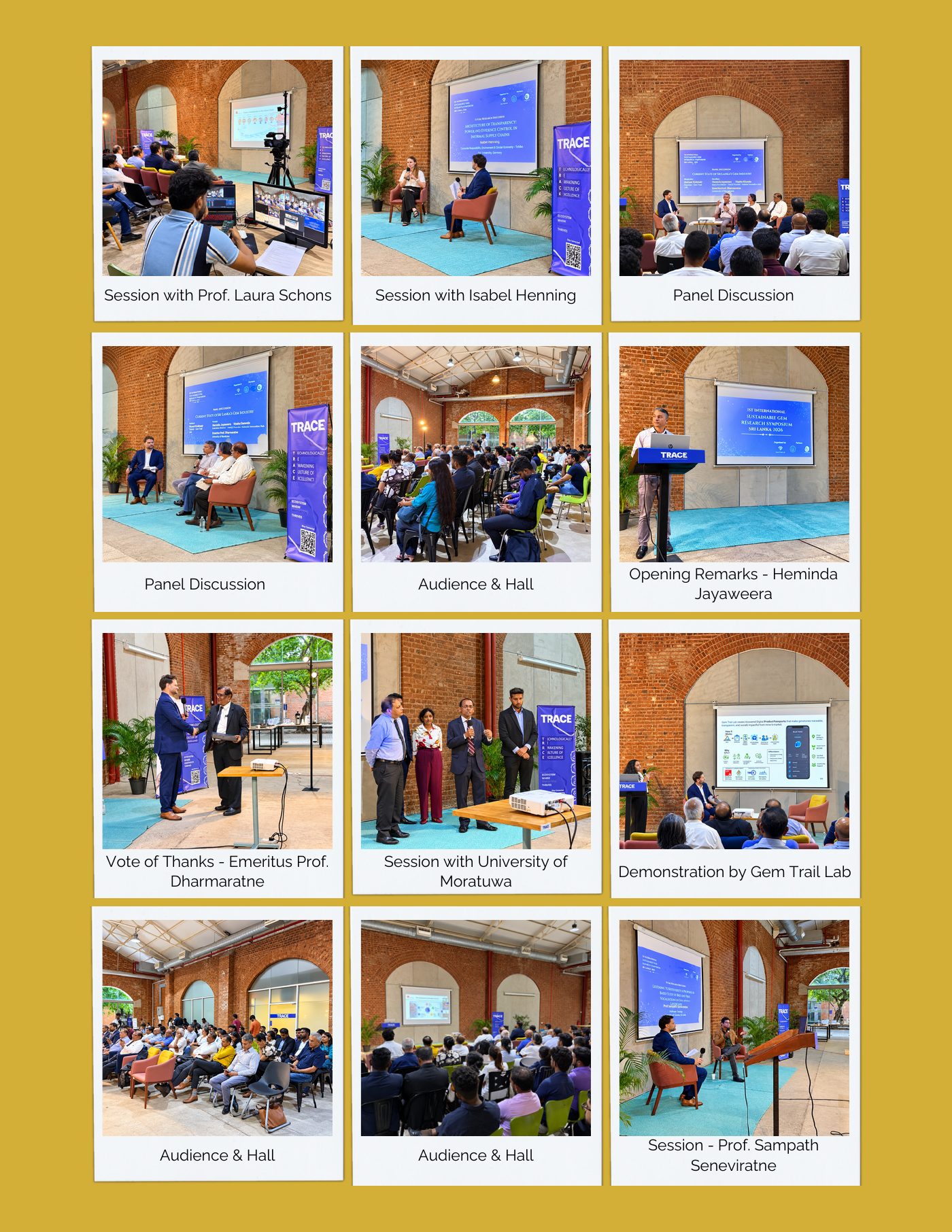
Session with Prof. Laura Schons

Session with Isabel Henning

Panel Discussion

Audience & Hall

Opening Remarks - Heminda
Jayaweera

Vote of Thanks - Emeritus Prof.
Dharmaratne

Session with University of
Moratuwa

Demonstration by Gem Trail Lab

Audience & Hall

Audience & Hall

Session - Prof. Sampath
Seneviratne

Panel Discussion
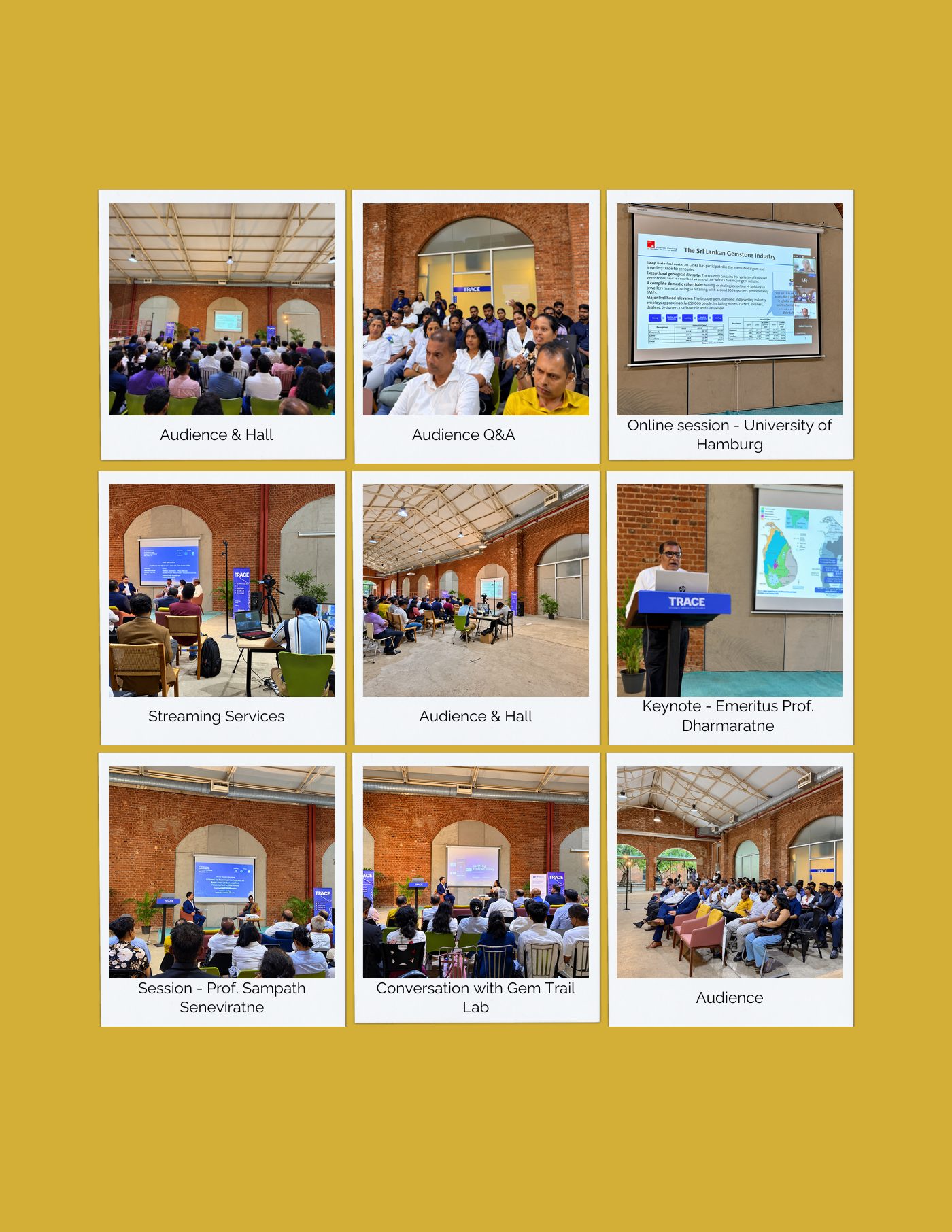
Audience & Hall

Audience Q&A

Online session - University of
Hamburg

Streaming Services

Audience & Hall

Keynote - Emeritus Prof.
Dharmaratne

Session - Prof. Sampath
Seneviratne

Conversation with Gem Trail
Lab

Audience
Beyond the gemstone lies a story of
science, people, nature and opportunity.
Understanding that story is where a more
sustainable gemstone industry begins.

Symposium Partners

Gem Trail Lab |

🌐 www.gemtraillab.org | ✉️ partnerships@gemtraillab.org
Cite this publication
Manuel Kreitmeir, Vandana Hettiaratchi (2026). 1st International Sustainable Gem Research Symposium Sri Lanka 2026 — Symposium Publication. Research Report. Gemstone Sustainability.org.
- Published
- 22 September 2026
- Type
- Research Report
- Institution
- Gem Trail Lab
- DOI
- Pending