Academic Article · Gender & Inclusion · Published
Gender inclusivity in artisanal and small-scale tanzanite mining in Mererani Demarcated Area, Tanzania, Africa: A future perspective
University of Dodoma · DOI: 10.29396/jgsb.2025.v8.n3.1
Journal of the Geological Survey of Brazil vol 8, n 3, 177–189, December 2025 · Online pub. 21 August 2025
Creative Commons Attribution 4.0 InternationalAbstract
This study examines the impact of Tanzania’s 2017 regulatory and institutional reforms on artisanal and small-scale mining (ASM) operations, with a focus on women’s participation in the tanzanite production value chain. Using a longitudinal research design and descriptive analysis of secondary data from the resident mine office, the study highlights significant growth in ASM activities in the Mererani area. In 2023, the ASM operators and other actors in the study area totalled 45,385 people, with men comprising 35,095 (77.33%) and women comprising 10,290 (22.67%). This indicates a substantial increase from the 4,210 people [3,231 (76.7%) men, and 979 (23.3%) women] recorded in 2018. Notably, the number of women holding mining licenses grew from 10 to 100, while female mine workers increased from 100 to 600 during the same period. Despite these advancements, men continue to dominate license-holding, although the gender gap has narrowed, indicating progress toward gender inclusion. The study also reveals a gradual expansion in tanzanite trading, with a rising number of license holders between 2018 and 2023. To further enhance women’s involvement, the paper advocates for a multifaceted approach, including targeted financial and technical support, establishment of cooperative unions, capacity building in value addition, and the creation of a more conducive operational environment. These measures are crucial for promoting equitable and inclusive economic growth in the Mererani area. The findings underscore the importance of sustained efforts to support ASM operations and promote gender equality in Tanzania’s tanzanite mining sub-sector, which remains a vital contributor to the national economy.
- Gender
- Artisanal mining
- Small-scale mining
- Tanzanite production value chain
- Mererani
- Tanzania
Publication reader · AI
Ask this publication
Abstract
Article Information
This work is licensed under a  Creative Commons Attribution 4.0 Internacional License.
Journal of the Geological Survey of Brazil vol 8, n 3 , 177-189, December 2025
This study examines the impact of Tanzania’s 2017 regulatory and institutional reforms on artisanal and
small-scale mining (ASM) operations, with a focus on women’s participation in the tanzanite production
value chain. Using a longitudinal research design and descriptive analysis of secondary data from the
resident mine office, the study highlights significant growth in ASM activities in the Mererani area. In
2023, the ASM operators and other actors in the study area totalled 45,385 people, with men compri -
sing 35,095 (77.33%) and women comprising 10,290 (22.67%). This indicates a substantial increase
from the 4,210 people [3,231 (76.7%) men, and 979 (23.3%) women ] recorded in 2018. Notably, the
number of women holding mining licenses grew from 10 to 100, while female mine workers increased
from 100 to 600 during the same period. Despite these advancements, men continue to dominate
license-holding, although the gender gap has narrowed, indicating progress toward gender inclusion.
The study also reveals a gradual expansion in tanzanite trading, with a rising number of license holders
between 2018 and 2023. To further enhance women’s involvement, the paper advocates for a mul -
tifaceted approach, including targeted financial and technical support, establishment of cooperative
unions, capacity building in value addition, and the creation of a more conducive operational envi -
ronment. These measures are crucial for promoting equitable and inclusive economic growth in the
Mererani area. The findings underscore the importance of sustained efforts to support ASM operations
and promote gender equality in Tanzania’s tanzanite mining sub-sector, which remains a vital contribu -
tor to the national economy.
Gender inclusivity in artisanal and small-scale tanzanite mining in Mererani
Demarcated Area, Tanzania, Africa: A future perspective
Michael M. Msabi1
¹Department of Geology, College of Earth Sciences and Engineering, University of Dodoma, P.O. Box 11090, Dodoma, Tanzania
Publication type: Research Papers
Received 26 March 2025
Accepted 20 August 2025
Online pub. 21 August 2025
Editor : Maria José Mesquita.
Keywords:
Gender
Artisanal mining
Small-scale mining
Tanzanite production value chain
Mererani
Tanzania
*Corresponding author
Michael M. Msabi
E-mail address: mmsabi@yahoo.com
ISSN: 2595-1939
https://doi.org/10.29396/jgsb.2025.v8.n3.1
Open access at jgsb.sgb.gov.br
1. Introduction
The extractive industries, including the mining sector,
have long been recognized as male-dominated spheres with
significant gender imbalances. However, governments and
international institutions in the Global South have periodically
attempted to introduce regulatory measures and policies aimed
at advancing gender inclusivity across these industries (Lahiri-
Dutt 2018). At the global level, the adoption of the Sustainable
Development Goals (SDGs) in 2015 by the United Nations has
provided further impetus for such efforts. Specifically, SDG
5 on Gender Equality calls for achieving gender equality and
empowering all women and girls, including in the context of
economic activities such as artisanal and small-scale mining
(ASM) (Denoncourt 2022; United Nations 2015).
The ASM serves as a crucial source of livelihood and
represents one of the primary non-agricultural rural activities in
the Global South (Maconachie and Conteh 2021; Hilson 2016).
It ranges from informal to formal and can be disorganized
or well-organized mining activities carried out using basic
tools and equipment, often by individuals, families, or small
cooperatives with minimal or no mechanization, and limited
capital investment (Hilson 2002; Veiga and Hinton 2002; IGF
2017). Hilson (2002) further elaborates that ASM is typically
characterized by its labour-intensive nature, low levels of
mechanization, and reliance on basic tools and techniques for
the extraction and processing of mineral resources (Veiga et al.
2015; Hilson and Maconachie 2017). These mining operations
are often informal, operating outside the regulatory framework,
and driven by individuals or small groups seeking to supplement
their livelihoods (Hilson 2002; Veiga and Hinton 2002). The
ASM industry is noted for having a negative impact on the
socio-economic position and progress of women due to various
environmental, health, safety, and economic concerns (Arthur-
Msabi - JGSB 2025, vol 8, N°3, 177 - 189, December 2025
178
Holmes and Abrefa Busia 2021; Geenen et al. 2022; Yakovleva
et al. 2022). According to the Intergovernmental Forum on
Mining, Minerals, Metals and Sustainable Development (IGF
2017), ASM can be distinguished from large-scale commercial
mining by its decentralized and scattered nature, as well as its
low levels of capital investment and technological sophistication.
ASM activities are typically undertaken by marginalized
populations, often in remote or economically depressed regions,
and play a crucial role in providing income and employment
opportunities for these communities (Veiga and Hinton 2002;
IGF 2017). However, the literature on women miners highlights
positive economic and labour impacts, emphasizing that ASM
employment provides women with an escape from poverty
(e.g., Labonne 1996; Yakovleva, 2007; Arthur-Holmes and
Abrefa Busia 2021). Studies indicate that women can earn up
to three times higher wages by working in the mining industry
compared to other forms of rural employment (Arthur-Holmes
and Abrefa Busia 2021). However, women consistently receive
lower wages than men for performing the same tasks in the
mining sector (Buss et al. 2019; Laing and Moonsammy 2021).
Beyond providing a source of livelihood, this employment in the
mining sector has a multiplier effect within these communities,
as women often reinvest their earnings in children’s education,
farming improvements, food security, and entrepreneurial
activities (Yakovleva 2007; Weldegiorgis et al. 2018; Hilson
et al. 2018; Orleans-Boham et al. 2020; Arthur-Holmes and
Abrefa Busia 2022).
The number of individuals participating in ASM is
challenging to pinpoint due to the sector’s informal and dynamic
nature (World Bank 2019). However, various studies have
estimated that around 40 million people in the Global South
are actively involved in ASM, with an additional 150 million
relying on it indirectly for their livelihoods (IGF 2018; Hilson et
al. 2018). A most recent study has reported that an estimated
130-270 million people worldwide rely on ASM operations for
income generation, whereas, in rural sub-Saharan Africa, the
number is around 60 million (Girard et al. 2022). In Tanzania,
the ASM sector has shown continuous growth, with the number
of artisanal and small-scale miners increasing from 150,000 in
1987 to 680,385 by 2011, of whom 27.6% were women (MEM
2012). Other estimates suggest even higher figures, ranging
from 600,000 to 1.5 million people involved in ASM across the
country (Marwa and Warioba 2015).
In recent years, there has been increased focus on
women’s participation in artisanal mining, particularly in
relation to social, cultural, economic, and policy-related
aspects. In 2018, the World Bank conducted a study in the
diamond mining areas of western Central African Republic
(CAR), which revealed that while the employment and
income benefits from ASM activities mostly accrue to men,
the associated risks – including health, social, environmental,
and economic – tend to disproportionately impact women
and their families (World Bank 2018). Further, the roles
typically undertaken by women in ASM operations, such as
stone crushing, washing, panning, and transporting gravel,
are often more physically demanding compared to some of
the tasks dominated by men, who are more likely to serve as
mine owners, managers, and sellers (Macintyre 2006; Hinton
2016; IGF 2018; Reichel 2020). This highlights the gendered
nature of participation and the uneven distribution of both the
benefits and the burdens within the artisanal and small-scale
mining sector. Gender inclusivity in the context of ASM can
be defined as the active engagement and empowerment of
women and other underrepresented groups throughout the
various stages of the mining value chain (Eftimie et al. 2012;
Lahiri-Dutt 2018). According to Eftimie et al. (2012), gender
inclusivity in ASM involves ensuring that women have equal
access to and control over resources, benefits, decision-
making processes, and leadership opportunities within the
ASM sector. This includes addressing the social, cultural,
and economic barriers that have traditionally limited women’s
participation and agency in ASM activities (Lahiri-Dutt 2018).
Lahiri-Dutt (2018) further emphasizes that gender inclusivity
in ASM requires recognizing and valuing women’s roles,
knowledge, and contributions, and proactively integrating
gender perspectives into policies, programs, and institutional
frameworks governing the sector. This approach aims to
foster a more equitable and sustainable development of the
ASM industry, with benefits and opportunities distributed
more evenly among women and men. Within the ASM sector,
women often face significant barriers and disadvantages
despite their crucial roles (Bashwira et al. 2014; Rutherford
and Buss 2019).
The Tanzanian government’s past regulatory management
of the mining industry, including the Tanzanite mining
operation, is marked by the enactment of the 1998 Mining
Act, the 2009 Mining Policy, and the 2010 Mining Act, which
promoted foreign investment. Subsequently, these efforts
led to conflicts between ASM and large-scale miners due
to insufficient regulation, limited enforcement capacity, and
socio-economic pressures driving informal trade, necessitating
further governance reforms to secure the tanzanite supply
chain (Schroeder 2010; Helliesen 2012). Particularly, the 2009
Mineral Policy of Tanzania includes a section (section 6.2) on
promoting women’s participation and prohibiting child labour
in mining activities. This policy highlights the government’s
commitments through the following objective “to encourage
and promote women participation in mining activities and
strengthen enforcement of laws and regulations against child
labour in mining activities” and its statements: (i) promoting
women’s participation in mining activities; (ii) ensuring that
all programmes related to mining, including education and
training opportunities, are based on gender equality and
equity; and (iii) collaborating with stakeholders to strengthen
monitoring and enforcement of laws and regulations on child
labour in mining activities (URT 2009).
Furthermore, in 2017, the Tanzanian government
instituted a series of legal and institutional reforms within
the mining sector, including the tanzanite subsector. These
reforms, including the enactment of new laws, such as:
Natural Wealth and Resources (Permanent Sovereignty)
Act, the Natural Wealth and Resources (Revenue and Re-
Negotiation of Unconscionable Terms) Act, and the Written
Laws (Miscellaneous Amendments) Act, aimed to enhance
state control, increase revenue, and promote local content
by mandating state ownership of at least 16% in mining
operations and enabling contract renegotiations (Jacob and
Pedersen 2018; Poncian 2019). The formalization and support
of the ASM sector are critical development strategies with
the potential to enhance rural livelihoods, reduce poverty,
and promote sustainable and equitable mineral extraction
in Tanzania (Schoneveld et al. 2018; Huggins et al. 2024).
However, formalization processes in Tanzania, carry significant
risks, particularly for women, who often face exclusion due
Gender in artisanal small-scale tanzanite mining in Mererani, Tanzania
179
to limited access to licenses, capital, and technical skills, as
well as socio-cultural barriers that restrict their participation in
formalized roles (Huggins et al. 2024; Huggins and Kinyondo
2024). For instance, formalization prioritized licensed
operators, marginalizing women engaged in informal ancillary
activities like food vending or material transport, which are
vital to ASM economies but often undervalued (Huggins et
al. 2024). In Mererani, the Government of Tanzania’s 2019
Mining (Mirerani Controlled Area) Regulations introduced
a walled trading area with formal contract requirements
to curb smuggling and enhance traceability, but these
measures inadvertently excluded many women miners due
to financial and administrative barriers, compounded by initial
security practices like strip-searching that disproportionately
affected them (URT 2019; Huggins and Kinyondo 2024). To
address ASM-specific challenges, the government increased
consultations with ASM organizations, fostering greater
stakeholder inclusion to counter past criticisms of top-down
policies, and invested in training centers and regional mineral
demonstration and trading hubs for gold ASM, to improve skills,
reduce smuggling, and enhance market access (Schoneveld
et al. 2018; Jacob and Pedersen 2018). This reform process
culminated in the introduction of new regulations, specifically
the Mining (Mererani Controlled Area) Regulations of 2019,
which were tailored to establish and govern the Mererani
demarcated area. This notable regulatory reform was intended
to curb the rampant smuggling of tanzanite by introducing a
trading market within the wall, while also increasing government
revenue generation from the trade of this precious gemstone.
The smuggling of tanzanite out of Tanzania, particularly
to Kenya, has been a persistent challenge in the Mererani
mining sector, driven by the gemstone’s high value and
global demand. The 2001 Wall Street Journal article alleged
that tanzanite was being used to fund terrorist activities,
highlighting extensive smuggling networks that undermined
Tanzania’s economy and tarnished the gem’s reputation
(Schroeder 2010). These illicit activities were facilitated by the
porous border with Kenya and weak regulatory oversight, with
tanzanite often mis- or under-declared or traded informally to
evade taxes (Helliesen 2012; Donahue 2018). To address this,
the Tanzanian government’s 2019 Mining (Mirerani Controlled
Area) Regulations established a walled area with a single-
entry point for all individuals holding valid access cards,
military and other security oversight, and a tanzanite trading
market within a controlled environment to preserve its locality,
rarity, value, authenticity, and enhance traceability and curb
smuggling (URT 2019; Huggins and Kinyondo 2019). Other
support services within the wall include the tanzanite market,
financial institutions, and relevant government agencies. This
regulatory framework was designed to enhance the traceability
and transparency of the tanzanite supply chain. Despite
several initiatives and interventions by the government, women
still face economic and socio-cultural barriers that restrict their
effective involvement in mining activities and, hence, receive
minimal benefits. These barriers include critical inaccessibility
of capital and finances for mining operations from mainstream
financial facilities, lack of appropriate managerial and
technical skills, machinery and technology, and lack of
access to geological information on the availability of gems
(Schoneveld et al. 2018; Huggins and Kinyondo 2019; Huggins
and Kinyondo 2024). These challenges highlight the need for
gender-inclusive formalization strategies, such as accessible
licensing, targeted financing, and training programs, to ensure
women benefit equitably from Mererani’s tanzanite ASM value
chain (Schroeder 2010; Huggins and Kinyondo 2019).
The significance of ASM extends beyond just employment,
as the revenues generated from these activities play a crucial
role in supporting households’ essential expenses, such
as school fees, medical costs, and support to subsistence
agriculture, providing a pathway for wealth creation (Verbrugge
2016; Hilson et al. 2018). Consequently, the formalization
and support of the ASM sector have been identified as key
development challenges, with the potential to boost rural
livelihoods, reduce poverty, and promote more sustainable and
equitable mineral extraction (Perks 2016). Despite the mining
legal and institutional reforms in 2017 and capacity-building
initiatives such as the Sustainable Management of Mineral
Resources Project, ASM is still struggling and is not inclusive
in terms of gender (URT 2018). Hilson and McQuilken (2014)
and Hilson et al. (2017) reported several initiatives aimed at
improving ASM operations in Sub-Saharan Africa, but the
sub-sector has not produced the intended outcomes.
In the context of tanzanite production in Tanzania, a rare
and valuable gemstone found only in the country, specifically
in the Mererani area of Simanjiro District, the Mererani area
is within the western limb of the Lelatema Antiform (Wilson et
al. 2009; Harris et al. 2014) and is the only known deposit of
gem-quality tanzanite in the world (Malisa 1998; 2003). The
Lelatema Antiform belongs to the fault-bounded granulite-
gneiss complexes of the Pan-African Mozambique Belt in
Tanzania (Muhongo and Lenoir 1994). The tanzanite mining
site is divided into five blocks: Tanzanite One undertakes
larger mining in Block C; medium-scale mining is undertaken
by Kilimanjaro Mining in Block A, and Tanzanite Africa in Block
D-extension. The neighbouring Blocks B and D are mined by
artisanal and small-scale miners. The tanzanite ASM activities
have historically been dominated by men, with women
often relegated to peripheral roles or excluded altogether.
Addressing gender inclusivity in the tanzanite production
value chain, therefore, is an important consideration to ensure
that women are equally represented, empowered, and able to
benefit from the various activities and processes involved in
the chain. In the context of this study, the tanzanite production
value chain encompasses the following major activities:
mining (extraction and sorting); trading and brokerage (local
tanzanite traders and brokers, tanzanite trading centers and
stations); beneficiation and value addition (cutting, polishing,
and jewelry making); ancillary economic activities (food and
catering businesses, hawking and vending, transportation
services, equipment rental and maintenance, and other
small-scale enterprises supporting the ASM operations); and
supportive services (mining equipment and tool suppliers,
financial services (e.g., micro-lending, mobile money),
technical assistance and training providers, and health and
safety services).
This study aims to explore the gender gaps in the tanzanite
ASM production value chain and propose strategies to enhance
their participation and targeted empowerment. Reliable,
sex-differentiated information on participation and trends
in the tanzanite ASM sector is crucial for informing policies,
programs, and investments aimed at promoting gender equity
and women’s empowerment. These evidence-based findings
will enable effective decision-making processes to address
gender inclusion in the production value chain.
Msabi - JGSB 2025, vol 8, N°3, 177 - 189, December 2025
180
2. Geological overview
2.1. Regional Geological Setting
The wealth of Tanzanian gemstones, including tanzanite,
is controlled by the presence of various rock types formed over
geological time. The tanzanite host rocks are Neoproterozoic
in age (Malisa 2003) and form part of the Neoproterozoic
Mozambique Mobile/Metamorphic Belt (NMMB) or Pan-
African Mozambique belt of East Africa (Stern 1994; Giuliani
et al. 2014; Thomas et al. 2014; Leger et al. 2015). This belt
extends southwards from the Arabian-Nubian Shield into
southern Ethiopia, Kenya and Somalia through Tanzania
to Malawi and Mozambique, including Madagascar and the
Antarctica continent (Kröner and Stern 2005). This belt evolved
from two distinct events: the Mozambique cycle (1100 to 850
Ma) and the Pan-African cycle (800 to 550 Ma), resulting in the
formation of high-grade granulites, gneisses, and migmatitic
lithologies due to deformation and metamorphism. These
events resulted in the formation of high-grade granulites,
gneisses and migmatitic lithologies due to deformation and
metamorphism (Kröner and Stern 2005; Thomas et al. 2013).
Geologically, particularly in Tanzania, this belt is commonly
dominated by granulite and amphibolite metamorphic facies
rock units comprising quartz-feldspar-garnet-sillimanite-
graphite schists, quartzites, marbles, and calc-gneisses,
which were formed during the Neoproterozoic Pan - African
event (Kröner and Stern 2005).
2.2. Tanzanite Geological Setting
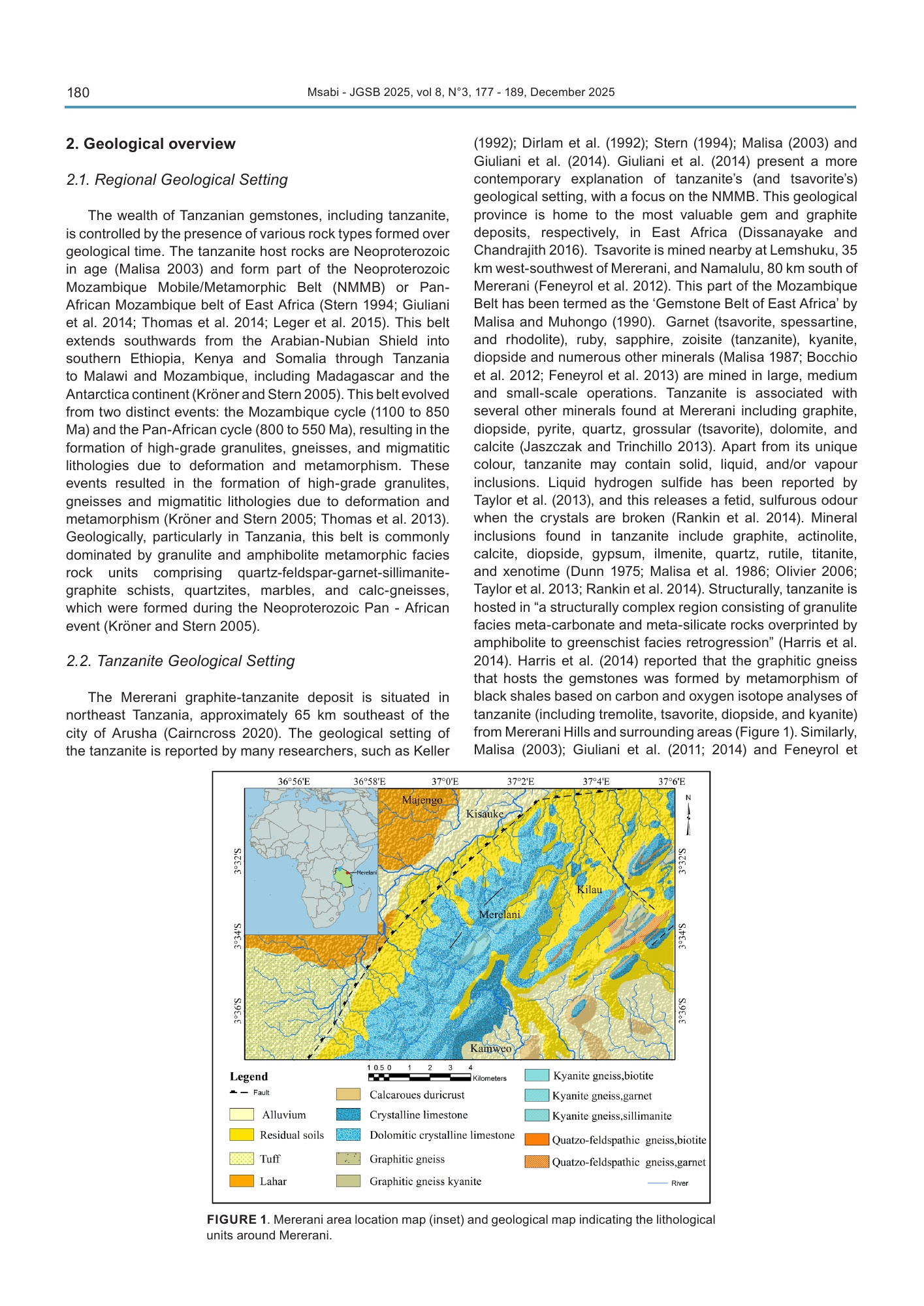
The Mererani graphite-tanzanite deposit is situated in
northeast Tanzania, approximately 65 km southeast of the
city of Arusha (Cairncross 2020). The geological setting of
the tanzanite is reported by many researchers, such as Keller
(1992); Dirlam et al. (1992); Stern (1994); Malisa (2003) and
Giuliani et al. (2014). Giuliani et al. (2014) present a more
contemporary explanation of tanzanite’s (and tsavorite’s)
geological setting, with a focus on the NMMB. This geological
province is home to the most valuable gem and graphite
deposits, respectively, in East Africa (Dissanayake and
Chandrajith 2016).  Tsavorite is mined nearby at Lemshuku, 35
km west-southwest of Mererani, and Namalulu, 80 km south of
Mererani (Feneyrol et al. 2012). This part of the Mozambique
Belt has been termed as the ‘Gemstone Belt of East Africa’ by
Malisa and Muhongo (1990).  Garnet (tsavorite, spessartine,
and rhodolite), ruby, sapphire, zoisite (tanzanite), kyanite,
diopside and numerous other minerals (Malisa 1987; Bocchio
et al. 2012; Feneyrol et al. 2013) are mined in large, medium
and small-scale operations. Tanzanite is associated with
several other minerals found at Mererani including graphite,
diopside, pyrite, quartz, grossular (tsavorite), dolomite, and
calcite (Jaszczak and Trinchillo 2013). Apart from its unique
colour, tanzanite may contain solid, liquid, and/or vapour
inclusions. Liquid hydrogen sulfide has been reported by
Taylor et al. (2013), and this releases a fetid, sulfurous odour
when the crystals are broken (Rankin et al. 2014). Mineral
inclusions found in tanzanite include graphite, actinolite,
calcite, diopside, gypsum, ilmenite, quartz, rutile, titanite,
and xenotime (Dunn 1975; Malisa et al. 1986; Olivier 2006;
Taylor et al. 2013; Rankin et al. 2014). Structurally, tanzanite is
hosted in “a structurally complex region consisting of granulite
facies meta-carbonate and meta-silicate rocks overprinted by
amphibolite to greenschist facies retrogression” (Harris et al.
2014). Harris et al. (2014) reported that the graphitic gneiss
that hosts the gemstones was formed by metamorphism of
black shales based on carbon and oxygen isotope analyses of
tanzanite (including tremolite, tsavorite, diopside, and kyanite)
from Mererani Hills and surrounding areas (Figure 1). Similarly,
Malisa (2003); Giuliani et al. (2011; 2014) and Feneyrol et
FIGURE 1. Mererani ar ea location map (inset) and geological map indicating the lithological
units around Mererani.
Gender in artisanal small-scale tanzanite mining in Mererani, Tanzania
181
al. (2017), have the same conclusion. Further, the study
by Francis (2017) summarized the geological occurrence,
associated minerals, and crystal forms of tanzanite.
3. Materials and Methods
3.1. Data Collection
This study employed a longitudinal research design with
quantitative approach to comprehensively assess the impact
of the 2017 legal and institutional reforms on the participation
of women and men in the ASM tanzanite mining operations
in the Mererani demarcated area. The secondary data from
the Resident Mine Office (RMO) covering the period from
2018 to 2023 were utilized to analyze gender dynamics in
Mererani’s tanzanite ASM value chain, specifically focusing
on participation trends post-2019 Mining (Mirerani Controlled
Area) Regulations, which established a walled area with a
single-access point. Pre-2018 data were excluded due to
inconsistent reporting, as the area’s porous nature prior to the
regulations allowed miners and operators to access the site
without oversight or restrictions. This lack of regulation made
it difficult to accurately track and document participation,
resulting in a significant gap in reliable data for understanding
the dynamics of the mining community. The present RMO’s
data capture and report accurate ASM operators in the
Mererani area. The study focused on the ASM operations in
blocks B and D to establish the number of people involved and
the nature of their activities and roles played in the Tanzanite
production value chain. During this study’s period in 2023, the
Mererani ASM demarcated area had a total of 45,385 people
(Men: 35,095; Women: 10,290) working in ASM’s various
operations in the Tanzanite production value chain.
3.2.Data Analysis
This study employed a robust analytical approach to
examine the longitudinal trends in the gender dynamics of
the Mererani artisanal and small-scale tanzanite mining
operations. The secondary source data were descriptively
analyzed to identify trends of persons involved in Mererani
tanzanite ASM operations, by their gender distribution,
between 2018 and 2023. Through descriptive statistics, this
study disaggregated figures for men and women involved in
the ASM activities. This provides a baseline understanding of
the gender distribution within the sector after reforms. Further,
the analysis focused on the involvement of men and women in
several aspects of the tanzanite production value chain, such
as mining license holders, mine workers, investors, tanzanite
traders, and ancillary economic services by quantifying the
percentage changes in the number and proportion of female
and male in all activities. The findings are provided in graphs
and tables to show the patterns and changes in gender
composition and involvement in the Mererani tanzanite ASM
industry over the last six years.
4. Results
4.1. ASM population distribution in Mererani Demarca-
ted Area
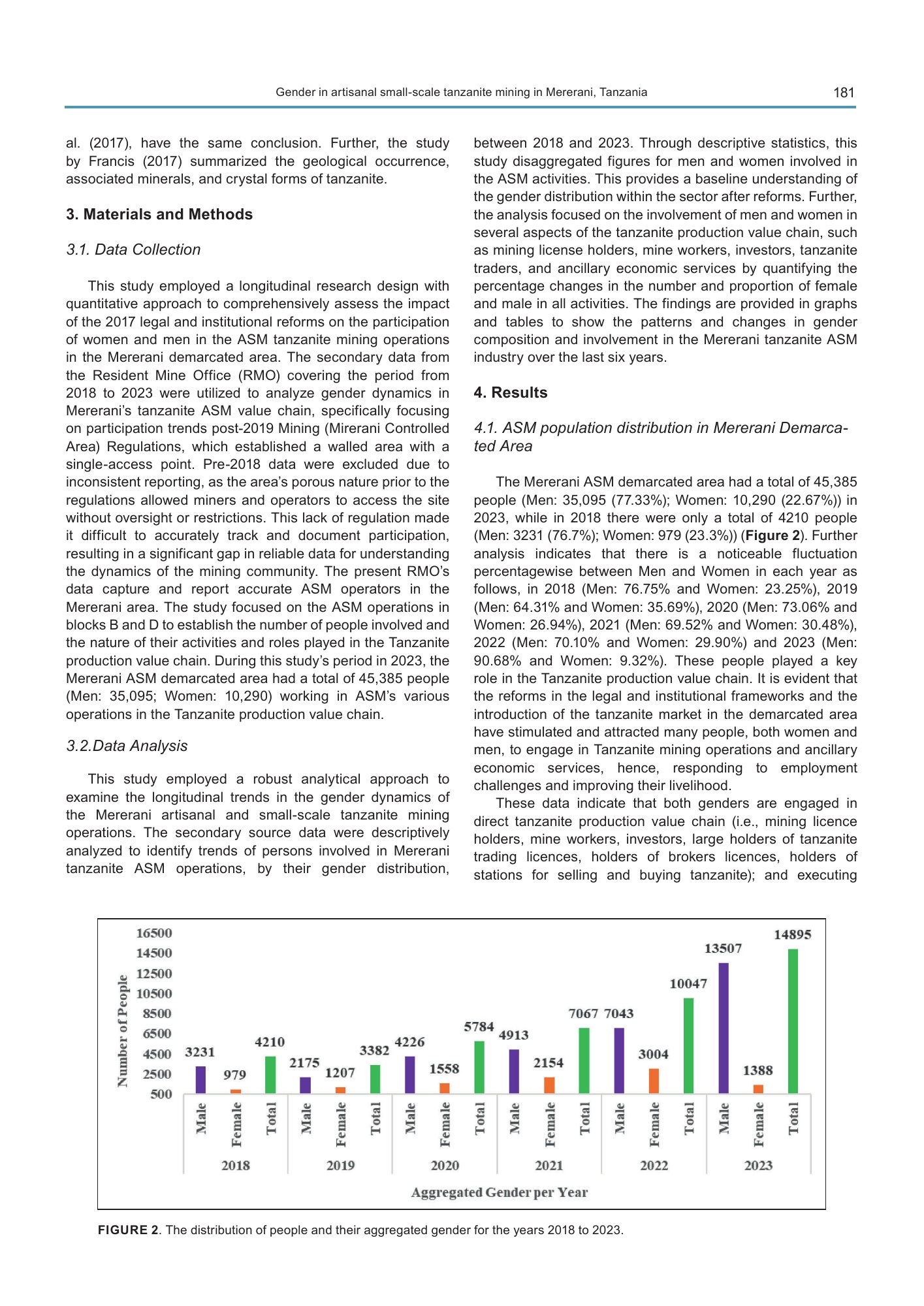
The Mererani ASM demarcated area had a total of 45,385
people (Men: 35,095 (77.33%); Women: 10,290 (22.67%)) in
2023, while in 2018 there were only a total of 4210 people
(Men: 3231 (76.7%); Women: 979 (23.3%)) (Figure 2). Further
analysis indicates that there is a noticeable fluctuation
percentagewise between Men and Women in each year as
follows, in 2018 (Men: 76.75% and Women: 23.25%), 2019
(Men: 64.31% and Women: 35.69%), 2020 (Men: 73.06% and
Women: 26.94%), 2021 (Men: 69.52% and Women: 30.48%),
2022 (Men: 70.10% and Women: 29.90%) and 2023 (Men:
90.68% and Women: 9.32%). These people played a key
role in the Tanzanite production value chain. It is evident that
the reforms in the legal and institutional frameworks and the
introduction of the tanzanite market in the demarcated area
have stimulated and attracted many people, both women and
men, to engage in Tanzanite mining operations and ancillary
economic services, hence, responding to employment
challenges and improving their livelihood.
These data indicate that both genders are engaged in
direct tanzanite production value chain (i.e., mining licence
holders, mine workers, investors, large holders of tanzanite
trading licences, holders of brokers licences, holders of
stations for selling and buying tanzanite); and executing
FIGURE  2. The distribution of people and their aggregated gender for the years 2018 to 2023.
Msabi - JGSB 2025, vol 8, N°3, 177 - 189, December 2025
182
ancillary economic services (i.e., clothes and mixed items
shops, food businesses – Mama and Baba Lishe, pharmacy,
motorcyclists – boda boda and Hawkers – Machinga).
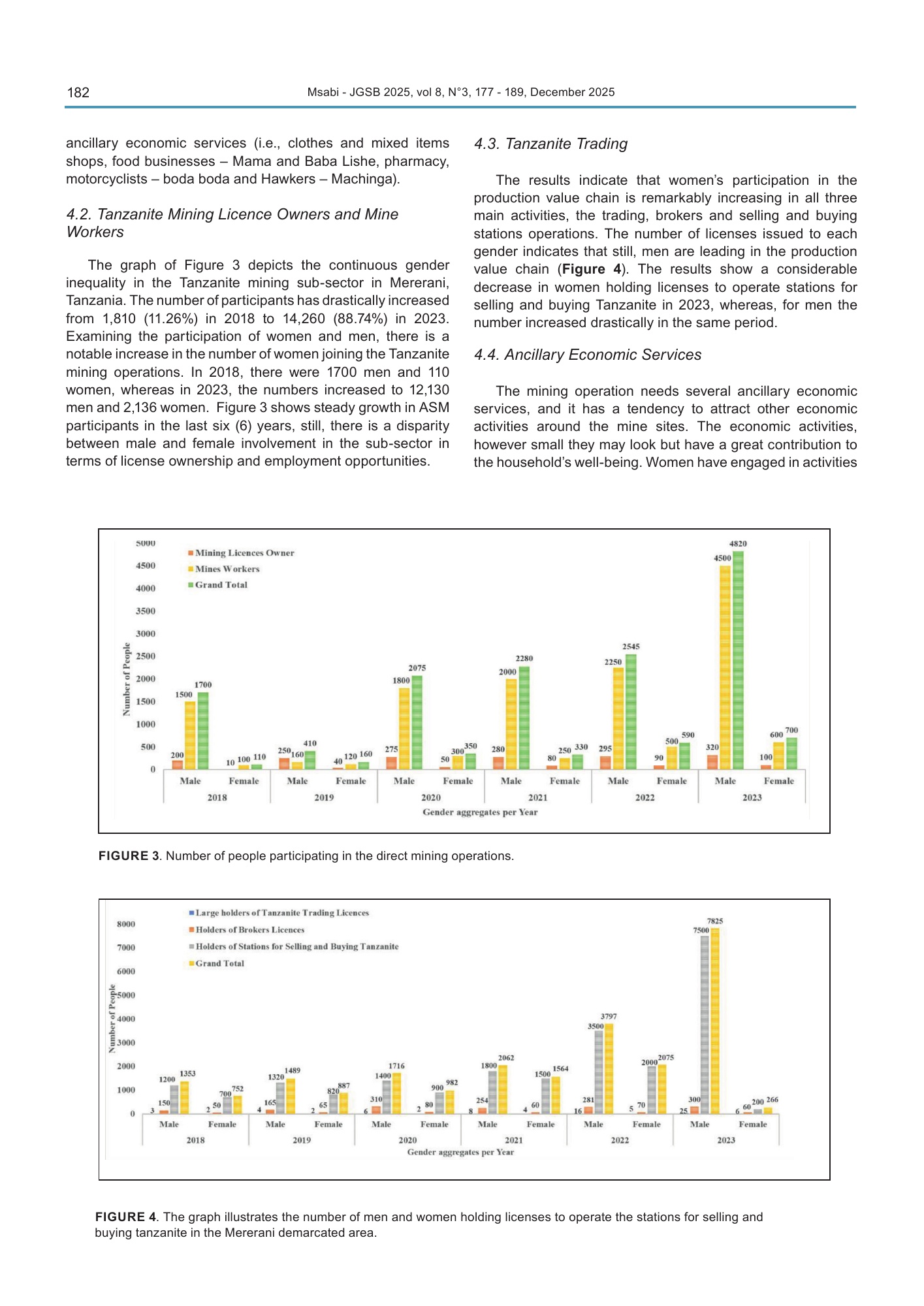
4.2. Tanzanite Mining Licence Owners and Mine
Workers
The graph of Figure 3 depicts the continuous gender
inequality in the Tanzanite mining sub-sector in Mererani,
Tanzania. The number of participants has drastically increased
from 1,810 (11.26%) in 2018 to 14,260 (88.74%) in 2023.
Examining the participation of women and men, there is a
notable increase in the number of women joining the Tanzanite
mining operations. In 2018, there were 1700 men and 110
women, whereas in 2023, the numbers increased to 12,130
men and 2,136 women.  Figure 3 shows steady growth in ASM
participants in the last six (6) years, still, there is a disparity
between male and female involvement in the sub-sector in
terms of license ownership and employment opportunities.
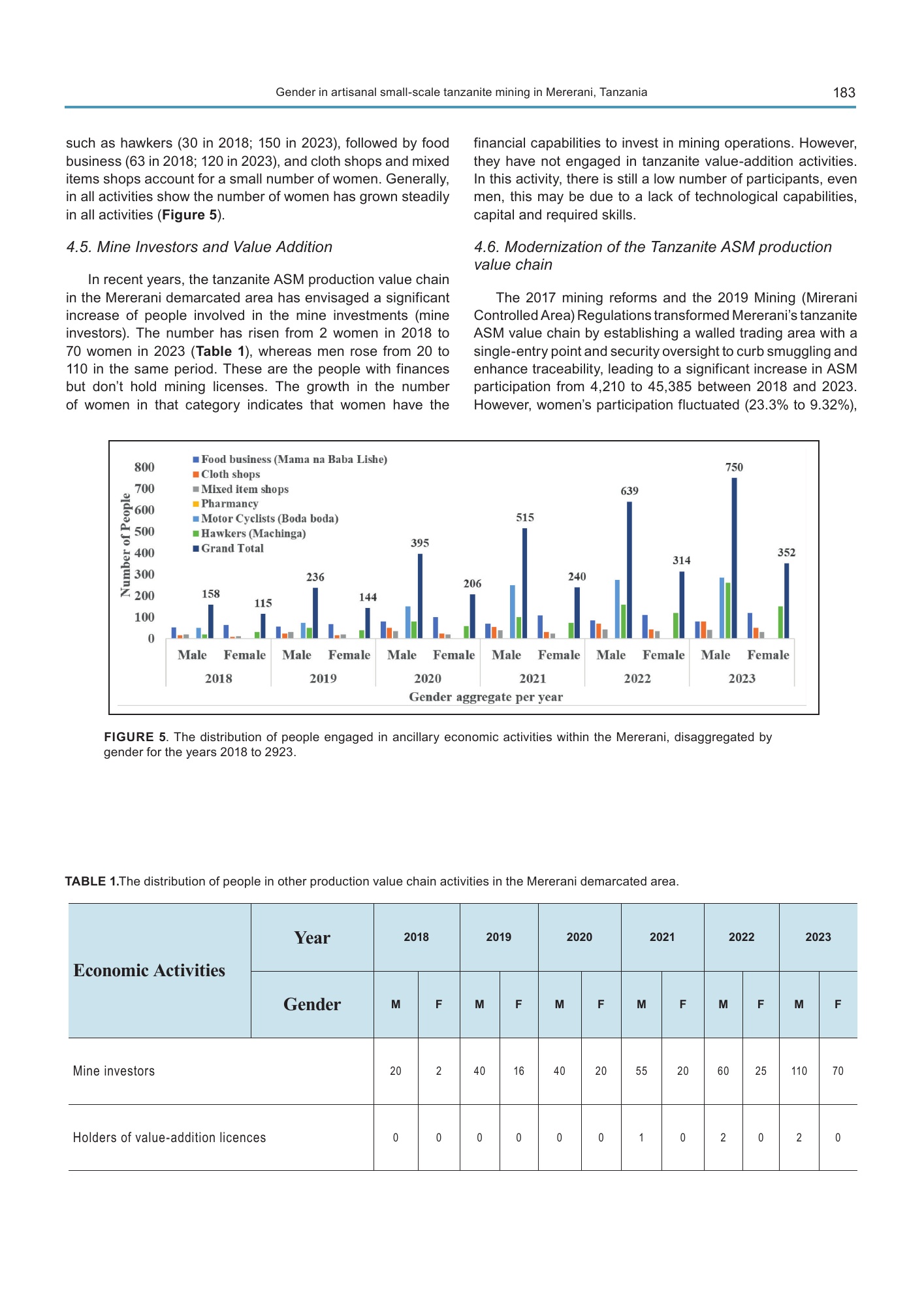
4.3. Tanzanite Trading
The results indicate that women’s participation in the
production value chain is remarkably increasing in all three
main activities, the trading, brokers and selling and buying
stations operations. The number of licenses issued to each
gender indicates that still, men are leading in the production
value chain ( Figure 4 ). The results show a considerable
decrease in women holding licenses to operate stations for
selling and buying Tanzanite in 2023, whereas, for men the
number increased drastically in the same period.
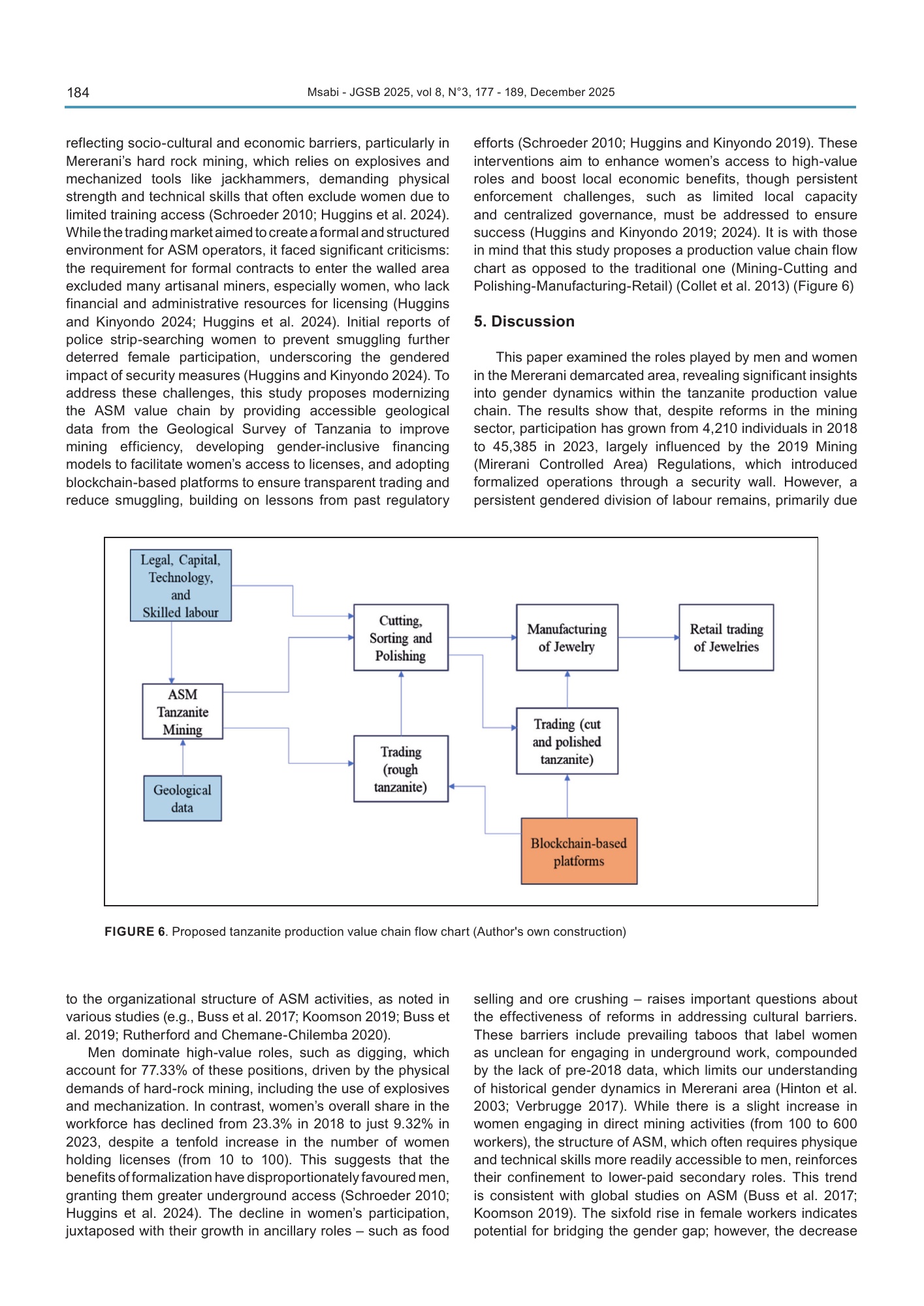
4.4. Ancillary Economic Services
The mining operation needs several ancillary economic
services, and it has a tendency to attract other economic
activities around the mine sites. The economic activities,
however small they may look but have a great contribution to
the household’s well-being. Women have engaged in activities
FIGURE  3. Number of people participating in the direct mining operations.
FIGURE  4. The graph illustrates the number of men and women holding licenses to operate the stations for selling and
buying tanzanite in the Mererani demarcated area.
Gender in artisanal small-scale tanzanite mining in Mererani, Tanzania
183
such as hawkers (30 in 2018; 150 in 2023), followed by food
business (63 in 2018; 120 in 2023), and cloth shops and mixed
items shops account for a small number of women. Generally,
in all activities show the number of women has grown steadily
in all activities (Figure 5).
4.5. Mine Investors and Value Addition
In recent years, the tanzanite ASM production value chain
in the Mererani demarcated area has envisaged a significant
increase of people involved in the mine investments (mine
investors). The number has risen from 2 women in 2018 to
70 women in 2023 ( Table 1), whereas men rose from 20 to
110 in the same period. These are the people with finances
but don’t hold mining licenses. The growth in the number
of women in that category indicates that women have the
financial capabilities to invest in mining operations. However,
they have not engaged in tanzanite value-addition activities.
In this activity, there is still a low number of participants, even
men, this may be due to a lack of technological capabilities,
capital and required skills.
4.6. Modernization of the Tanzanite ASM production
value chain
The 2017 mining reforms and the 2019 Mining (Mirerani
Controlled Area) Regulations transformed Mererani’s tanzanite
ASM value chain by establishing a walled trading area with a
single-entry point and security oversight to curb smuggling and
enhance traceability, leading to a significant increase in ASM
participation from 4,210 to 45,385 between 2018 and 2023.
However, women’s participation fluctuated (23.3% to 9.32%),
FIGURE  5. The distribution of people engaged in ancillary economic activities within the Mererani, disaggregated by
gender for the years 2018 to 2923.
TABLE 1.The distribution of people in other production value chain activities in the Mererani demarcated area.
Economic Activities
Year 2018 2019 2020 2021 2022 2023
Gender M F M F M F M F M F M F
Mine investors 20 2 40 16 40 20 55 20 60 25 110 70
Holders of value-addition licences 0 0 0 0 0 0 1 0 2 0 2 0
Msabi - JGSB 2025, vol 8, N°3, 177 - 189, December 2025
184
reflecting socio-cultural and economic barriers, particularly in
Mererani’s hard rock mining, which relies on explosives and
mechanized tools like jackhammers, demanding physical
strength and technical skills that often exclude women due to
limited training access (Schroeder 2010; Huggins et al. 2024).
While the trading market aimed to create a formal and structured
environment for ASM operators, it faced significant criticisms:
the requirement for formal contracts to enter the walled area
excluded many artisanal miners, especially women, who lack
financial and administrative resources for licensing (Huggins
and Kinyondo 2024; Huggins et al. 2024). Initial reports of
police strip-searching women to prevent smuggling further
deterred female participation, underscoring the gendered
impact of security measures (Huggins and Kinyondo 2024). To
address these challenges, this study proposes modernizing
the ASM value chain by providing accessible geological
data from the Geological Survey of Tanzania to improve
mining efficiency, developing gender-inclusive financing
models to facilitate women’s access to licenses, and adopting
blockchain-based platforms to ensure transparent trading and
reduce smuggling, building on lessons from past regulatory
efforts (Schroeder 2010; Huggins and Kinyondo 2019). These
interventions aim to enhance women’s access to high-value
roles and boost local economic benefits, though persistent
enforcement challenges, such as limited local capacity
and centralized governance, must be addressed to ensure
success (Huggins and Kinyondo 2019; 2024). It is with those
in mind that this study proposes a production value chain flow
chart as opposed to the traditional one (Mining-Cutting and
Polishing-Manufacturing-Retail) (Collet et al. 2013) (Figure 6)
5. Discussion
This paper examined the roles played by men and women
in the Mererani demarcated area, revealing significant insights
into gender dynamics within the tanzanite production value
chain. The results show that, despite reforms in the mining
sector, participation has grown from 4,210 individuals in 2018
to 45,385 in 2023, largely influenced by the 2019 Mining
(Mirerani Controlled Area) Regulations, which introduced
formalized operations through a security wall. However, a
persistent gendered division of labour remains, primarily due
FIGURE  6. Proposed tanzanite production value chain flow chart (Author's own construction)
to the organizational structure of ASM activities, as noted in
various studies (e.g., Buss et al. 2017; Koomson 2019; Buss et
al. 2019; Rutherford and Chemane-Chilemba 2020).
Men dominate high-value roles, such as digging, which
account for 77.33% of these positions, driven by the physical
demands of hard-rock mining, including the use of explosives
and mechanization. In contrast, women’s overall share in the
workforce has declined from 23.3% in 2018 to just 9.32% in
2023, despite a tenfold increase in the number of women
holding licenses (from 10 to 100). This suggests that the
benefits of formalization have disproportionately favoured men,
granting them greater underground access (Schroeder 2010;
Huggins et al. 2024). The decline in women’s participation,
juxtaposed with their growth in ancillary roles – such as food
selling and ore crushing – raises important questions about
the effectiveness of reforms in addressing cultural barriers.
These barriers include prevailing taboos that label women
as unclean for engaging in underground work, compounded
by the lack of pre-2018 data, which limits our understanding
of historical gender dynamics in Mererani area (Hinton et al.
2003; Verbrugge 2017). While there is a slight increase in
women engaging in direct mining activities (from 100 to 600
workers), the structure of ASM, which often requires physique
and technical skills more readily accessible to men, reinforces
their confinement to lower-paid secondary roles. This trend
is consistent with global studies on ASM (Buss et al. 2017;
Koomson 2019). The sixfold rise in female workers indicates
potential for bridging the gender gap; however, the decrease
Gender in artisanal small-scale tanzanite mining in Mererani, Tanzania
185
in their overall share highlights unintended consequences of
the securitization measures, such as restricted mobility due to
the wall’s single-entry point, which disproportionately affects
women involved in ancillary activities (Huggins and Kinyondo
2024). Comparing Mererani to the national ASM average,
where women represent 27.60% (Mutagwaba et al. 2018),
underscores the need for targeted interventions to enhance
women’s participation in the tanzanite production value
chain. The current reliance on Resident Mine Office (RMO)
data post-2018 also constrains the longitudinal analysis,
potentially underrepresenting informal participation before the
establishment of the wall.
To effectively close the gender gap, initiatives focused
on attracting more women to the tanzanite value chain are
essential. Women, who often engage in labour-intensive
roles such as gem sorting, stone crushing, and transporting
materials, could greatly benefit from targeted training in
advanced technologies like computer-aided design (CAD) and
automated grading systems powered by artificial intelligence
(Chow and Reyes-Aldasoro 2022). These technologies
could alleviate physical demands and enhance precision
in tasks traditionally performed by women, enabling their
transition into higher-value roles such as gemstone cutting
and quality assessment. Furthermore, the implementation of
blockchain-based traceability platforms (Cartier et al. 2018)
could empower women traders and brokers by ensuring
transparent market access and fair compensation, thereby
reducing exploitation within the supply chain. By equipping
women with the necessary skills through accessible training
programs, barriers related to limited technical knowledge
and market exclusion can be effectively addressed (Eftimie
et al. 2012; Lahiri-Dutt 2018). This approach aligns with the
goals of Tanzania’s 2009 Mineral Policy, which advocates
for gender equity in mining. The government’s mining policy
also promotes the value addition of tanzanite within the
country, presenting an opportunity for women to enhance
their livelihoods. Research by Collet et al. (2013) indicates that
local gem cutting retains revenue within country, as this stage
in the value chain yields the highest income. Nevertheless,
successful value addition necessitates a skilled workforce
proficient in jewelry design, manufacturing, business
management, and modern technologies (Wannarumon 2011;
Collet et al. 2013; Hsu et al. 2014).
Another critical intervention involves the establishment
and strengthening of women-led cooperatives within the
tanzanite ASM sector. Some cooperatives and associations
are playing various roles in mineral and gemstones including
tanzanite such as policy advocacy (Tanzania Mineral Dealer’s
Association – TAMIDA, Tanzania Women Miners Association
– TAWOMA, Tanzanite Women Miners Development Union
– TWMDU), self-help financial activities (Manyara Women
Mining Network) and dispute resolution (Manyara Region
Mining Association – MAREMA) (Denoncourt 2022; Huggins et
al. 2024). Addressing the financial challenges faced by women
miners, such as the need for modern tools and equipment, is
vital for their engagement in mining operations (Spiegel 2012).
Furthermore, the targeted training in advanced technologies
can facilitate women’s transition into higher-value roles, while
blockchain traceability can improve fair compensation for
women traders. Women-led cooperatives can help overcome
financial barriers and combat cultural taboos, thereby
enhancing women’s representation and empowerment in
the tanzanite value chain. The potential for value addition,
in line with the government’s export goals, underscores
the importance of skill development in jewelry design and
manufacturing, although current low female technical capacity
remains a significant challenge (Collet et al. 2013).
6. Conclusion
This study’s findings present a complex and nuanced
picture of gender dynamics in the artisanal and small-scale
mining (ASM) of tanzanite in the Mererani demarcated area.
While the participation of men has steadily increased, the
engagement of women has fluctuated, with their overall
share declining from 23.3% in 2018 to just 9.32% in 2023.
This trend is particularly concerning, given that the number
of women holding mining licenses and other formal roles
has grown slowly, compared to men, even as they expand
their involvement in ancillary economic activities. To
address these challenges and unlock the full potential of the
tanzanite ASM sector, a multifaceted approach is required.
Policymakers and stakeholders must prioritize gender-
centred reforms, strengthening regulatory frameworks and
support mechanisms to enhance women’s participation and
empowerment. Capacity-building initiatives, improved access
to finance, and the integration of emerging technologies can
further catalyse the advancement of women in the tanzanite
production value chain. By leveraging the value addition
potential of tanzanite through innovative technologies, the
local communities in Mererani can benefit from increased
employment opportunities, improved mining practices, and
fairer trade. This, in turn, will contribute to more sustainable
and equitable community development, as well as broader
socioeconomic growth and gender equity in Tanzania.
6.1. Recommendations
Future research should investigate gendered barriers
faced by women in navigating the tanzanite ASM ecosystem,
exploring innovative solutions that foster inclusive and impactful
reforms. This study proposes a few recommendations,
including advanced gemstone cutting, polishing, enhancement,
identification, sorting, grading, and traceability technologies,
that can significantly improve women’s participation in the
tanzanite ASM value chain in Mererani, Tanzania. These
technologies are grouped in the following areas:
a. Application of advanced gemstone cutting and
polishing techniques such as:
i. Lasers are used to precisely cut and polish
gemstones, resulting in improved symmetry, proportions, and
overall appearance (Breeding et al. 2010; McClure et al. 2010).
ii. Computer-aided design (CAD) and computer-aided
manufacturing (CAM) technologies allow the creation of highly
complex and customized gemstone cuts, leading to improved
brilliance and fire (Wannarumon 2011; Awotwe 2016; Prabhu
2020; Sun 2023; Mancebo 2023).
b. Application of gemstone enhancement and treatment
techniques such as:
i. High-pressure, high-temperature (HPHT) and
irradiation and heat treatment techniques enhance the colour
of various gemstones to increase their value (Schmetzer 2010;
Song et al. 2016; Phichaikamjornwut et al. 2019; Karampelas
et al. 2020).
Msabi - JGSB 2025, vol 8, N°3, 177 - 189, December 2025
186
c. Improvement of gemstone identification, sorting and
grading can be done through techniques such as:
i. Advanced spectroscopy techniques like Raman
spectroscopy, UV-Vis-NIR spectroscopy, and X-ray diffraction
are used to accurately identify and characterize gemstones
(Gaft et al. 2015).
ii. Application of automated gemstone grading systems,
especially artificial intelligence (AI)-powered systems, grade
gemstones’ cut, colour, clarity, and carat weight with high
precision, while reducing human bias and errors (Chow and
Reyes-Aldasoro 2022).
d. Gemstone traceability, origin and fair trading can be
done through:
i. Blockchain-based platforms/technology is well-
developed to trace the movement, ensuring transparency (fair
trading) and authenticity of gemstones in the supply chain
(Cartier et al. 2018; Min 2019).
ii. Analyzing the isotopic composition of gemstones
such as tanzanite to determine their geographical origin
(Giuliani et al. 2000), which is important for ensuring ethical
sourcing, fair trading and in some cases preventing the trade
of conflict gemstones.
However, Tanzanite brokers, dealers and traders are
recommended to acquire the required skills and training
that will enable them to understand the negative side of the
technologies especially the ones that produce synthetic and
laboratory-grown gemstones. For example, the:
i. chemical vapour deposition (CVD) and high-pressure,
high-temperature (HPHT) techniques produce gem-quality
diamonds and other synthetic gemstones which are almost
indistinguishable from natural stones (Song et al. 2016).
ii. gemstone growth optimization technique to produce
larger, higher-quality synthetic gemstones with improved
optical and physical properties (Tripathi and Barua 2019).
Acknowledgements
The author is grateful to the staff of the Department
of Geology of the University of Dodoma for their valuable
contribution during the process of developing this paper.
Further, the author expresses sincere gratitude to the
anonymous reviewers of the JGSB for their insightful feedback
and constructive suggestions, which significantly contributed
to improving the quality and clarity of the manuscript. Their
expertise and dedication to the peer-review process are
greatly appreciated.
Declaration of competing interest
The author declares that he has no known competing
financial interests or personal relationships that could have
appeared to influence the findings reported in this paper
and that this research received no external funding as it was
entirely self-sponsored by the author.
References
Arthur-Holmes F., Abrefa Busia K. 2021. Occupying the fringes: the
struggles of women in artisanal and small-scale gold mining in Rural
Ghana-Evidence from the Prestea–Huni Valley Municipality.  Gender
Issues, 38, 156-179. https://doi.org/10.1007/s12147-020-09261-4
Arthur-Holmes F., Abrefa Busia K. 2022. Women, North-South migration
and artisanal and small-scale mining in Ghana: motivations, drivers
and socio-economic implications. The Extractive Industries and
Society, 10, 101076. https://doi.org/10.1016/j.exis.2022.101076
Awotwe P. 2016. Demand and supply: college faculty’s perceptions of
computer-aided design (CAD) and computer-aided manufacture
(CAM) in jewelry design and production. MSc Dissertation, Department
Political Science & Public Administration, The University of North
Dakota. Available on line at: https://commons.und.edu/theses/1987 /
(accessed on 17 Sept. 2025).
Bashwira M.R., Cuvelier J., Hilhorst D., van der Haar G. 2014. Not only
a man’s world: women’s involvement in artisanal mining in eastern
DRC. Resources Policy, 40, 109-116. https://doi.org/10.1016/j.
resourpol.2013.11.002
Bocchio R., Adamo I., Bordoni V., Caucia F., Diella V. 2012. Gem-
quality zoisite from Merelani (Northeastern Tanzania): review
and new data. Periodico di Mineralogia, 81(3). https://doi.
org/10.2451/2012PM0022
Breeding C.M., Shen A.H., Eaton-Magaña S., Rossman G.R., Shigley J.E.,
Gilbertson A. 2010. Developments in gemstone analysis techniques
and instrumentation during the 2000s. Gems and Gemology, 46(3),
241-257. https://doi.org/10.5741/GEMS.46.3.241
Buss D., Rutherford B., Hinton J., Stewart J., Lebert J., Côté G.E., Sebina-
Zziwa A., Kibombo R., Kisekka F. 2017. Gender and artisanal and small-
scale mining in central and east Africa: Barriers and benefits. Institute
for the Study of International Development (ISID). McGill University.
GrOW Working Paper Series. Available on line at: https://nru.uncst.
go.ug/handle/123456789/7940 / (accessed on 17 Sept. 2025).
Buss D., Rutherford B., Stewart J., Côté G.E., Sebina-Zziwa A., Kibombo
R., Lebert J. 2019. Gender and artisanal and small-scale mining:
implications for formalization. Extractive Industries and Society,  6(4),
1101-1112. https://doi.org/10.1016/j.exis.2019.10.010
Cairncross B. 2020. The where of mineral names: Tanzanite, a variety of
Zoisite, Merelani Hills, Simanjiro District, Manyara Region, Tanzania.
Rocks and Minerals, 95(5), 458-462. https://doi.org/10.1080/0035752
9.2020.1771156
Cartier L.E., Ali S.H., Krzemnicki M.S. 2018. Blockchain, chain of
custody and trace elements: an overview of tracking and traceability
opportunities in the gem industry. Journal of Gemmology, 36(3), 212-
227. http://doi.org/10.15506/JoG.2018.36.3.212
Chow B.H.Y., Reyes-Aldasoro C.C. 2022. Automatic gemstone
classification using computer vision. Minerals, 12(1), 60. https://doi.
org/10.3390/min12010060
Collet L., Curtze L., Reed K. 2013. Responsible Sourcing of Colored
Gemstones. Graduate Institute of Geneva Applied Research
Seminar Report (December). Available online at: https://www.
responsiblejewellery.com/wp-content/uploads/Responsible-
Sourcing-of-Colored-Gemstones_ARS-Final-Report_-Collet-Curtze-
Reed.pdf / (accessed on 17 Sept. 2025).
Denoncourt J.A. 2022. Supporting sustainable development goal 5
gender equality and entrepreneurship in the Tanzanite Mine-to-
Market. Sustainability, 14(7), 4192. https://doi.org/10.3390/su14074192
Dirlam D.M., Misiorowski E.B., Tozer R., Stark K.B., Bassett A. 1992. Gem
wealth of Tanzania. Gems and Gemology, 28(2), 80-102. Available
online at: https://www.gia.edu/doc/Gem-Wealth-of-Tanzania.pdf /
(accessed on 17 Sept. 2025).
Dissanayake C.B., Chandrajith R. 2016. Sri Lanka – Madagascar
Gondwana linkage: evidence for a pan-african mineral belt. Journal of
Geology, 107(2), 223-235. https://doi.org/10.1086/314342
Donahue K.C. 2018. Tanzanite: commodity fiction or commodity
nightmare?. In: Lahiri-Dutt K. (ed.). Between the plough and the pick:
Informal, artisanal and small-scale mining in the contemporary world.
Australia, ANU Press. p. 63-88. Available online at: https://www.jstor.
org/stable/j.ctt22h6r60.8 / (accessed on 17 Sept. 2025).
Dunn P.J. 1975. Notes on inclusions in tanzanite and tourmalinated
quartz. Journal of Gemmology, 14(7), 335-338. Available online at:
https://gem-a.com/wp-content/uploads/2023/11/JoG1975_14_7.pdf /
(accessed on 17 Sept. 2025).
Eftimie A., Heller K., Strongman J., Hinton J., Lahiri-Dutt K., Mutemeri
Author A B C D E F
MMM
A - Study design/ Conceptualization   B - Investigation/ Data acquisition
C - Data Interpretation/ Validation   D - Writing
E - Review/Editing    F - Supervision/Project administration
Authorship credits
Gender in artisanal small-scale tanzanite mining in Mererani, Tanzania
187
N. 2012. Gender dimensions of artisanal and small-scale mining: a
rapid assessment toolkit. The World Bank. Available online at: https://
openknowledge.worldbank.org/handle/10986/2731 / (accessed on 17
Sept. 2025).
Feneyrol J., Giuliani G., Ohnenstetter D., Fallick A.E., Martelat J.E., Monié
P., Dubessy J., Rollion-Bard C., Goff E. Le, Malisa E., Rakotondrazafy
A.F.M., Pardieu V., Kahn T., Ichang D., Venance E., Voarintsoa N.R.,
Ranatsenho M.M., Simonet C., Omito E., Saul M. 2013. New aspects
and perspectives on tsavorite deposits. Ore Geology Reviews, 53,1-
25. https://doi.org/10.1016/j.oregeorev.2013.01.016
Feneyrol J., Giuliani G., Ohnenstetter D., Rollion-Bard C.,
Robert J.L., Malisa E.P.J. 2012. Evidence of evaporates in
the genesis of the vanadian grossular ‘tsavorite’ deposit in
Namalulu, Tanzania. Canadian Mineralogist, 50, 745-769.
https://doi.org/10.3749/canmin.50.3.745
Feneyrol J., Guiliani G., Demaiffe D., Ohnenstetter D., Fallick A.E.,
Dubessy J., Martelat J.E., Rakotondrazafy A.F.M., Omito E., Ichang’i
D., Nyamai C., Wamunyu A. 2017. Age and origin of the tsavorite
and tanzanite mineralizing fluids in the Neoproterozoic Mozambique
Metamorphic Belt. Canadian Mineralogist, 55(4),763-786. https://doi.
org/10.3749/canmin.1600085
Francis C.A. 2017. Moore’s Compendium of mineral discoveries: 1960–
2015 (2 vols.) by Thomas P. Moore. Tucson, The Mineralogical Record,
Inc., 813 pages. Rocks and Minerals, 92(4), 388-389. https://doi.org/10
.1080/00357529.2017.1283669
Gaft M., Reisfeld R., Panczer G. 2015. Modern luminescence spectroscopy
of minerals and materials. Springer Cham, Heidelberg, Germany, 606
p. https://doi.org/10.1007/978-3-319-24765-6
Geenen S., Kabilambali G., Bashizi F.M., Vanlerberghe E. 2022. Women
who “age too fast”: female work, bodies and health in the gold mines of
Eastern Democratic Republic of Congo. The Extractive Industries and
Society, 12, 101138. https://doi.org/10.1016/j.exis.2022.101138
Girard V., Molina-Millan T., Vic G. 2022. Artisanal mining in Africa.
NOVAFRICA Working Paper Series, 2201. Available on line at: https://
novafrica.org/wp-content/uploads/2022/03/2201.pdf  / (accessed on
17 Sept. 2025).
Giuliani G, Chaussidon M, Schubnel H.J., Piat D., Rollion-Bard C.,
France-Lanord C., Giard D., de Narvaez D., Rondeau B. 2000. Oxygen
isotopes and emerald trade routes since antiquity. Science, 287(5453),
631-633. https://doi.org/10.1126/science.287.5453.631
Giuliani G., Fallick A.E., Feneyrol J., Ohnenstetter D., Pardieu V.,
Saul M. 2011. 18O/16O and V/Cr ratios in gem tsavorites from the
Neoproterozoic Mozambique Metamorphic Belt: A clue towards their
origins? Mineralium Deposita, 46, 671-676.  http://dx.doi.org/10.1007/
s00126-011-0355-6
Giuliani G., Feneyrol J., Ohnenstetter D., Pardieu V., Marshall D., Walton
L., Martelat J.E., Fallick A.E. 2014. Tsavorite and tanzanite deposits.
In: Geology of gem deposits. 2nd edition. Short course series 44.
Québec, Canada, Mineralogical Association of Canada. p. 217-246.
Harris C., Hlongwane W., Gule N., Scheepers R. 2014. Origin of tanzanite
and associated gemstone mineralization at Merelani, Tanzania. South
African Journal of Geology, 117(1), 15-30. https://doi.org/10.2113/
gssajg.117.1.15
Helliesen M.S. 2012. Tangled up in Blue: tanzanite mining and conflict in
Mererani, Tanzania. Critical African Studies, 4(7), 58-93. https://doi.or
g/10.1080/21681392.2012.10597799
Hilson G. 2002. Small-scale mining and its socio-economic impact in
developing countries. Natural Resources Forum, 26(1), 3-13. https://
doi.org/10.1111/1477-8947.00002
Hilson G. 2016. Artisanal and small-scale mining and agriculture. Exploring
their links in rural sub-Saharan Africa. London, IIED. 20 p. Available on
line at: https://www.iied.org/16617iied / (accessed on 17 Sept. 2025).
Hilson G., Hilson A., Maconachie R., McQuilken J., Goumandakoye H.
2017. Artisanal and small-scale mining (ASM) in sub-Saharan Africa:
Re-conceptualizing formalization and ‘illegal’ activity. Geoforum, 83,
80-90. https://doi.org/10.1016/j.geoforum.2017.05.004
Hilson G., Hilson A., Siwale A., Maconachie R. 2018. Female faces in
informal ‘spaces’: women and artisanal and small-scale mining in sub-
Saharan Africa. Africa Journal of Management, 4(3), 306-346. https://
doi.org/10.1080/23322373.2018.1516940
Hilson G., Maconachie R. 2017. Formalising artisanal and small-scale
mining: insights, contestations and clarifications. Area, 49(4), 443-
451. https://doi.org/10.1111/area.12328
Hilson G., McQuilken J. 2014. Four decades of support for artisanal
and small-scale mining in sub-Saharan Africa: A critical review.
Extractive Industries and Society, 1, 104-118. https://doi.org/10.1016/j.
exis.2014.01.002
Hinton J. 2016. The Gender Dimensions of Tin, Tantalum and Tungsten
Mining in the Great Lakes Region: Gender Resource Facility.
Amsterdam, Gender Resource Facility. Available on line at: https://
www.kit.nl/wp-content/uploads/2019/02/The-Gender-Dimensions-of-
3Ts-in-the-GLR-1.pdf / (accessed on 17 Sept. 2025).
Hinton J., Veiga M.M., Beinhoff C. 2003. Women and artisanal mining:
gender roles and the road ahead. In: Hilson G. (ed.). The socio-
economic impacts of artisanal and small-scale mining in developing
countries. London, Taylor and Francis, p. 161-203.
Hsu T., Lucas A., Qiu Z., Li M., Yu Q. 2014. Exploring the chinese gem
and jewelry industry. Gems and Gemology, 50(1), 2-29. http://dx.doi.
org/10.5741/GEMS.50.1.2
Huggins C., Kinyondo A. 2019. Resource nationalism and formalization
of artisanal and small-scale mining in Tanzania: evidence from
the tanzanite sector. Resources Policy, 63, 101436. https://doi.
org/10.1016/j.resourpol.2019.101436
Huggins C., Kinyondo A. 2024. Securitization of the mining sector?
The role of the armed forces in state interventions in Tanzania. The
Extractive Industries and Society, 17, 101441. https://doi.org/10.1016/j.
exis.2024.101441
Huggins C., Siwale-Mulenga A., Parmelo S. 2024. Gender, livelihoods
and local development in artisanal and small-scale mining areas:
evidence from gemstone production in Zambia and Tanzania. The
Extractive Industries and Society, 18, 101461. https://doi.org/10.1016/j.
exis.2024.101461
Intergovernmental Forum on Mining, Minerals, Metals and Sustainable
Development (IGF). 2018. Women in artisanal and small-scale mining:
challenges and opportunities for greater participation. Winnipeg, IGF.
Available on line at: https://www.iisd.org/system/files/publications/igf-
women-asm-challenges-opportunities-participation.pdf  / (accessed
on 7 Sept. 2025).
Intergovernmental Forum on Mining, Minerals, Metals and Sustainable
Development (IGF). 2017. Global Trends in Artisanal and Small-Scale
Mining (ASM): A review of key numbers and issues. Winnipeg: IISD.
Available on line at: https://www.iisd.org/system/files/publications/igf-
asm-global-trends.pdf / (accessed on 7 Sept. 2025)
Jacob T., Pedersen R.H. 2018. New resource nationalism? Continuity and
change in Tanzania’s extractive industries. The Extractive Industries
and Society, 5(2), 287-292. https://doi.org/10.1016/j.exis.2018.02.001
Jaszczak J.A., Trinchillo D. 2013. Miracle at Merelani: a remarkable
occurrence of graphite, diopside and associated minerals from the Karo
Mine, Block D, Merelani Hills, Arusha Region, Tanzania.  Rocks and
Minerals, 88(2), 154-165. http://doi.org/10.1080/00357529.2013.763671
Karampelas S., Kiefert L., Bersani D., Vandenabeele P. 2020. Gem
treatments, synthetics and imitations. In: Karampelas S., Kiefert
L., Bersani D., Vandenabeele P. Gems and gemmology. Short
Introductions to Cultural Heritage Science. Springer, Cham., p. 67-90.
https://doi.org/10.1007/978-3-030-35449-7_4
Keller P.C. 1992. Gemstones of East Africa. Phoenix, Arizona, Geoscience
Press, 144 p.
Koomson E. 2019. Work patterns and gender reproduction in the Talensi
small-scale gold-mining industry in Ghana: implications for social
welfare policy. International Journal of Social Welfare, 28(1), 100-107.
https://doi.org/10.1111/ijsw.12310
Kröner A., Stern R.J. 2005. Pan-African
Orogeny. Encyclopedia of Geology, 1, 1-12.
https://doi.org/10.1016/B0-12-369396-9/00431-7
Labonne B. 1996. Artisanal mining: an economic stepping stone for
women. Natural Resources Forum, 20(2), 117-122. https://doi.
org/10.1111/j.1477-8947.1996.tb00644.x
Lahiri-Dutt K. 2018. Extractive peasants: reframing informal artisanal and
small-scale mining debates, Third World Quarterly, 398(8), 1561-1582.
https://doi.org/10.1080/01436597.2018.1458300
Laing T., Moonsammy S. 2021. Evaluating the impact of small-scale
mining on the achievement of the sustainable development goals in
Guyana. Environmental Science and Policy, 116, 147-159. https://doi.
org/10.1016/j.envsci.2020.11.010
Leger C., Barth A., Falk D., Mruma A.H., Magigita M., Boniface N., Manya
S., Kagya M., Stanek K.P. 2015. Explanatory notes for the minerogenic
map of Tanzania. Geological Survey of Tanzania, 376 p.
Macintyre M. 2006. Women miners in developing countries: pit women
and others (K. Lahiri-Dutt, Ed.) (1st ed.). Routledge. https://doi.
org/10.4324/9781315233734
Msabi - JGSB 2025, vol 8, N°3, 177 - 189, December 2025
188
Maconachie R., Conteh F. 2021. Artisanal mining policy reforms,
informality and challenges to the Sustainable Development Goals in
Sierra Leone. Environmental Science and Policy, 116, 38-46. https://
doi.org/10.1016/j.envsci.2020.10.011
Malisa E. 1987. Geology of the tanzanite gemstone deposits in the
Lelatema area, NE Tanzania, Annales – Academiae Scientiarum
Fennicae, Series A III: Geologica- Geographica. 146pp.
Malisa, E., Muhongo, S. 1990. Tectonic setting of gemstone mineralization
in the Proterozoic metamorphic terrane of the Mozambique Belt
in Tanzania. Precambrian Research, 46(1-2), 167-176. https://doi.
org/10.1016/0301-9268(90)90071-W
Malisa E.P. 2003. Petrology and lithogeochemistry of the mineralized
tanzanite-grossular-bearing rocks in the Merelani-Lelatema area,
northeastern Tanzania. Tanzania Journal of Science 29(2), 55-70.
https://doi.org/10.4314/tjs.v29i2.18378
Malisa E.P. 1998. Application of graphite as a geothermometer in hydrothermally
altered metamorphic rocks of the Merelani-Lelatema area, Mozambique
Belt, northeastern Tanzania. Journal of African Earth Sciences, 26(2),
313-316. https://doi.org/10.1016/S0899-5362(98)00013-X
Malisa E.P., Kinnunen K., Koljonen T. 1986. Notes on fluid inclusions of
vanadiferous zoisite (tanzanite) and green grossular in Merelani area,
northern Tanzania. Bulletin Geological Survey Finland 58, 53-58.
https://doi.org/10.17741/bgsf/58.2.006
Mancebo C.P.C. 2023. 3D printing and its possible role in the sustainability
of the fashion market. MSc Thesis, Departamento de Artes, Faculdade
de Artes e Letras, Universidade Beira Interior. Available online at:
http://hdl.handle.net/10400.6/13919 / (accessed on 17 Sept. 2025)
Marwa N.W., Warioba L. 2015. Challenges posed on the new mining act
and its regulations in Tanzania. Journal of Politics and Law, 8(4), 179-
185. http://dx.doi.org/10.5539/jpl.v8n4p185
McClure S.F., Kane R.E., Sturman N. 2010. Gemstone enhancement and
its detection in the 2000s. Gems and Gemology, 46(3). http://dx.doi.
org/10.5741/GEMS.46.3.218
Ministry of Energy and Minerals (MEM). 2012. Tanzania Baseline Survey
on ASM. Report of Tanzania Baseline Survey on Artisanal and Small-
scale Mining conducted 2011-2012. Ministry of Energy and Minerals.
Min H. 2019. Blockchain technology for enhancing supply chain
resilience. Business Horizons, 62(1), 35-45. https://doi.org/10.1016/j.
bushor.2018.08.012
Muhongo S., Lenoir J.C. 1994. Pan-African granulite facies metamorphism
in the Mozambique Belt of Tanzania: U-Pb zircon geochronology.
Journal of the Geological Society of London, 151, 343-347. https://doi.
org/10.1144/gsjgs.151.2.0343
Mutagwaba W., Tindyebwa J.B., Makanta V., Kaballega D., Maeda G.
2018. Artisanal and small-scale mining in Tanzania–Evidence to
inform an ‘action dialogue’.  International Institute for Environment and
Development, London. Available online at: https://www.iied.org/sites/
default/files/pdfs/migrate/16641IIED.pdf / (accessed on 17 Sept. 2025)
Olivier, B. 2006. The geology and petrology of the Merelani tanzanite
deposit, NE Tanzania. PhD Dissertation, Stellenbosch University,
South Africa. Available online at: https://core.ac.uk/reader/37318984
/ (accessed on 17 Sept. 2025)
Orleans-Boham H., Sakyi-Addo G.B., Tahiru A., Amankwah R.K. 2020.
Women in artisanal mining: reflections on the impacts of a ban on
operations in Ghana. The Extractive Industries and Society, 7(2), 583-
586. https://doi.org/10.1016/j.exis.2020.03.004
Perks R. 2016. Tracking the ‘missing minerals’: Small-scale mining sites
and the transparency deficit in Tanzania’s mineral supply chains.
Journal of Modern African Studies, 54(2), 301-326.
Phichaikamjornwut B., Pongkrapan S., Intarasiri S., Bootkul D. 2019.
Conclusive comparison of gamma irradiation and heat treatment
for colour enhancement of Rubellite from Mozambique.  Vibrational
Spectroscopy, 103, 102926. https://doi.org/10.1016/j.
vibspec.2019.102926
Poncian J. 2019. Galvanising political support through resource
nationalism: a case of Tanzania’s 2017 extractive sector
reforms. Political Geography, 69, 77-88. https://doi.org/10.1016/j.
polgeo.2018.12.013
Prabhu A. 2020. Minimizing visual defects through augmentation
of computer-aided diamond rough planning. MSc Dissertation,
Department of Mechanical Engineering, University of Nevada, Las
Vegas. http://dx.doi.org/10.34917/23469743
Rankin A., Taylor D., Treloar P. 2014. Mercaptans in Tanzanite from
Merelani, Tanzania – A new type of stinkstone? Journal of Gemmology
34(1), 11-13.
Reichel V. 2020. Financial inclusion for women and men in artisanal gold
mining communities: a case study from the Democratic Republic of the
Congo. The Extractive Industries and Society, 7(2), 412-419. https://
doi.org/10.1016/j.exis.2019.05.003
Rutherford B., Buss D. 2019. Gendered governance and socio-economic
differentiation among women artisanal and small-scale miners in
Central and East Africa. Third World Thematics: A TWQ Journal, 4(1),
63-79. https://doi.org/10.1080/23802014.2019.1646614
Rutherford B., Chemane-Chilemba L. 2020. The governance of artisanal
and small-scale mining in Manica District, Mozambique: implications
for women’s livelihoods. Canadian Journal of African Studies / Revue
Canadienne Des Études Africaines, 54(1), 139-156. https://doi.org/10.
1080/00083968.2019.1671206
Schmetzer K. 2010. High-pressure high-temperature treatment of
diamonds: a review of the patent literature from five decades (1960-
2009). Journal of Gemmology, 32(1), 52. http://dx.doi.org/10.15506/
JoG.2010.32.1-4.52
Schoneveld G.C., Chacha M., Njau M., Jønsson J., Cerutti P.O., Weng X.
2018. The new face of informality in the Tanzanian mineral economy:
transforming artisanal mining through foreign investment? London,
UK, International Institute for Environment and Development (IIED).
Available on line at: https://www.iied.org/sites/default/files/pdfs/
migrate/17614IIED.pdf / (accessed on 17 Sept. 2025)
Schroeder R.A. 2010. Tanzanite as conflict gem: Certifying a secure
commodity chain in Tanzania. Geoforum, 41(1), 56-65. https://doi.
org/10.1016/j.geoforum.2009.02.005
Song Z., Lu T., Tang S., Ke J., Su J., Gao B., Hu N., Zhang J., Zhou J., Bi
L., Wang D. 2016. Identification of Colourless HPHT-grown Synthetic
Diamonds from Shandong, China. The Journal of Gemmology, 35(2),
140-148. http://dx.doi.org/10.15506/JoG.2016.35.2.140
Spiegel S.J. 2012. Microfinance services, poverty and artisanal
mineworkers in Africa: In search of measures for empowering
vulnerable groups. Journal of International Development, 24(4), 485-
517. https://doi.org/10.1002/jid.1781
Stern R.J. 1994. Arc Assembly and Continental Collision in the
Neoproterozoic East African Orogen: Implications for the Consolidation
of Gondwanaland. Annual Reviews of Earth and Planetary Sciences,
22, 315-319. http://dx.doi.org/10.1146/annurev.ea.22.050194.001535
Sun Y. 2023.  Exploring technological application for artistic practices in
filigree jewellery design development. Doctoral Thesis, Creative Arts
Department, Loughborough University. Available on line at: https://
repository.lboro.ac.uk/articles/thesis/Exploring_technological_
application_for_artistic_practices_in_filigree_jewellery_design_deve
lopment/24231508?file=42535603 / (accessed on 17 Sept. 2025)
Taylor D., Rankin A.H., Treloar P.J. 2013. Liquid hydrogen sulphide
(H2S) fluid inclusions in unheated tanzanites (zoisite) from Merelani,
Tanzania: Part 1. Recognition, characterization and gemmological
importance. Journal of Gemmology 33 (5/6), 149-59. http://dx.doi.org/
doi:10.15506/JoG.2013.33.5.149
Thomas R.J., Bushi A.M., Roberts N.M., Jacobs J. 2014. Geochronology of
granitic rocks from the Ruangwa region, southern Tanzania–Links with
NE Mozambique and beyond. Journal of African Earth Sciences, 100,
70-80. http://dx.doi.org/10.1016/j.jafrearsci.2014.06.012
Thomas R.J., Roberts N.M.W., Jacobs J., Bushi A.M., Horstwood M.S.A.,
Mruma A. 2013. Structural and geochronological constraints on the
evolution of the eastern margin of the Tanzania Craton in the Mpwapwa
area, central Tanzania. Precambrian Research, 224, 671-689. https://
doi.org/10.1016/j.precamres.2012.11.010
Tripathi L.N., Barua S. 2019. Growth and characterization of two-dimensional
crystals for communication and energy applications. Progress in
Crystal Growth and Characterization of Materials, 65(4), 100465.
https://doi.org/10.1016/j.pcrysgrow.2019.100465
United Nations. 2015. Transforming our world: the 2030 agenda for
sustainable development. United Nations. Available on line at: https://
sdgs.un.org/2030agenda / (accessed on 17 Sept. 2025)
United Republic of Tanzania (URT). 2009. The mineral policy of Tanzania.
The United Republic of Tanzania, Ministry of Energy and Minerals,
28p. Available on line at: https://www.madini.go.tz/media/Mineral_
Policy_of_Tanzania_2009_sw.pdf / (accessed on 17 Sept. 2025)
United Republic of Tanzania (URT). 2018. Sustainable Management of Mineral
Resources Project. The United Republic of Tanzania, Ministry of Energy
and Minerals. Available on line at: https://documents.worldbank.org/en/
publication/documents-reports/documentdetail/533771468312619886/
tanzania-sustainable-management-of-mineral-resources-project /
(accessed on 17 Sept. 2025)
Gender in artisanal small-scale tanzanite mining in Mererani, Tanzania
189
United Republic of Tanzania (URT). 2019. The Mining (Mirerani Controlled
Area) Regulations, 2019. The United Republic of Tanzania, Ministry
of Energy and Minerals. Available on line at: https://www.tumemadini.
go.tz/media/uploads/regulations/2025/01/14/THE-MINING-
MIRERANI-CONTROLLED-AREA-REGULATIONS-2019-1.pdf /
(accessed on 17 Sept. 2025)
Veiga M.M., Angeloci G., Niquen W., Seccatore J. 2015. Reducing mercury
pollution by training Peruvian artisanal gold miners.  Journal of Cleaner
Production, 94, 268-277. https://doi.org/10.1016/j.jclepro.2015.01.087
Veiga M.M., Hinton J.J. 2002. Abandoned artisanal gold mines in the
Brazilian Amazon: A legacy of mercury pollution. Natural Resources
Forum, 26(1), 15-26. https://doi.org/10.1111/1477-8947.00003
Verbrugge B. 2016. Voices from below: Artisanal- and small-scale mining
as a product and catalyst of rural transformation. Journal of Rural
Studies, 47, 108-116. https://doi.org/10.1016/j.jrurstud.2016.07.025
Verbrugge H. 2017. Scratching the surface: locating women in Tanzania’s
artisanal and small-scale gold mining sector. Ph.D. Thesis, Department
of Social Sciences, Anthropology, University of Leuven.
Wannarumon S. 2011. Reviews of computer-aided technologies for jewelry
design and casting.  Naresuan University Engineering Journal,  6(1),
45-56. http://dx.doi.org/10.14456/nuej.2011.8
Weldegiorgis F., Lawson L., Verbrugge H. 2018. Women in Artisanal
and Small-Scale Mining: Challenges and opportunities for greater
participation. Winnipeg, International Institute for Sustainable
Development. Available on line at: https://www.iisd.org/publications/
report/women-artisanal-and-small-scale-mining-challenges-and-
opportunities-greater / (accessed on 17 Sept. 2025)
Wilson W.E., Saul J.M., Pardieu V., Hughes R.W. 2009. The Merelani
tanzanite mines: Lelatema Mountains, Arusha region, Tanzania.
Mineralogical Record, 40(5), 347-408. Available on line at: link.gale.
com/apps/doc/A208461314/AONE?u=anon~4251e2c4&sid=googleS
cholar&xid=c2b9a779 / (accessed on 17 Sept. 2025)
World Bank. 2018. A gendered assessment of the impact of the conflict
on the artisanal diamond mining in the Central African Republic: case
study of Nola, Carnot and Berberati. Washington, D.C., World Bank.
World Bank. 2019.  State of the artisanal and small-scale mining
sector. Washington, D.C., World Bank. Available on line at: https://
delvedatabase.org/resources/state-of-the-artisanal-and-small-scale-
mining-sector / (accessed on 17 Sept. 2025)
Yakovleva N. 2007. Perspectives on female participation in artisanal
and small-scale mining: A case study of Birim North District of
Ghana. Resources Policy, 32(1-2), 29-41. https://doi.org/10.1016/j.
resourpol.2007.03.002
Yakovleva N., Vazquez-Brust D.A., Arthur-Holmes F., Busia K.A. 2022.
Gender equality in artisanal and small-scale mining in Ghana:
Assessing progress towards SDG 5 using salience and institutional
analysis and design. Environmental Science and Policy, 136, 92-102.
https://doi.org/10.1016/j.envsci.2022.06.003
Cite this publication
Michael M. Msabi (2025). Gender inclusivity in artisanal and small-scale tanzanite mining in Mererani Demarcated Area, Tanzania, Africa: A future perspective. Journal of the Geological Survey of Brazil vol 8, n 3, 177–189, December 2025 · Online pub. 21 August 2025. https://doi.org/10.29396/jgsb.2025.v8.n3.1
- Published
- 21 August 2025
- Type
- Academic Article
- Institution
- University of Dodoma
- DOI
- 10.29396/jgsb.2025.v8.n3.1