Academic Article · Environment · Published
Environmental Impacts of Moonstone Mining in the Ambalangoda Divisional Secretariat Division with Special Reference to Meetiyagoda and Udakerewa Grama Niladhari Divisions in Sri Lanka
Sabaragamuwa University of Sri Lanka · DOI: 10.4038/sljssh.v5i2.134
Sri Lanka Journal of Social Sciences and Humanities, Volume 5 Issue 2, August 2025: 36-47
Abstract
The moonstone mining industry has experienced significant growth in recent decades, driven by increasing global demand for precious gemstones in both jewellery and ornamental markets. Moonstones are a unique and valuable kind of semi-gemstone and a specialised part of the gem mining industry. As Sri Lanka's mining industry grows rapidly, a number of effects are becoming more noticeable. The objectives of this study were to identify the environmental impacts of moonstone mining, identify the moonstone mining locations and detect the causes of environmental impacts of moonstone mining. The desired objectives were achieved using GIS analysis and chi-square test analysis. The study area of this study is the Meetiyagoda and Udakerewa Grama Niladhari Divisions in the Ambalangoda Divisional Secretariat Division. The study assesses the environmental impacts of moonstone mining, focusing on the open pits, vegetation clearance, earth subsidence, and soil changes. The data gathered from questionnaires and interviews revealed environmental impacts caused by human negligence and weaknesses in the legal proceedings. Seven active mining locations can be identified in the study area, and all active mining locations are expanded linear distribution pattern. The findings offer potential implications for sustainable mining activities in the study area.
- Moonstone
- Mining Industry
- Mining Locations
- Environmental Impacts
- Meetiyagoda & Udakerewa Grama Niladhari Divisions
Publication reader · AI
Ask this publication
Environmental Impacts of
Moonstone Mining in the
Ambalangoda Divisional Secretariat
Division with Special Reference to
Meetiyagoda and Udakerewa Grama
Niladhari Divisions in Sri Lanka
Sri Lanka Journal of Social Sciences and Humanities
Volume 5 Issue 2, August 2025: 36-47
ISSN: 2773 692X (Online), 2773 6911 (Print)
Copyright: © 2025 The Author(s)
Published by the Faculty of Social Sciences and
Languages, Sabaragamuwa University of Sri Lanka
Website: https://www.sab.ac.lk/sljssh
DOI: https://doi.org/10.4038/sljssh.v5i2.134
Anuththara, M.S.1* and Uduporuwa, R.J.M.2
1,2Department of Geography and Environmental Management, Sabaragamuwa University of Sri Lanka
Received: 10 January 2025, Revised: 19 July 2025, Accepted: 22 August 2025.
How to Cite this Article:  Anuththara, M.S. & Uduporuwa, R.J.M . (202 5). Environmental impacts of moonstone mining in  the
Ambalangoda divisional secretariat division with special reference to Meetiyagoda & Udakerewa grama niladhari divisions in Sr i
Lanka. Sri Lanka Journal of Social Sciences and Humanities, 5(2), 36-47.
Abstract
The moonstone mining industry has experienced significant growth in recent decades, driven by increasing global demand for
precious gemstones in both jewellery and ornamental markets. Moonstones are a unique and valuable kind of semi-gemstone and
a specialised part of the gem mining industry. As Sri Lanka's mining industry grows rapidly, a number of effects are becoming more
noticeable. The objectives of this study were to identify the environmental impacts of moonstone mining, identify the moonstone
mining locations and detect the causes of environmental impacts of moonstone mining. The desired objectives were achieved using
GIS analysis and chi-square test analysis. The study area of this study is the Meetiyagoda and Udakerewa Grama Niladhari Divisions
in the Ambalangoda Divisional Secretariat Division. T he study assesses the environmental impacts of moonstone mining , focusing
on the open pits, vegetation clearance, earth subsidence, and soil changes. The data  gathered from questionnaires and interviews
revealed environmental impacts caused by human negligence and weaknesses in the legal proceedings. Seven active mining
locations can be identified in the study area , and all active mining locations are expanded linear distribution pattern.  The findings
offer potential implications for sustainable mining activities in the study area.
Keywords: Moonstone, Mining Industry, Mining Locations, Environmental Impacts, Meetiyagoda & Udakerewa Grama Niladhari
Divisions

INTRODUCTION
In the current global economic landscape, people are
engaged in various sectors due to increasingly competitive
economic conditions. Natural resources are spread on the
Earth's surface as both depleting and non -depleting
resources. The relationship between humans and the
environment is imperative. Human existence depends
significantly on the environment, while human actions also
impact environmental sustainability. Human contribution to
the existence of the environment is also important. With the
increase in population, human needs also exceed the limit.
At present, many resources are rapidly depleting , and their
ability to be used has decreased. Excessive exploitation of
natural resources  adversely affects both humans and the
environment.

Sri Lanka, a developing nation in South Asia with an area of
65,610 square kilometres, is currently transitioning from a
predominantly agrarian economy to an industrial one.  It is
apparent that Sri Lankans, who were accustomed to an
agrarian way of life, are noticing a particular affinity towards

* Corresponding author: Tel.: +94 (76) 905 0224; Email: sanjuanuththara1998@gmail.com
https://orcid.org/0009-0008-2634-9266


This article is published under the Creative Commons CC-BY-ND License (http://creativecommons.org/licenses/by-nd/4.0/). This license permits use, distribution,
and reproduction, commercial and non-commercial, provided that the original work is properly cited and is not changed in anyway.

the industrial sector in the present. An industry is a group of
competitors producing substitutes that are close enough
that the behaviour of any firm affects each of the others
either directly or indirectly (Porter M ., 1979). Employment
possibilities have been distributed unevenly throughout the
primary sector, industrial sector, and service sector in every
nation in the world. Most of the developing countries in the
world are still based on primary sector employment
opportunities. However, it is clear that several of the world's
developed nations are focused on the industrial sector.
Most developed nations only contribute to the industrial
and service sectors, excluding the primary sector. An
unequal distribution of employment opportunities can be
identified in the primary, industrial and service sectors in the
world. It is noteworthy that Sri Lanka's economy, which
previously relied on employment in the primary sector, is
currently leaning towards the industrial sector.

In Sri Lanka, various challenges such as land constraints,
transportation issues, human resources, and raw material
37

Anuththara & Uduporuwa (2025)
availability have led to anomalies in industrial expansion.
These factors contribute to the uneven geographical
distribution of industries, including those related to mining
and quarrying.

The mining  and quarrying sector in Sri Lanka consists of
three main sub-sectors. These are : Quarrying of
Stone/Granite, Sand, Clay and Soil, Mining of Gems and
Other Mining and quarrying not Elsewhere Classified.
Mining of Gems plays a prominent role in earning foreign
exchange for the country. According to the Central Bank
data (2021), mining and quarrying contributed 2.1% of Gross
Domestic Product (GDP). Its growth rate represented 2.8 %
in 2021. Most people only know about the gem industry. In
addition, the moonstone industry also exists in Sri Lanka. It
is also distinctive that it is a prevalent industry mostly among
foreigners. The moonstone industry in Sri Lanka was
identified during the colonial period. Moonstone has a high
value as it is not a common resource that is widespread in
the world. Since the distribution is very less, the people who
know about the moonstone industry are also few. The
Central Environmental Authority (CEA), Geological Survey
and Mines Bureau (GSMB) and National Gem and Jewellery
Authority (NGJA) are significant government institutions in
these mining activities.

Moonstone is a sub-variety of orthoclase feldspar, which is
a meta morphic rock composed  of sodium, potassium,
aluminium, and silicate. It is known for its optical
phenomenon called opalescence, which makes it highly
attractive and valuable. The moonstones are currently sold
at a range from one hundred rupees to ten thousand rupees
(Divisional Secretariat Office, 2023). Moonstone can be
found in some regions of the world. Consistent with the
International Gem Society, the world's largest moonstone
was discovered at Kilimanjaro in 1918. It was said to be
between 300 and 450 carats in weight. The size of this
moonstone may be the largest ever recorded.

Moonstones are  a very attractive and relatively valuable
mineral. It is known as ‘Sandakan’ in Sinhala, ‘Moonstone’ in
English and ‘Chandrakantham’ in Tamil. It commands a
significant share of the world market for precious and semi-
precious stones. Sri Lanka is recognised as one of the leading
global producers of moonstone. However, its distribution is
geographically limited. In particular,  Meetiyagoda and
Udakerewa Grama Niladhari Divisions (GNDs) of the
Ambalangoda Divisional Secretariat Division (DSD) in  Galle
district. This area is located about 9 kilometres from the
Hikkaduwa tourist area. The moonstone mining industry has
existed for more than a century in this area. These stones
are called moonstone because of the belief that they are
associated with the moon. It is believed that the rays of the
moon fall directly on the ground in this area, and these
minerals originate as a result of that impact. Initially,
moonstone was discovered with kaolin clay mining and later
gained the distinctive attention of foreign traders. In nature,
there are blue and white colo ured stones. They have a
brilliant appearance and are frequently used to create silver
jewellery. The value of a moonstone is determined by its
weight and colour. More colo ured and more weighted
stones are more expensive. In this location, moonstone was
found when kaolin clay was being dug out. In the past, only
the kaolin deposit was recognised, and those who carried
out the excavation discovered a unique kind of stone. After
it was determined to be moonstone, people started paying
attention to those excavations. The moonstone mining
industry, which began in that way, is still active today. The
Moonstone mining site is around ten feet long and five feet
wide. The mining site is excavated at a rate of about three
feet per day. The mining site is divided into two parts. After
the excavation of the mine to a limited depth is done, cross-
cutting of the dona starts. In carrying out mining activities,
soil collapse occurs in the interior of the mine (Field Survey,
2023). To reduce that condition, coconut shoots, Wire Fern
(Dicranopteris linearis) and Bovitia (Melastoma
malabathricum) are used. Modern electric  equipment is
used to supply light and air inside the mining site. Specific
buckets and trowels are used to bring the clay -bearing
moonstone to the ground. Excavating in mines on rainy days
is risky. Due to this, the minimum level of the number of
employees can be seen in the current period. The majority
of the mines in this region are currently owned by p rivate
owners, despite the fact that they were mostly operated by
the government in the past. Despite the economic
importance of moonstone mining in the study area, there is
a lack of comprehensive research on the environmental
impacts and the sustainabili ty of the mining practices. The
environmental impacts of moonstone mining in the study
area have become a significant concern due to the rapid
expansion of mining activities in recent years. While
moonstone mining has been a traditional source of
livelihood for local communities, its unregulated growth has
led to severe environmental consequences. Open pits,
vegetation clearance, occurrence of earth subsidence and
soil changes are key environmental issues arising from the
mining process in the study area.

Therefore, this study aims to investigate the environmental
impacts of moonstone mining in the Meetiyagoda and
Udakerewa GNDs of Sri Lanka. By understanding the extent
of environmental degradation and exploring sustainable
mining approaches, the research seeks to contribute to a
more balanced and responsible utilisation of this valuable
natural resource.
Objectives of the Study
Currently, mining-related activities are the main concern in
Sri Lanka. There were no moonstone mining locations in Sri
Lanka except Meetiyagoda and Udakerewa GNDs in
Ambalangoda DSD. The main objective of this study is to
identify the environmental impacts of moonstone mining in
Meetiyagoda & Udakerewa GNDs in Ambalangoda DSD. The
minor objectives are to identify the moonstone mining
locations in Meetiyagoda & Udakerewa GNDs in
Ambalangoda DSD and to detect  the causes of
environmental impacts of moonstone mining in
Meetiyagoda & Udakerewa GNDs in Ambalangoda DSD.
Some kinds of analytical techniques are used to achieve
those objectives in the study.

As environmental impacts are studied mainly, it is important
to take measures to minimise those negative impacts. For
that, this study is important for policy formulation to
minimise those effects in future. It can also be used to
manage risks and raise awareness , and focus people’s
attention, as the study focuses on environmental impacts.
38

Sri Lanka Journal of Social Sciences and Humanities
LITERATURE REVIEW
A number of studies on mining-related activities have been
carried out by local and foreign researchers, but there have
not been enough studies done on moonstone mining and its
environmental effects globally and Sri Lankan context.
Hazen et al. (2008) conducted a comprehensive study on
mineral evolution, highlighting how a combination of
physical, chemical, and biological processes influences the
mineralogy of terrestrial planets over geological time. Their
research introduced the concept of mineral evoluti on as a
series of stages driven by three primary mechanisms:
planetary accretion and differentiation, tectonic and
geochemical processes, and biological activity. Currently,
over 4,300 mineral species are known on Earth, with
approximately 50 new species d iscovered annually. The
authors aimed to understand the patterns and causes
behind the increasing diversity and distribution of minerals
throughout Earth's history by analysing key transformations
in mineral assemblages linked to planetary changes.

In a related regional study, Kaphle and Einfalt (2014)
explored the prospects for mining precious and
semiprecious stones in the Nepal Himalaya, an area known
for gemstone occurrences spanning more than six decades.
Prominent among these are ruby, sapphire, and topaz, with
additional deposits of tourmaline, aquamarine, amazonite,
gahnite, danburite, kyanite, garnet, epidote, amethyst,
citrine, smoky quartz, agate, jasper, and transparent rock
crystals (Kaphle, 2011). The study emphasises that
Himalayan gemstones are in high demand in international
markets, often preferred by collectors and buyers for their
uniqueness. Mining operations, primarily situated in remote
and underdeveloped regions, have contributed to local
infrastructure development, improved living conditions, and
economic contributions to Nepal’s gross domestic product.

Kanazawa and Kamitani  (2006) examined the global
distribution and resource potential of rare earth minerals,
noting their uneven geographical availability. Their study
indicated that in 2003, the majority of the world’s rare earth
production originated from China, India, Malay sia, and Sri
Lanka. The researchers identified and described key rare
earth deposits, including the Bayan Obo Deposit in China,
the Mountain Pass Carbonatite Deposit in the United States,
the Mount Weld Carbonatite and Placer Deposits in
Australia, and the  Ion Adsorption Clay deposits in China.
While mining activities have increased in recent years, the
study also highlighted growing environmental concerns
related to chemical extraction processes, necessitating a
more sustainable approach to rare earth mine ral
exploitation.

Dissanayake and Chandrajith (1999) investigated the
geological link between Sri Lanka and Madagascar within the
context of the Gondwana supercontinent, providing
evidence for a Pan -African mineral belt. Their research
delineated three major lithotectonic u nits in Sri Lanka: the
Highland Complex, the Vijayan Complex, and the Wanni
Complex. The Highland Complex includes supracrustal rocks
derived from the former Highland Series, while the Vijayan
Complex to the east consists of biotite-hornblende gneisses,
metasedimentary bands, and charnockitic gneisses. The
Wanni Complex is characterised by amphibolite to granulite-
facies rocks, pelitic to semipelitic metasediments, granitoid
gneisses, and charnockitic intrusions. This study contributes
to the broader understanding of the geological continuity
between Sri Lanka and other Gondwanan fragments,
particularly Madagascar.

Jayasinghe (2019) provided an in -depth overview of gem
resources in Sri Lanka, emphasising the country's long -
standing history and geological suitability for gem mining.
According to the article, approximately 20% of Sri Lanka’s
total land area has been identified as viable for gem mining
activities. This highlights the significant economic and
cultural role that gem resources continue to play in the
country, reinforcing Sri Lanka's reputation as one of the
world's key sources of high-quality gemstones.

Sri Lanka's high-grade Precambrian metamorphic basement
is separated into four major litho -tectonic units: the
Highland Complex, the Vijayan Complex, the Wanni
Complex, and the Kadugannawa Complex. As well as this
study indicated the five major gem fields in Sri Lanka,
explicitly, Ratnapura, Elehera, Bibile, Okkampitiya, and
Kataragama. Tunnel mining, open-pit deep mining, open-pit
shallow mining, and riverbed mining are the four types of
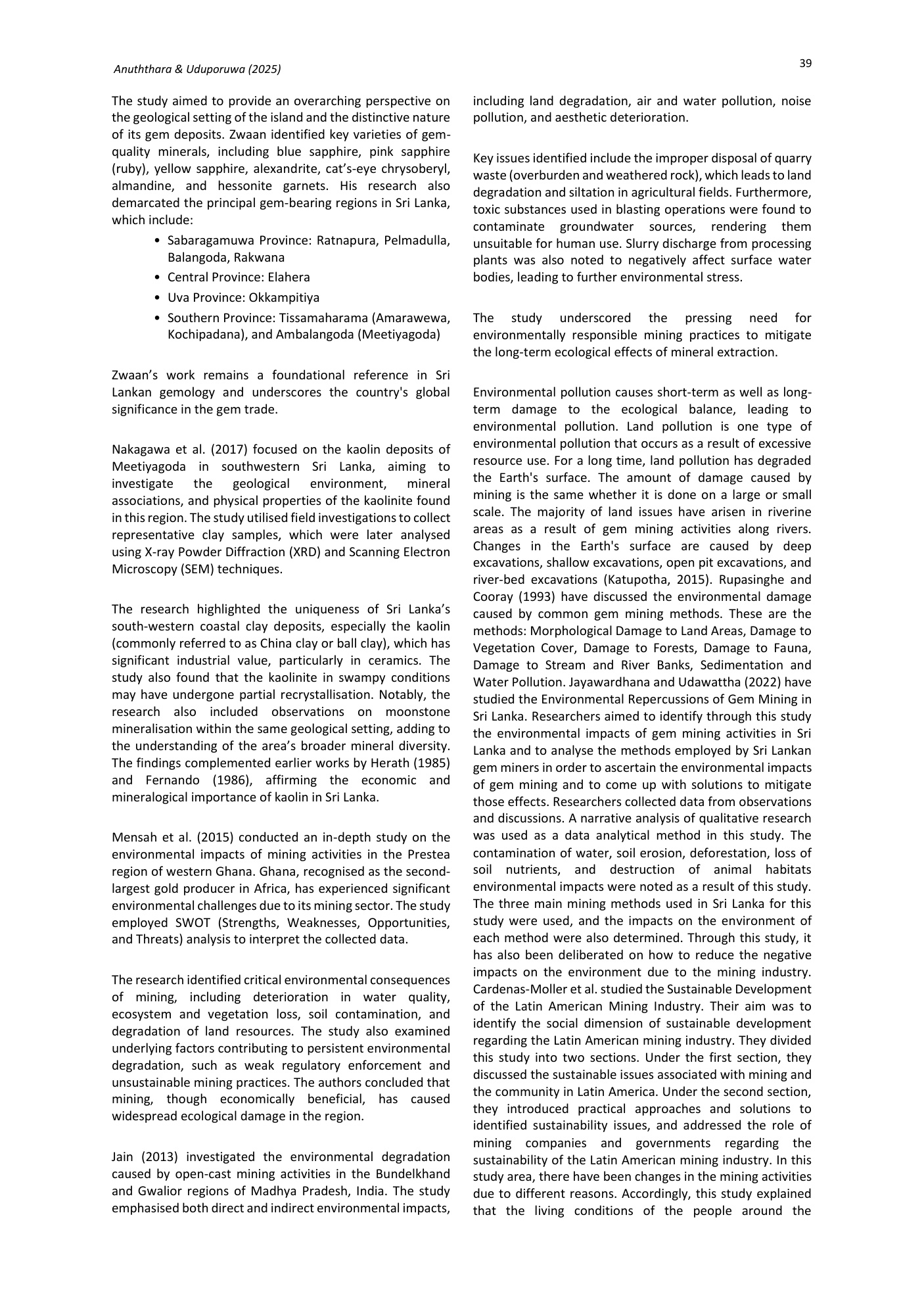
gem mining in Sri Lanka. Dissanayake and Rupasingha (1995)
proposed a  classification scheme for gem deposits in Sri
Lanka. It is mainly based on the general classification of
three main rock types. According to the classification
scheme, gems are based on the source of the deposit. The
advantage of genetic classification of gem deposits lies in its
predictive value. Identification of such gem features may
help locate target areas for detailed exploration.

Figure 1: Gem deposits in Sri Lanka

Source: National gem and jewellery authority, 1995

Zwaan (1982) conducted a comprehensive study titled “Sri
Lanka: The Gem Island,” offering a valuable synthesis of
geological and gemological insights on Sri Lanka, based on
his field visits between 1958 and 1981. Throughout this
period, he examined several  major gem mining localities
across the country, using firsthand observations to compile
detailed data on the geology, mining practices, gem cutting
techniques, and the characteristics of gem materials found
in Sri Lanka.
39

Anuththara & Uduporuwa (2025)
The study aimed to provide an overarching perspective on
the geological setting of the island and the distinctive nature
of its gem deposits. Zwaan identified key varieties of gem -
quality minerals, including blue sapphire, pink sapphire
(ruby), yellow sapp hire, alexandrite, cat’s -eye chrysoberyl,
almandine, and hessonite garnets. His research also
demarcated the principal gem -bearing regions in Sri Lanka,
which include:
• Sabaragamuwa Province: Ratnapura, Pelmadulla,
Balangoda, Rakwana
• Central Province: Elahera
• Uva Province: Okkampitiya
• Southern Province: Tissamaharama (Amarawewa,
Kochipadana), and Ambalangoda (Meetiyagoda)

Zwaan’s work remains a foundational reference in Sri
Lankan gemology and underscores the country's global
significance in the gem trade.

Nakagawa et al. (2017) focused on the kaolin deposits of
Meetiyagoda in southwestern Sri Lanka, aiming to
investigate the geological environment, mineral
associations, and physical properties of the kaolinite found
in this region. The study utilised field investigations to collect
representative clay samples, which were later analysed
using X-ray Powder Diffraction (XRD) and Scanning Electron
Microscopy (SEM) techniques.

The research highlighted the uniqueness of Sri Lanka’s
south-western coastal clay deposits, especially the kaolin
(commonly referred to as China clay or ball clay), which has
significant industrial value, particularly in ceramics. The
study also found that the kaolinite in swampy conditions
may have undergone partial recrystallisation. Notably, the
research also included observations on moonstone
mineralisation within the same geological setting, adding to
the understanding of the area’s broader mineral div ersity.
The findings complemented earlier works by Herath (1985)
and Fernando (1986), affirming the economic and
mineralogical importance of kaolin in Sri Lanka.

Mensah et al. (2015) conducted an in -depth study on the
environmental impacts of mining activities in the Prestea
region of western Ghana. Ghana, recognised as the second-
largest gold producer in Africa, has experienced significant
environmental challenges due to its mining sector. The study
employed SWOT (Strengths, Weaknesses, Opportunities,
and Threats) analysis to interpret the collected data.

The research identified critical environmental consequences
of mining, including deterioration in water quality,
ecosystem and vegetation loss, soil contamination, and
degradation of land resources. The study also examined
underlying factors contributing to persistent environmental
degradation, such as weak regulatory enforcement and
unsustainable mining practices. The authors concluded that
mining, though economically beneficial, has caused
widespread ecological damage in the region.

Jain (2013) investigated the environmental degradation
caused by open -cast mining activities in the Bundelkhand
and Gwalior regions of Madhya Pradesh, India. The study
emphasised both direct and indirect environmental impacts,
including land degradation, air and water pollution, noise
pollution, and aesthetic deterioration.

Key issues identified include the improper disposal of quarry
waste (overburden and weathered rock), which leads to land
degradation and siltation in agricultural fields. Furthermore,
toxic substances used in blasting operations were found to
contaminate g roundwater sources, rendering them
unsuitable for human use. Slurry discharge from processing
plants was also noted to negatively affect surface water
bodies, leading to further environmental stress.

The study underscored the pressing need for
environmentally responsible mining practices to mitigate
the long-term ecological effects of mineral extraction.

Environmental pollution causes short -term as well as long -
term damage to the ecological balance, leading to
environmental pollution. Land pollution is one type of
environmental pollution that occurs as a result of excessive
resource use. For a long time, land pollution has degraded
the Earth 's surface. The amount of damage caused by
mining is the same whether it is done on a large or small
scale. The majority of land issues have arisen in riverine
areas as a result of gem mining activities along rivers.
Changes in the Earth's surface are caused by deep
excavations, shallow excavations, open pit excavations, and
river-bed excavations (Katupotha, 2015). Rupasinghe and
Cooray (1993) have discussed the environmental damage
caused by common gem mining methods. These are the
methods: Morphological Damage to Land Areas, Damage to
Vegetation Cover, Damage to Forests, Damage to Fa una,
Damage to Stream and River Banks, Sedimentation and
Water Pollution. Jayawardhana and Udawattha (2022) have
studied the Environmental Repercussions of Gem Mining in
Sri Lanka. Researchers aimed to identify through this study
the environmental impacts of gem mining activities in Sri
Lanka and to analyse the methods employed by Sri Lankan
gem miners in order to ascertain the environmental impacts
of gem mining and to come up with solutions to mitigate
those effects. Researchers collected data from observations
and discussions. A narrative analysis of qualitative research
was used as a data analytical method in this study. The
contamination of water, soil erosion, deforestation, loss of
soil nutrients, and destruction of animal habitats
environmental impacts were noted as a result of this study.
The three main mining methods used in Sri Lanka for this
study were used, and the impacts on the en vironment of
each method were also determined. Through this study, it
has also been deliberated on how to reduce the negative
impacts on the environment due to the mining industry.
Cardenas-Moller et al. studied the Sustainable Development
of the Latin Ame rican Mining Industry. Their aim was to
identify the social dimension of sustainable development
regarding the Latin American mining industry. They divided
this study into two sections. Under the first section, they
discussed the sustainable issues associated with mining and
the community in Latin America. Under the second section,
they introduced practical approaches and solutions to
identified sustainability issues, and addressed the role of
mining companies and governments regarding the
sustainability of the Latin American mining industry. In this
study area, there have been changes in the mining activities
due to different reasons. Accordingly, this study explained
that the living conditions of the people around the
40

Sri Lanka Journal of Social Sciences and Humanities
traditional mining areas have also changed. The Peru Royalty
was initiated at a rate of 20% in 1996, and it was increased
to 50% in 2001 for the mining activities. Researchers
identified a large concern in relation to the economic
benefits of mining in Lat in America. They identified that
mining companies benefited more than the local
community. With the expansion of mining activities, the
population of the study area also increased. With that, there
were some cultural issues like a lack of adequate housing
and infrastructure for migrant workers, differences between
the behaviour and lifestyle patterns of migrant workers and
the local community, increased prostitution and related
venereal diseases and increased problems due to
differences in payments between migrant workers and the
local community. Under the second section of this study,
researchers discussed the practical approaches and
solutions. The approaches and solutions they identified
were as instruments and Procedures for the Communities to
exercise their Rights ( including Environmental Impact
Assessments, Management Plans, Remediation/Prevention
Plans), used Tri -directional Dialogue, used Community
Decision-Making Model , and the need for communication
between mining companies, local community , and local
authorities was pointed out.

Iamsupa et al. (2016) conducted a comprehensive study
titled “Gemological Characteristics of Moonstone from Sri
Lanka”, with the primary objective of examining the
gemological properties, spectroscopic features, and
chemical composition of Ceylon moonstone. Additionally,
the study aimed to understand the structural features
responsible for the optical phenomenon of adularescence.
Samples were collected from the study area and subjected
to a range of analytical techniques.

Petrographic analysis and scanning electron microscopy
coupled with energy dispersive spectroscopy (SEM -EDS)
were employed to investigate the submicroscopic features,
including the nature of perthite. Chemical composition was
determined through X-ray fluorescence (XRF) analysis,
providing insights into the elemental makeup of the
samples. The findings highlighted key gemological
properties and clarified the role of perthitic structures in
generating adularescence.

In contrast, Kitula (2004) examined the environmental and
socio-economic impacts of mining on local livelihoods in
Tanzania, focusing on the Geita district. Using a mixed -
method approach, the study collected both primary and
secondary data. Primary data collection techniques included
participatory rural appraisal (PRA), participant observation,
and formal and informal surveys. Data analysis involved
statistical tools such as analysis of variance (ANOWA) and
Chi-square tests, supplemented by field investigations. This
research emphasised the socio-economic consequences of
mining activities, highlighting implications for sustainable
development.

The growing demand for moonstones in the global jewellery
market has brought increased attention to the moonstone
mining industry. However, research on this sector remains
limited, particularly regarding the challenges and
opportunities associated with sustainable practices. Existing
studies have not sufficiently exp lored technological
innovations such as automated mining or environmentally
responsible extraction methods that could mitigate
ecological damage. Additionally, issues such as market
volatility, supply chain transparency, and ethical sourcing
remain understudied. Although Sri Lanka is renowned for its
gem mining heritage, there is a notable gap in the literature
specifically addressing moonstone mining in regions like
Meetiyagoda and Udakerewa GNDs. F uture research
focusing on sustainable technologies and supply chain
governance is critical for enhancing the long -term viability
and ethical standards of this industry.
MATERIALS AND METHODS
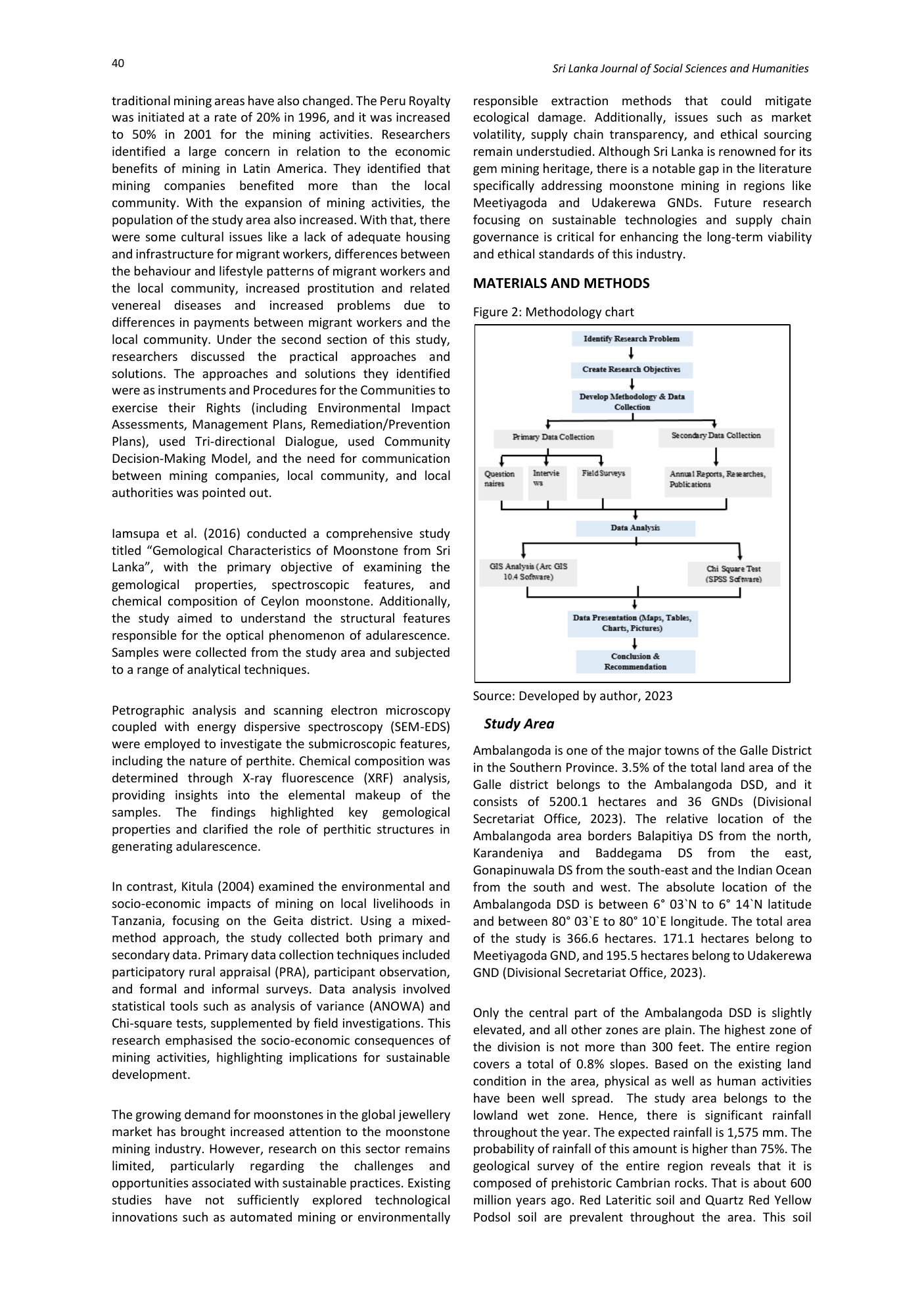
Figure 2: Methodology chart

Source: Developed by author, 2023
Study Area
Ambalangoda is one of the major towns of the Galle District
in the Southern Province. 3.5% of the total land area of the
Galle district belongs to the Ambalangoda DSD , and it
consists of 5200.1 hectares and 36 GNDs (Divisional
Secretariat Office, 2023). The relative  location of the
Ambalangoda area borders Balapitiya DS from the north,
Karandeniya and Baddegama DS from the east,
Gonapinuwala DS from the south-east and the Indian Ocean
from the south and west. The absolute  location of the
Ambalangoda DSD is between 6° 03`N to 6° 14`N latitude
and between 80° 03`E to 80° 10`E longitude. The total area
of the study is 366.6 hectares. 171.1 hectares belong to
Meetiyagoda GND, and 195.5 hectares belong to Udakerewa
GND (Divisional Secretariat Office, 2023).

Only the central part of the Ambalangoda DSD is slightly
elevated, and all other zones are plain. The highest zone of
the division is not more than 300 feet. The entire region
covers a total of 0.8 % slopes. Based on the existing land
condition in the area, physical as well as human activities
have been well spread.  The study area belongs to the
lowland wet zone. Hence, there is significant rainfall
throughout the year. The expected rainfall is 1,575 mm. The
probability of rainfall of this amount is higher than 75%. The
geological survey of the entire region reveals that it is
composed of prehistoric Cambrian rocks. That is about 600
million years ago. Red Lateritic soil and Quartz Red Yellow
Podsol soil are prevalent throughout the area. This soil
41

Anuththara & Uduporuwa (2025)
covers about 60% of the total land area. Thereafter, mainly
Half Bog soils and Bog with Alluvial mixed soil cover 33 % of
the land area (Divisional Secretariat Office, 2023). Although
these are widely distributed, other categories do not
represent such an important distribution. In terms of
mineral resources, two types that are endemic to both GNDs
can be identified: Kaolin Clay & Moonstone Rocks. Blue and
white moonstones can be found in this area. Those are a rare
species of gem. These moonstones contain t hree minerals
that are Silicon, Calcium and Phosphorus.

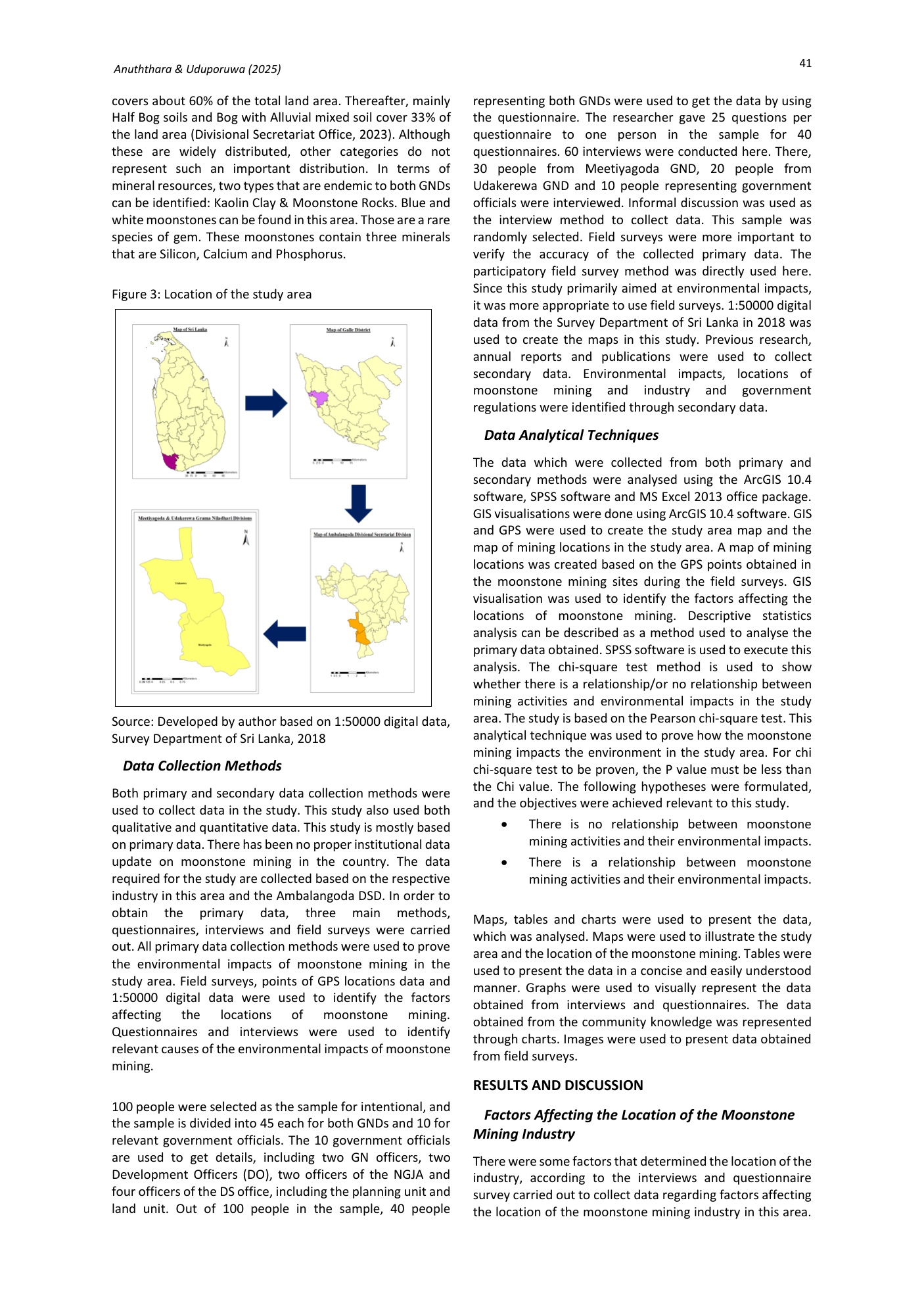
Figure 3: Location of the study area

Source: Developed by author based on 1:50000 digital data,
Survey Department of Sri Lanka, 2018
Data Collection Methods
Both primary and secondary data collection methods were
used to collect data in the study. This study also used both
qualitative and quantitative data. This study is mostly based
on primary data. There has been no proper institutional data
update on moonstone mining in the country. The data
required for the study are collected based on the respective
industry in this area and the Ambalangoda DSD. In order to
obtain the primary data , three main methods ,
questionnaires, interviews and field surveys were carri ed
out. All primary data collection methods were used to prove
the environmental impacts of moonstone mining in the
study area. Field surveys, points of GPS locations data and
1:50000 digital data were used to identify the factors
affecting the locations of moonstone mining.
Questionnaires and interviews were used to identify
relevant causes of the environmental impacts of moonstone
mining.

100 people were selected as the sample for intentional, and
the sample is divided into 45 each for both GNDs and 10 for
relevant government officials. The 10 government officials
are used to get details , including two GN officers, two
Development Officers (DO), two officers of the NGJA and
four officers of the DS office, including the planning unit and
land unit. Out of 100 people in the sample, 40 people
representing both GNDs were used to get the data by using
the questionnaire. The researcher gave 25 que stions per
questionnaire to one person in the sample for 40
questionnaires. 60 interviews were conducted here. There,
30 people from Meetiyagoda GND, 20 people from
Udakerewa GND and 10 people representing government
officials were interviewed. Informal di scussion was used as
the interview method to collect data. This sample was
randomly selected. Field surveys were more important to
verify the accuracy of the collected primary data. The
participatory field survey method was directly used here.
Since this s tudy primarily aimed at environmental impacts,
it was more appropriate to use field surveys. 1:50000 digital
data from the Survey Department of Sri Lanka in 2018 was
used to create the maps in this study. Previous research,
annual reports and publications were used to collect
secondary data. Environmental impacts, locations of
moonstone mining and industry and government
regulations were identified through secondary data.
Data Analytical Techniques
The data which were collected from both primary and
secondary methods were analysed using the ArcGIS 10.4
software, SPSS software and MS Excel 2013 office package.
GIS visualisations were done using ArcGIS 10.4 software. GIS
and GPS were used to create the study area map and the
map of mining locations in the study area. A map of mining
locations was created based on the GPS points obtained in
the moonstone mining sites during the field surveys. GIS
visualisation was used to identify the factors affecting the
locations of moonstone mining. Descriptive statistics
analysis can be described as a method used to analyse the
primary data obtained. SPSS software is used to execute this
analysis. The chi-square test method is used to show
whether there is a relationship/or no relationship between
mining activities and environmental impacts in the study
area. The study is based on the Pearson chi-square test. This
analytical technique was used to prove how the moonstone
mining impacts the environment in the study area. For chi
chi-square test to be proven, the P value must be less than
the Chi value. The following h ypotheses were formulated ,
and the objectives were achieved relevant to this study.
• There is no relationship between moonstone
mining activities and their environmental impacts.
• There is a relationship between moonstone
mining activities and their environmental impacts.

Maps, tables and charts were used to present the data ,
which was analysed. Maps were used to illustrate the study
area and the location of the moonstone mining. Tables were
used to present the data in a concise and easily understood
manner. Graphs were used to visually represent the data
obtained from interviews and questionnaires. The data
obtained from the community knowledge was represented
through charts. Images were used to present data obtained
from field surveys.
RESULTS AND DISCUSSION
Factors Affecting the Location of the Moonstone
Mining Industry
There were some factors that determined the location of the
industry, according to the interviews and questionnaire
survey carried out to collect data regarding factors affecting
the location of the moonstone mining industry in this area.
42

Sri Lanka Journal of Social Sciences and Humanities
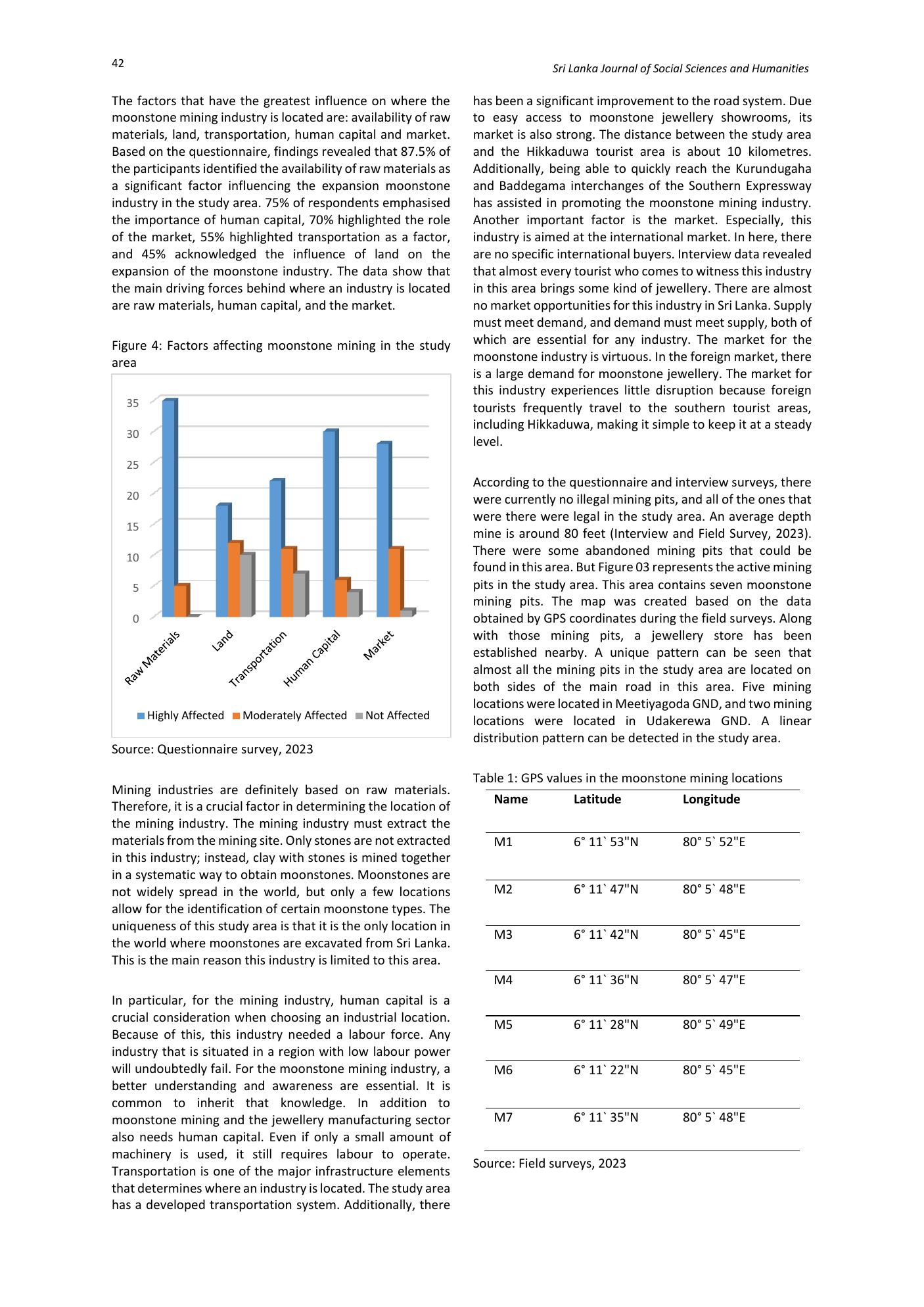
The factors that have the greatest influence on where the
moonstone mining industry is located are: availability of raw
materials, land, transportation, human capital and market.
Based on the questionnaire, findings revealed that 87.5% of
the participants identified the availability of raw materials as
a significant factor influencing the expansion moonstone
industry in the study area. 75 % of respondents emphasised
the importance of human capital, 70 % highlighted the role
of the market, 55% highlighted transportation as a factor ,
and 45 % acknowledged the influence of land on the
expansion of the moonstone industry. The data show that
the main driving forces behind where an industry is located
are raw materials, human capital, and the market.

Figure 4: Factors affecting moonstone mining in the study
area

Source: Questionnaire survey, 2023

Mining industries are definitely based on raw materials.
Therefore, it is a crucial factor in determining the location of
the mining industry. The mining industry must extract the
materials from the mining site. Only stones are not extracted
in this industry; instead, clay with stones is mined together
in a systematic way to obtain moonstones. Moonstones are
not widely spread in the world, but only a few locations
allow for the identification of certain moonstone types. The
uniqueness of this study area is that it is the only location in
the world where moonstones are excavated from Sri Lanka.
This is the main reason this industry is limited to this area.

In particular , for the mining industry, human capital is a
crucial consideration when choosing an industrial location.
Because of this, this industry needed a labour force. Any
industry that is situated in a region with low labour power
will undoubtedly fail. For the moonstone mining industry, a
better understanding and awareness are essential. It is
common to inherit that knowledge. In addition to
moonstone mining and the jewellery manufacturing sector
also needs human capital. Even if only a small amount  of
machinery is used, it still requires labour to operate.
Transportation is one of the major infrastructure elements
that determines where an industry is located. The study area
has a developed transportation system. Additionally, there
has been a significant improvement to the road system. Due
to easy access to moonstone jewellery showrooms, its
market is also strong. The distance between the study area
and the Hikkaduwa tourist area is about 10 kilometres.
Additionally, being able to quickly reach the K urundugaha
and Baddegama interchanges of the Southern Expressway
has assisted in promoting the moonstone mining industry.
Another important factor is the market. Especially, this
industry is aimed at the international market. In here, there
are no specific international buyers. Interview data revealed
that almost every tourist who comes to witness this industry
in this area brings some kind of jewellery. There are almost
no market opportunities for this industry in Sri Lanka. Supply
must meet demand, and demand must meet supply, both of
which are essential for any industry. The market for the
moonstone industry is virtuous. In the foreign market, there
is a large demand for moonstone jewellery. The market for
this industry experiences little disruption because foreign
tourists frequently travel to the southern tourist areas,
including Hikkaduwa, making it simple to keep it at a steady
level.

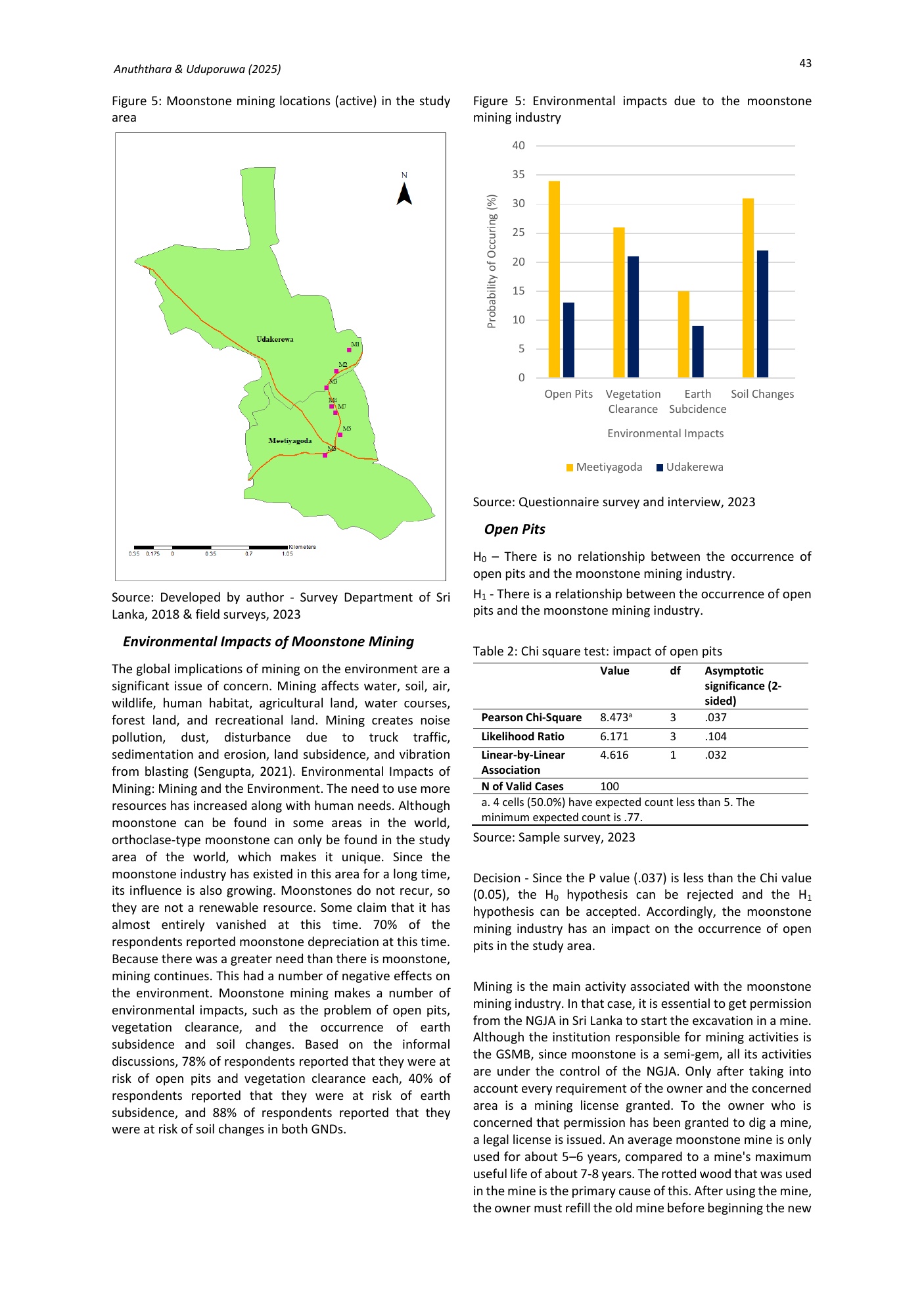
According to the questionnaire and interview surveys, there
were currently no illegal mining pits, and all of the ones that
were there were legal in the study area. An average depth
mine is around 80 feet (Interview and Field Survey, 2023).
There were some abandoned mining pits that could  be
found in this area. But Figure 03 represents the active mining
pits in the study area. This area contains seven moonstone
mining pits. The map was created based on the data
obtained by GPS coordinates during the field surveys. Along
with those mining pits, a jewellery store has been
established nearby. A unique pattern can be seen that
almost all the mining pits in the study area are located on
both sides of the main road in this area. Five mining
locations were located in Meetiyagoda GND, and two mining
locations were located in Udakerewa GND. A linear
distribution pattern can be detected in the study area.

Table 1: GPS values in the moonstone mining locations
Name Latitude Longitude
M1 6° 11` 53"N 80° 5` 52"E
M2 6° 11` 47"N 80° 5` 48"E
M3 6° 11` 42"N 80° 5` 45"E
M4 6° 11` 36"N 80° 5` 47"E
M5 6° 11` 28"N 80° 5` 49"E
M6 6° 11` 22"N 80° 5` 45"E
M7 6° 11` 35"N 80° 5` 48"E
Source: Field surveys, 2023
0
5
10
15
20
25
30
35
Highly Affected Moderately Affected Not Affected
43

Anuththara & Uduporuwa (2025)
Figure 5: Moonstone mining locations (active) in the study
area

Source: Developed by  author - Survey D epartment of Sri
Lanka, 2018 & field surveys, 2023
Environmental Impacts of Moonstone Mining
The global implications of mining on the environment are a
significant issue of concern. Mining affects water, soil, air,
wildlife, human habitat, agricultural land , water courses,
forest land, and recreational land. Mining creates noise
pollution, dust, disturbance due to truck traffic,
sedimentation and erosion, land subsidence, and vibration
from blasting (Sengupta, 2021). Environmental Impacts of
Mining: Mining and the Environment. The need to use more
resources has increased along with human needs. Alt hough
moonstone can be found in some areas in the world,
orthoclase-type moonstone can only be found in the study
area of the world, which makes it unique. Since the
moonstone industry has existed in this area for a long time,
its influence is also growing. Moonstones do not recur, so
they are not a renewable resource. Some claim that it has
almost entirely vanished at this time. 70 % of the
respondents reported moonstone depreciation at this time.
Because there was a greater need than there is moonstone,
mining continues. This had a number of negative effects on
the environment. Moonstone mining makes a number of
environmental impacts, such as the problem of open pits,
vegetation clearance, and the occurrence of earth
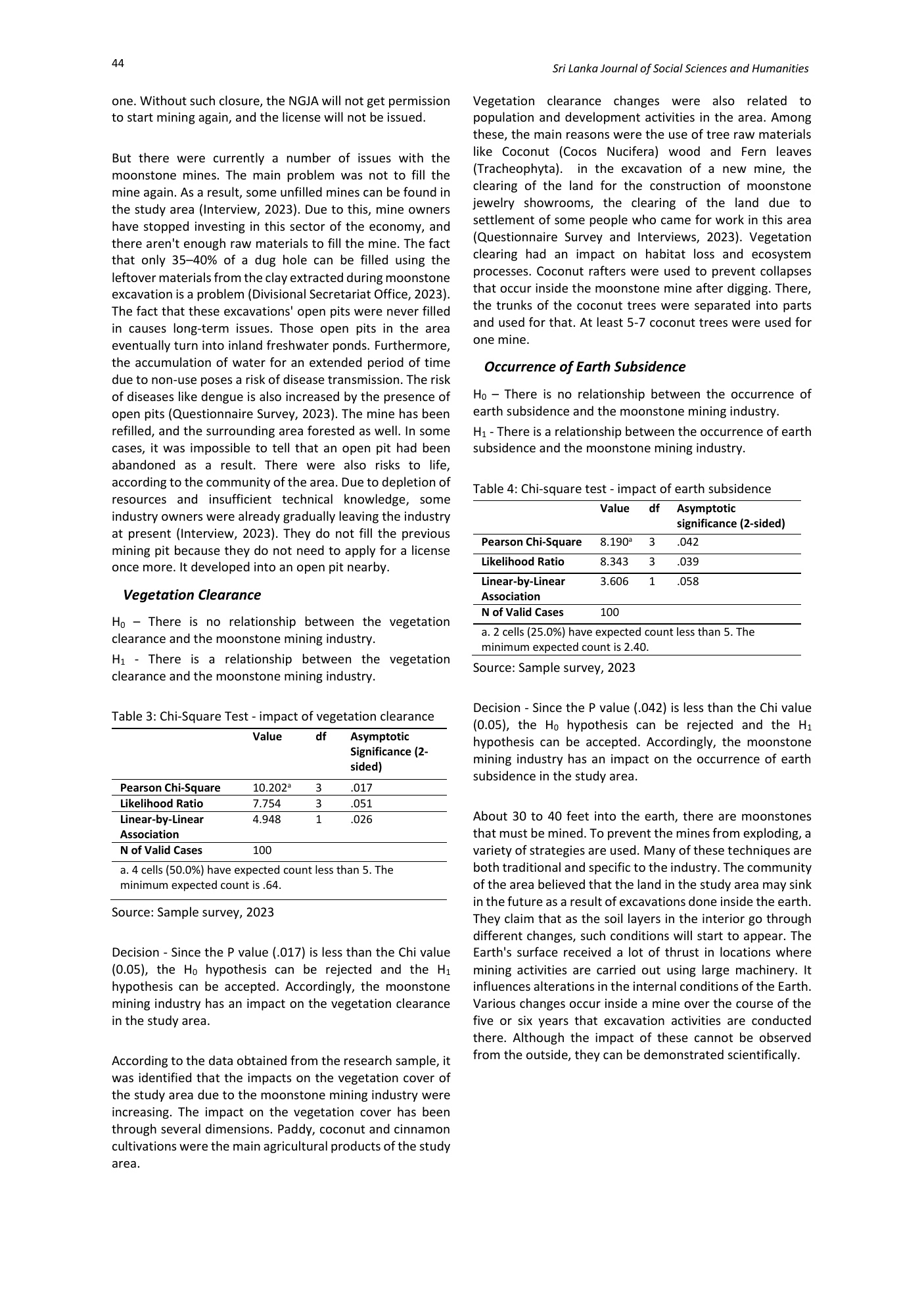
subsidence and soil changes. Based on the informal
discussions, 78% of respondents reported that they were at
risk of open pits and vegetation clearance each, 40 % of
respondents reported that  they were at risk of earth
subsidence, and 88 % of respondents reported that  they
were at risk of soil changes in both GNDs.


Figure 5: Environmental impacts due to the moonstone
mining industry

Source: Questionnaire survey and interview, 2023
Open Pits
H0 – There is no relationship between the occurrence of
open pits and the moonstone mining industry.
H1 - There is a relationship between the occurrence of open
pits and the moonstone mining industry.

Table 2: Chi square test: impact of open pits
 Value df Asymptotic
significance (2-
sided)
Pearson Chi-Square 8.473a 3 .037
Likelihood Ratio 6.171 3 .104
Linear-by-Linear
Association
4.616 1 .032
N of Valid Cases 100
a. 4 cells (50.0%) have expected count less than 5. The
minimum expected count is .77.
Source: Sample survey, 2023

Decision - Since the P value (.037) is less than the Chi value
(0.05), the H 0 hypothesis can be rejected and the H 1
hypothesis can be accepted. According ly, the moonstone
mining industry has an impact on the occurrence of open
pits in the study area.

Mining is the main activity associated with the moonstone
mining industry. In that case, it is essential to get permission
from the NGJA in Sri Lanka to start the excavation in a mine.
Although the institution responsible for mining activities is
the GSMB, since moonstone is a semi -gem, all its activities
are under the control of the NGJA. Only after taking into
account every requirement of the owner and the concerned
area is a mining license granted. To the owner who is
concerned that permission has been g ranted to dig a mine,
a legal license is issued. An average moonstone mine is only
used for about 5 –6 years, compared to a mine's maximum
useful life of about 7-8 years. The rotted wood that was used
in the mine is the primary cause of this. After using the mine,
the owner must refill the old mine before beginning the new
0
5
10
15
20
25
30
35
40
Open Pits Vegetation
Clearance
Earth
Subcidence
Soil Changes
Probability of Occuring (%)
Environmental Impacts
Meetiyagoda Udakerewa
44

Sri Lanka Journal of Social Sciences and Humanities
one. Without such closure, the NGJA will not get permission
to start mining again, and the license will not be issued.

But there were currently a number of issues with the
moonstone mines. The main problem was not to fill the
mine again. As a result, some unfilled mines can be found in
the study area (Interview, 2023). Due to this, mine owners
have stopped investing in this s ector of the economy, and
there aren't enough raw materials to fill the mine. The fact
that only 35 –40% of a dug hole can be filled using the
leftover materials from the clay extracted during moonstone
excavation is a problem (Divisional Secretariat Office, 2023).
The fact that these excavations' open pits were never filled
in causes long-term issues. Those open pits in the area
eventually turn into inland freshwater ponds. Furthermore,
the accumulation of water for an extended period of time
due to non-use poses a risk of disease transmission. The risk
of diseases like dengue is also increased by the presence of
open pits (Questionnaire Survey, 2023). The mine has been
refilled, and the surrounding area forested as well. In some
cases, it was impossible to tell that an open pit had been
abandoned as a result. There were also risks to life,
according to the community of the area. Due to depletion of
resources and insufficient technical knowledge , some
industry owners were already gradually leaving the industry
at present (Interview, 2023). They do not fill the previous
mining pit because they do not need to apply for a license
once more. It developed into an open pit nearby.
Vegetation Clearance
H0 – There is no relationship between the vegetation
clearance and the moonstone mining industry.
H1 - There is a relationship between the vegetation
clearance and the moonstone mining industry.

Table 3: Chi-Square Test - impact of vegetation clearance
 Value df Asymptotic
Significance (2-
sided)
Pearson Chi-Square 10.202a 3 .017
Likelihood Ratio 7.754 3 .051
Linear-by-Linear
Association
4.948 1 .026
N of Valid Cases 100
a. 4 cells (50.0%) have expected count less than 5. The
minimum expected count is .64.
Source: Sample survey, 2023

Decision - Since the P value (.017) is less than the Chi value
(0.05), the H 0 hypothesis can be rejected and the H 1
hypothesis can be accepted. According ly, the moonstone
mining industry has an impact on the vegetation clearance
in the study area.

According to the data obtained from the research sample, it
was identified that the impacts on the vegetation cover of
the study area due to the moonstone mining industry were
increasing. The impact on the vegetation cover has been
through several dimensions. Paddy, coconut and cinnamon
cultivations were the main agricultural products of the study
area.

Vegetation clearance changes were also related to
population and development activities in the area. Among
these, the main reasons were the use of tree raw materials
like Coconut (Cocos Nucifera) wood and Fern leaves
(Tracheophyta).  in the excavation of a  new mine, the
clearing of the land for the construction of moonstone
jewelry showrooms, the clearing of the land due to
settlement of some people who came for work in this area
(Questionnaire Survey and Interviews, 2023). Vegetation
clearing had an impact  on habitat loss and ecosystem
processes. Coconut rafters were used to prevent collapses
that occur inside the moonstone mine after digging. There,
the trunks of the coconut tree s were separated into parts
and used for that. At least 5 -7 coconut trees were used for
one mine.
Occurrence of Earth Subsidence
H0 – There is no relationship between the occurrence of
earth subsidence and the moonstone mining industry.
H1 - There is a relationship between the occurrence of earth
subsidence and the moonstone mining industry.

Table 4: Chi-square test - impact of earth subsidence
 Value df Asymptotic
significance (2-sided)
Pearson Chi-Square 8.190a 3 .042
Likelihood Ratio 8.343 3 .039
Linear-by-Linear
Association
3.606 1 .058
N of Valid Cases 100
a. 2 cells (25.0%) have expected count less than 5. The
minimum expected count is 2.40.
Source: Sample survey, 2023

Decision - Since the P value (.042) is less than the Chi value
(0.05), the H 0 hypothesis can be rejected and the H 1
hypothesis can be accepted. According ly, the moonstone
mining industry has an impact on the occurrence of earth
subsidence in the study area.

About 30 to 40 feet into the earth, there are moonstones
that must be mined. To prevent the mines from exploding, a
variety of strategies are used. Many of these techniques are
both traditional and specific to the industry. The community
of the area believed that the land in the study area may sink
in the future as a result of excavations done inside the earth.
They claim that as the soil layers in the in terior go through
different changes, such conditions will start to appear. The
Earth's surface received a lot of thrust in locations where
mining activities are carried out using large machinery. It
influences alterations in the internal conditions of the Earth.
Various changes occur inside a mine over the course of the
five or six years that excavation activities are conducted
there. Although the impact of these cannot be observed
from the outside, they can be demonstrated scientifically.
45

Anuththara & Uduporuwa (2025)
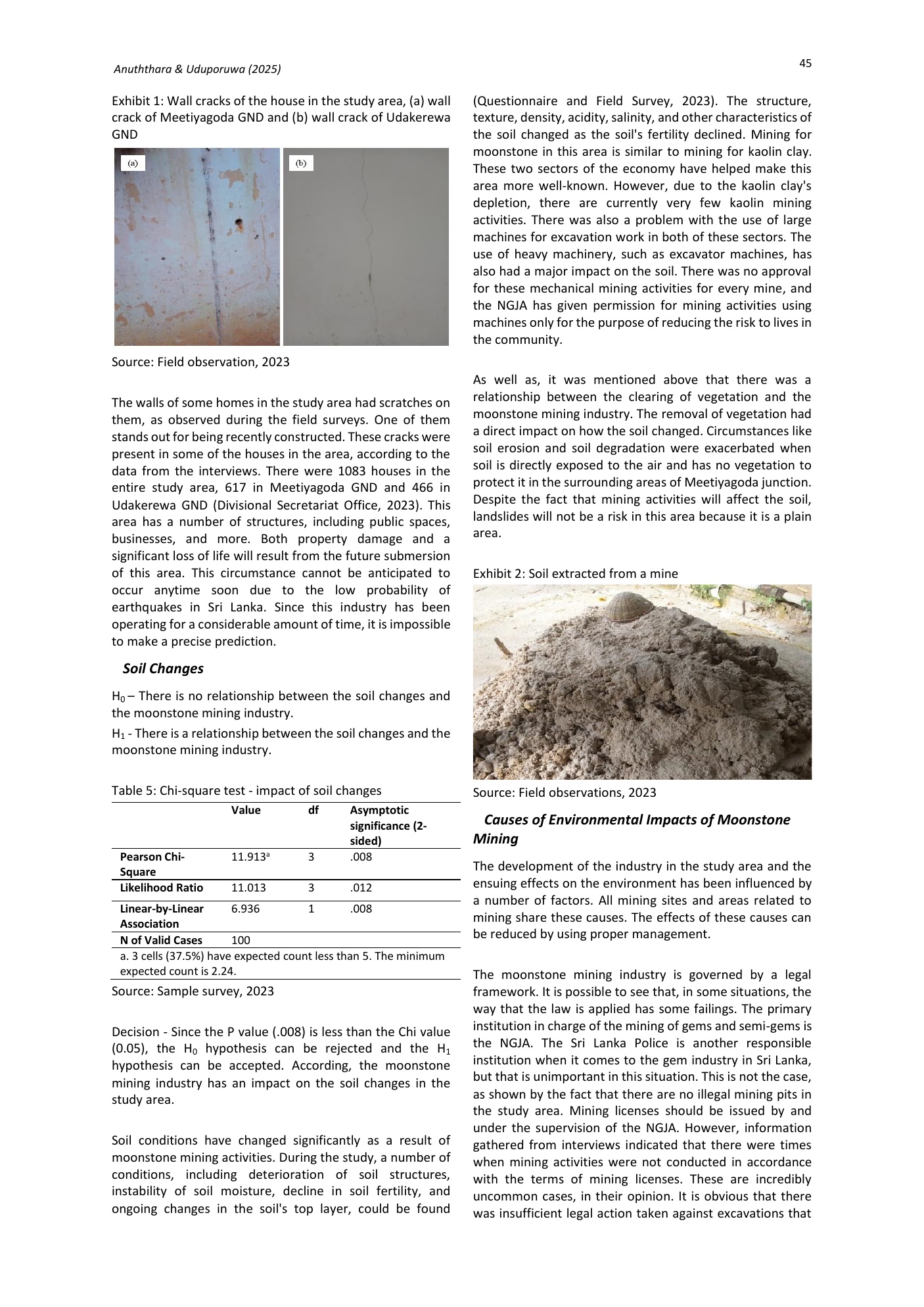
Exhibit 1: Wall cracks of the house in the study area, (a) wall
crack of Meetiyagoda GND and (b) wall crack of Udakerewa
GND

Source: Field observation, 2023

The walls of some homes in the study area had scratches on
them, as observed during the field surveys. One of them
stands out for being recently constructed. These cracks were
present in some of the houses in the area, according to the
data from the interviews. There were 1083 houses in the
entire study area, 617 in Meetiyagoda GND and 466 in
Udakerewa GND (Divisional Secretariat Office, 2023). This
area has a number of structures, including public spaces,
businesses, and more. Both property damage and a
significant loss of life will result from the future submersion
of this area. This circumstance cannot be anticipated to
occur anytime soon due to the low probability of
earthquakes in Sri Lanka. Since this industry has been
operating for a considerable amount of time, it is impossible
to make a precise prediction.
Soil Changes
H0 – There is no relationship between the soil changes and
the moonstone mining industry.
H1 - There is a relationship between the soil changes and the
moonstone mining industry.

Table 5: Chi-square test - impact of soil changes
 Value df Asymptotic
significance (2-
sided)
Pearson Chi-
Square
11.913a 3 .008
Likelihood Ratio 11.013 3 .012
Linear-by-Linear
Association
6.936 1 .008
N of Valid Cases 100
a. 3 cells (37.5%) have expected count less than 5. The minimum
expected count is 2.24.
Source: Sample survey, 2023

Decision - Since the P value (.008) is less than the Chi value
(0.05), the H 0 hypothesis can be rejected and the H 1
hypothesis can be accepted. According, the moonstone
mining industry has an impact on the soil changes in the
study area.

Soil conditions have changed significantly as a result of
moonstone mining activities. During the study, a number of
conditions, including deterioration of soil structures,
instability of soil moisture, decline in soil fertility, and
ongoing changes in the soil's top layer, could be found
(Questionnaire and Field Survey, 2023). The structure,
texture, density, acidity, salinity, and other characteristics of
the soil changed as the soil's fertility declined. Mining for
moonstone in this area is similar to mi ning for kaolin clay.
These two sectors of the economy have helped make this
area more well -known. However, due to the kaolin clay's
depletion, there are currently very few kaolin mining
activities. There was also a problem with the use of large
machines for excavation work in both of these sectors. The
use of heavy machinery , such as excavator machines , has
also had a major impact on the soil. There was no approval
for these mechanical mining activities for every mine , and
the NGJA has given permission for  mining activities using
machines only for the purpose of reducing the risk to lives in
the community.

As well as, it was mentioned above that there was a
relationship between the clearing of vegetation and the
moonstone mining industry. The removal of vegetation had
a direct impact on how the soil changed. Circumstances like
soil erosion and soil degradation were exacerbated when
soil is directly exposed to the air and has no vegetation to
protect it in the surrounding areas of Meetiyagoda junction.
Despite the fact that mining activities will affect the soil,
landslides will not be a risk in this area beca use it is a plain
area.

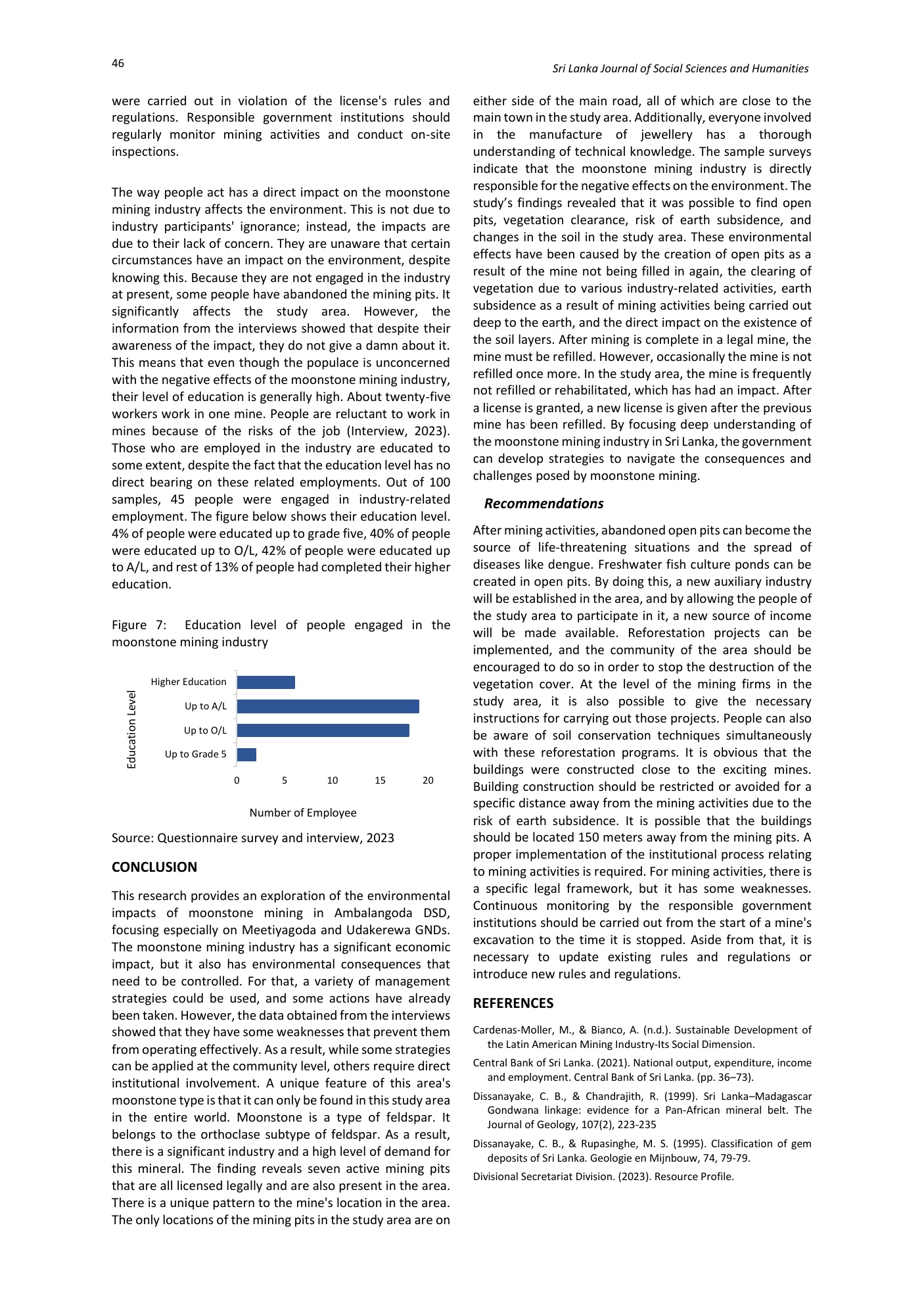
Exhibit 2: Soil extracted from a mine

Source: Field observations, 2023
Causes of Environmental Impacts of Moonstone
Mining
The development of the industry in the study area and the
ensuing effects on the environment has been influenced by
a number of factors. All mining sites and areas related to
mining share these causes. The effects of these causes can
be reduced by using proper management.

The moonstone mining industry is governed by a legal
framework. It is possible to see that, in some situations, the
way that the law is applied has some failings. The primary
institution in charge of the mining of gems and semi-gems is
the NGJA. The Sri La nka Police is another responsible
institution when it comes to the gem industry in Sri Lanka,
but that is unimportant in this situation. This is not the case,
as shown by the fact that there are no illegal mining pits in
the study area. Mining licenses sho uld be issued by and
under the supervision of the NGJA. However, information
gathered from interviews indicated that there were times
when mining activities were not conducted in accordance
with the terms of mining licenses. These are incredibly
uncommon cases, in their opinion. It is obvious that there
was insufficient legal action taken against excavations that
46

Sri Lanka Journal of Social Sciences and Humanities
were carried out in violation of the license's rules and
regulations. Responsible government institutions should
regularly monitor mining activities and conduct on -site
inspections.

The way people act has a direct impact on the moonstone
mining industry affects the environment. This is not due to
industry participants' ignorance; instead, the impacts are
due to their lack of concern. They are unaware that certain
circumstances have an impact on the environment, despite
knowing this. Because they are not engaged in the industry
at present, some people have abandoned the mining pits. It
significantly affects the study area. However, the
information from the interviews showed that despite  their
awareness of the impact, they do not give a damn about it.
This means that even though the populace is unconcerned
with the negative effects of the moonstone mining industry,
their level of education is generally high. About twenty -five
workers work in one mine. People are reluctant to work in
mines because of the risks of the job (Interview, 2023).
Those who are employed in the industry are educated to
some extent, despite the fact that the education level has no
direct bearing on these related empl oyments. Out of 100
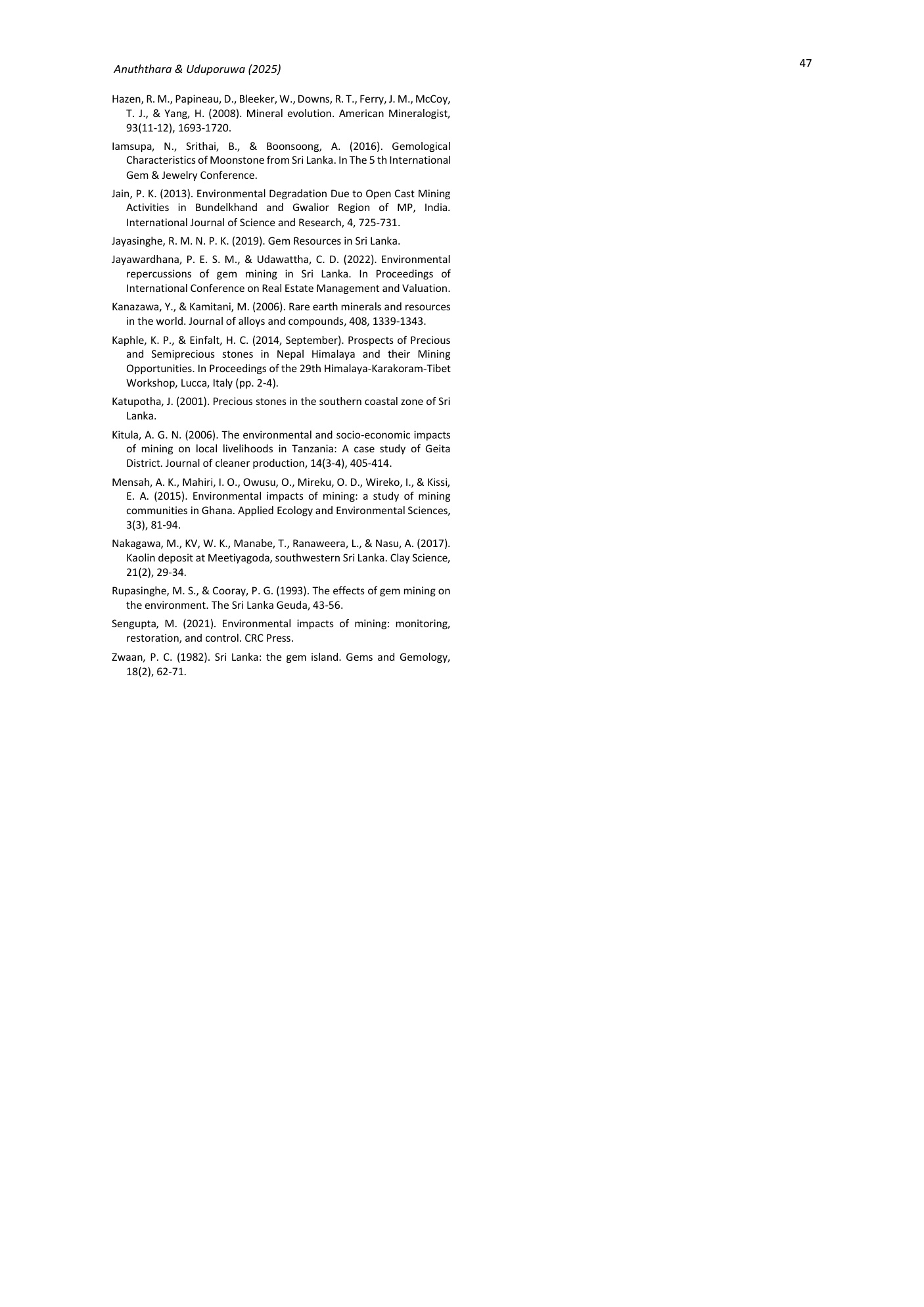
samples, 45 people were engaged in industry-related
employment. The figure below shows their education level.
4% of people were educated up to grade five, 40% of people
were educated up to O/L, 42 % of people were educated up
to A/L, and rest of 13% of people had completed their higher
education.

Figure 7:  Education level of people engaged in the
moonstone mining industry

Source: Questionnaire survey and interview, 2023
CONCLUSION
This research provides an exploration of the environmental
impacts of moonstone mining in Ambalangoda DSD,
focusing especially on Meetiyagoda and Udakerewa GNDs.
The moonstone mining industry has a significant economic
impact, but it also has environmental consequences that
need to be controlled. For that, a variety of management
strategies could be used, and some actions have al ready
been taken. However, the data obtained from the interviews
showed that they have some weaknesses that prevent them
from operating effectively. As a result, while some strategies
can be applied at the community level, others require direct
institutional involvement. A unique feature of this area's
moonstone type is that it can only be found in this study area
in the entire world. Moonstone is a type of feldspar. It
belongs to the orthoclase subtype of feldspar. As a result,
there is a significant industry and a high level of demand for
this mineral. The finding reveals seven active mining pits
that are all licensed legally and are also present in the area.
There is a unique pattern to the mine's location in the area.
The only locations of the mining pits in the study area are on
either side of the main road, all of which are close to the
main town in the study area. Additionally, everyone involved
in the manufacture of jewellery has a thorough
understanding of technical knowledge. The sample surveys
indicate that the moonstone mining industry is directly
responsible for the negative effects on the environment. The
study’s findings revealed that it was possible to find open
pits, vegetation clearance, risk of earth subsidence, and
changes in the soil in the study area. These environmental
effects have been caused by the creation of open pits as a
result of the mine not being filled in again, the clearing of
vegetation due to various industry-related activities, earth
subsidence as a result of mining activities being carried out
deep to the earth, and the direct impact on the existence of
the soil layers. After mining is complete in a legal mine, the
mine must be refilled. However, occasionally the mine is not
refilled once more. In the study area, the mine is frequently
not refilled or rehabilitated, which has had an impact. After
a license is granted, a new license is given after the previous
mine has been refilled. By focusing deep understanding of
the moonstone mining industry in Sri Lanka, the government
can develop strategies to navigate the consequences and
challenges posed by moonstone mining.
Recommendations
After mining activities, abandoned open pits can become the
source of life -threatening situations and the spread of
diseases like dengue. Freshwater fish culture ponds can be
created in open pits. By doing this, a new auxiliary industry
will be established in the area, and by allowing the people of
the study area to participate in it, a new source of income
will be made available. Reforestation projec ts can be
implemented, and the community of the area should be
encouraged to do so in order to stop the dest ruction of the
vegetation cover. At the level of the mining firms in the
study area, it is also possible to give the necessary
instructions for carrying out those projects. People can also
be aware of soil conservation techniques simultaneously
with these reforestation programs. It is obvious that the
buildings were constructed close to the exciting mines.
Building construction should be restricted or avoided for a
specific distance away from the mining activities due to the
risk of earth subsidence.  It is possible that the buildings
should be located 150 meters away from the mining pits. A
proper implementation of the institutional process relating
to mining activities is required. For mining activities, there is
a specific legal framework, but it has some weaknesses.
Continuous monitoring by t he responsible government
institutions should be carried out from the start of a mine's
excavation to the time it is stopped. Aside from that, it is
necessary to update existing rules and regulations or
introduce new rules and regulations.
REFERENCES
Cardenas-Moller, M., & Bianco, A. (n.d.). Sustainable Development of
the Latin American Mining Industry-Its Social Dimension.
Central Bank of Sri Lanka. (2021). National output, expenditure, income
and employment. Central Bank of Sri Lanka. (pp. 36–73).
Dissanayake, C. B., & Chandrajith, R. (1999). Sri Lanka –Madagascar
Gondwana linkage: evidence for a Pan -African mineral belt. The
Journal of Geology, 107(2), 223-235
Dissanayake, C. B., & Rupasinghe, M. S. (1995). Classification of gem
deposits of Sri Lanka. Geologie en Mijnbouw, 74, 79-79.
Divisional Secretariat Division. (2023). Resource Profile.
0 5 10 15 20
Up to Grade 5
Up to O/L
Up to A/L
Higher Education
Number of Employee
Education Level
47

Anuththara & Uduporuwa (2025)
Hazen, R. M., Papineau, D., Bleeker, W., Downs, R. T., Ferry, J. M., McCoy,
T. J., & Yang, H. (2008). Mineral evolution. American Mineralogist,
93(11-12), 1693-1720.
Iamsupa, N., Srithai, B., & Boonsoong, A. (2016). Gemological
Characteristics of Moonstone from Sri Lanka. In The 5 th International
Gem & Jewelry Conference.
Jain, P. K. (2013). Environmental Degradation Due to Open Cast Mining
Activities in Bundelkhand and Gwalior Region of MP, India.
International Journal of Science and Research, 4, 725-731.
Jayasinghe, R. M. N. P. K. (2019). Gem Resources in Sri Lanka.
Jayawardhana, P. E. S. M., & Udawattha, C. D. (2022). Environmental
repercussions of gem mining in Sri Lanka. In Proceedings of
International Conference on Real Estate Management and Valuation.
Kanazawa, Y., & Kamitani, M. (2006). Rare earth minerals and resources
in the world. Journal of alloys and compounds, 408, 1339-1343.
Kaphle, K. P., & Einfalt, H. C. (2014, September). Prospects of Precious
and Semiprecious stones in Nepal Himalaya and their Mining
Opportunities. In Proceedings of the 29th Himalaya-Karakoram-Tibet
Workshop, Lucca, Italy (pp. 2-4).
Katupotha, J. (2001). Precious stones in the southern coastal zone of Sri
Lanka.
Kitula, A. G. N. (2006). The environmental and socio -economic impacts
of mining on local livelihoods in Tanzania: A case study of Geita
District. Journal of cleaner production, 14(3-4), 405-414.
Mensah, A. K., Mahiri, I. O., Owusu, O., Mireku, O. D., Wireko, I., & Kissi,
E. A. (2015). Environmental impacts of mining: a study of mining
communities in Ghana. Applied Ecology and Environmental Sciences,
3(3), 81-94.
Nakagawa, M., KV, W. K., Manabe, T., Ranaweera, L., & Nasu, A. (2017).
Kaolin deposit at Meetiyagoda, southwestern Sri Lanka. Clay Science,
21(2), 29-34.
Rupasinghe, M. S., & Cooray, P. G. (1993). The effects of gem mining on
the environment. The Sri Lanka Geuda, 43-56.
Sengupta, M. (2021). Environmental impacts of mining: monitoring,
restoration, and control. CRC Press.
Zwaan, P. C. (1982). Sri Lanka: the gem island. Gems and Gemology,
18(2), 62-71.
Cite this publication
Anuththara, M.S., Uduporuwa, R.J.M. (2025). Environmental Impacts of Moonstone Mining in the Ambalangoda Divisional Secretariat Division with Special Reference to Meetiyagoda and Udakerewa Grama Niladhari Divisions in Sri Lanka. Sri Lanka Journal of Social Sciences and Humanities, Volume 5 Issue 2, August 2025: 36-47. https://doi.org/10.4038/sljssh.v5i2.134
- Published
- 1 August 2025
- Type
- Academic Article
- Institution
- Sabaragamuwa University of Sri Lanka
- DOI
- 10.4038/sljssh.v5i2.134